
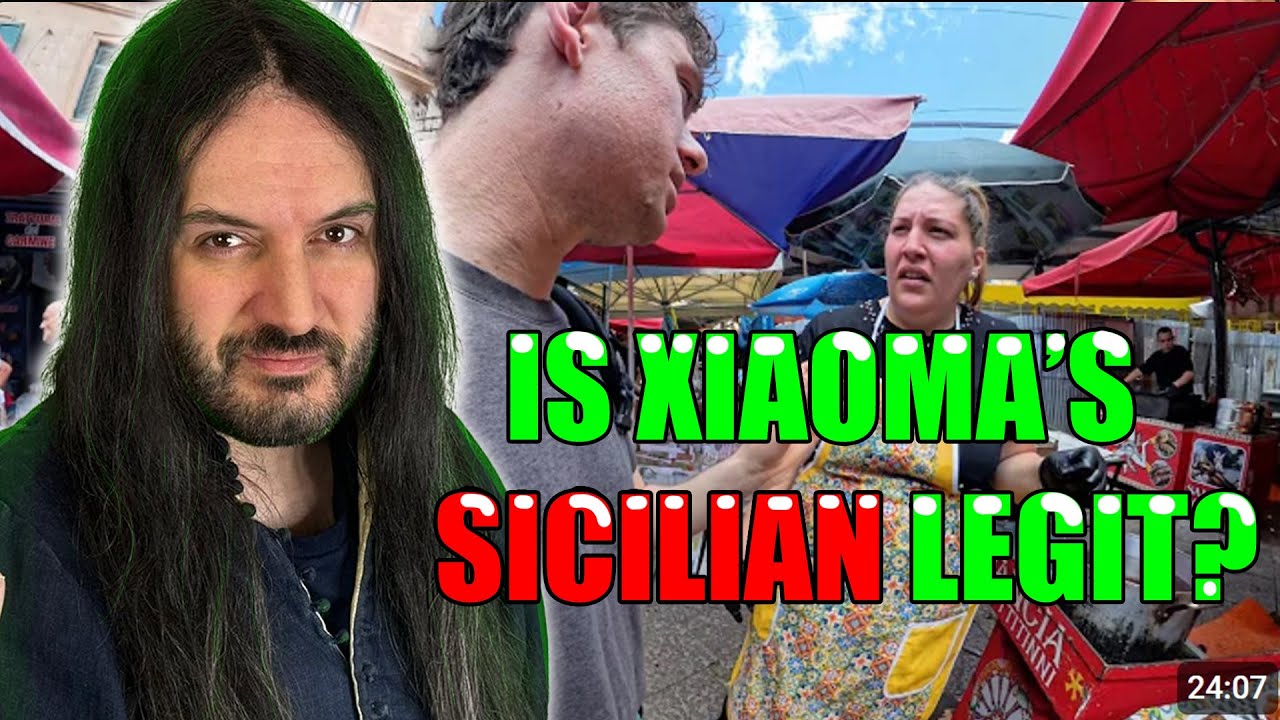
We gotta talk!
Link to the original video
The Sicilian language stands as a testament to Sicily’s rich cultural tapestry, bearing witness to the numerous civilizations that have shaped this Mediterranean island throughout history. While often miscategorized as a dialect of Italian, Sicilian is recognized by UNESCO as a distinct language with its own grammatical structures, vocabulary, and literary tradition.
The roots of Sicilian stretch deep into antiquity, emerging from a complex interplay of linguistic influences. The ancient Greek colonizers left an indelible mark on the language, contributing numerous words and expressions that persist to this day. Subsequently, Latin became the dominant influence during the Roman period, forming the foundation of what would eventually become Sicilian.
The language underwent significant evolution during the Arab domination of Sicily from the 9th to 11th centuries. This period enriched Sicilian with thousands of Arabic loanwords, particularly in agriculture, cuisine, and commerce. Words like “zibibbu” (a type of grape) and “cassata” (a traditional dessert) exemplify this Arabic influence, which distinguishes Sicilian from other Romance languages.
Under Norman rule, Sicilian absorbed French and Provençal elements, while the later Aragonese period introduced Catalan and Spanish influences. This linguistic amalgamation produced a sophisticated language that, by the 13th century, had become one of Europe’s earliest literary languages. The Sicilian School of Poetry, under Frederick II’s patronage, pioneered the sonnet form and established Sicilian as a prestigious literary medium before Tuscan emerged as the basis for modern Italian.
Sicilian developed unique phonological features that set it apart from Italian. For instance, the language exhibits a preference for open vowels and frequently transforms initial Latin ‘fl’ into ‘chi’ (pronounced as ‘ki’). The language also maintains a complex system of verb tenses, including a distinctive past tense formation that differs significantly from standard Italian.
Today, Sicilian remains vibrant among the island’s population of five million, though its use faces challenges from standardized Italian. The language varies across Sicily, with distinct dialectal differences between regions like Palermo, Catania, and Messina. These variations reflect local historical influences and cultural particularities, creating a rich mosaic of linguistic expression.
Modern Sicilian continues to evolve, incorporating new words while maintaining its fundamental character. Contemporary writers and artists use the language to express cultural identity and preserve traditional storytelling. However, formal education in Sicilian remains limited, raising concerns about its long-term preservation.
The language serves as more than just a means of communication; it embodies Sicily’s cultural memory and historical experience. Through its vocabulary and expressions, Sicilian preserves traces of ancient traditions, social customs, and ways of life that might otherwise be lost to time. Folk songs, proverbs, and literature in Sicilian provide invaluable insights into the island’s cultural heritage.
Despite challenges from globalization and standardization, efforts to preserve Sicilian have gained momentum in recent years. Cultural organizations, academic institutions, and local communities work to document the language, create educational materials, and promote its use among younger generations. These initiatives recognize that preserving Sicilian means protecting an essential part of Mediterranean cultural heritage.
The story of Sicilian demonstrates how languages evolve through cultural contact while maintaining their distinctive character. It stands as a living bridge between past and present, connecting modern Sicilians with their ancestors’ diverse cultural legacy. As Sicily continues to navigate its place in a globalized world, the Sicilian language remains a powerful symbol of cultural resilience and historical continuity.
#sicilian #xiaomanyc #polyglots
40 Comments
Link to the original video
https://www.youtube.com/watch?v=hYUidZTQ1xw&t=142s
He hasn't tried Finnish yet.
08:55 Malaka ine is greek though
Maltese…a little further south. Sugar is Zokkor.
Here in the UK I'm a big proponent of Cornish interests. And the Cornish have their own language which is now being actively resurrected after centuries of suppression to the point where Cornish was considered extinct.
It's lovely to see local languages survive, and I think Xiaoma (Ari) does a superb job in raising awareness around the globe.
It's never in the interests of local communities to ridicule outsiders for trying their best!
I love octopus water! 🤣🤣🤣
Il mio vicino siciliano ha dei borbonismi, "c' é o ci sono" dice "have" che mi ricorda l' "hay" spagnolo
I'm from Como, in northern Italy, and I remember a time when a Japanese girl tried to pose me a question in our local language (western Lombard).
In my region local languages (or dialects, as we erroneously use to call them ) are way less spoken in cities than in the south, so it came totally unexpected: I had her repeat me the question a few times until a local friend of mine said it with a more recognizable inflection.
I hope it wasn't too embarrassing for her, I really appreciate to see northern Italian languages represented, since we're losing them faster than other parts of the nation.
I've just been in Palermo and I've noticed a lot of single kisses between men.
Metatron, I would have never guessed you are Sicilian. You speak English so well, how did you nail the accent?
Should have titled this video "Sicilian man SHOCKS american by analyzing his video in FLUENT ENGLISH" Everyone would know exactly what it is about lmao.
His camera lens is destroying my ability to watch this lol
My fiancée is Sicilian. Her family cannot speak English. So I am learning both Italian and the variant of Sicilian from her area. It is super fun. I really love Sicilian.
i laughed watching the original, i laughed even harder watching this review. subscribed, my new favourite channel. grazie assai biddruuu.
Why are the oranges in Sicily orange? I thought the oranges there were red?
So "pistiasti" is slightly rude word? Kinda like "食う" would be in Japanese?
I like that guy's "I 💖 nothing" shirt.
teste di minqua
a roma il caffè americano lo chiamiamo sciacquatura di piatti
Everything about Greece is superior.
Is mangiare/pistiare kinda like eat/feed in English and essen/fressen in German where one is rude because has more of a connotation of an animal eating?
As a fluent Catalan speaker, I can vouch for his pretty accurate Catalan when he speaks it. Again, he makes the odd mistake but it's good, overall.
What you said in the end is so true. I live in a country of my 3rd language since many years and yet have not had a single conversation without saying something wrong.
His Spanish is not good at all. I don’t speak anything but English and Spanish. I can only imagine how bad the rest of the languages “speaks”. I believe he is a poser
Ma dai sei italiano! Ma pensa te! Daje!
i am a bit disappointed, when he tried the granita he should have said …minkia! to show how good it was ( I learned sicilian from my barber , Ignazio ru Capu) ( compà quando hai chiamato il tuo amico stava muriennu)
If he tries in speaking milanese in Milan no one would understand him, maybe just a couple elderly in some bar. That’s very sad
La prossima volta deve andare a Catania e filmare la reazione lì. Poi abbiamo un accento distinto da quello palermitano.
Troppo bello sentirti parlare in palermitano 😂
We say "acqua lorda"
My family are all from Sicily, the Palermo area
I'm sicilian and he's very good at learning languages, yes. Ofc not perfect, not fluent, still super basic but really impressive
Dio signore Onnipotente quanto amo il paese in cui mi hai fatto nascere….siamo un continente in 300Mm²….grazie Padre
E tu sei il n° 1 anca se te set un cicinin jargianes!
Amazing video
That bit about the northern part was edited, I guess you said something that might upset some people who live there? 😉
@metatronacademy I just looked through your videos and I don't find any that really entirely deals with Sicilian language. I have been living in Malta for some time, have friends in Catania and sometimes go there. I would really love it to learn more – not because I want to be able to speak like somebody's grandfather, Vito Corleone or a "malacarne", but simply to understand more of what is going on around me like when I am on the street market. I am sure al lot of other people would find it interesting of other reasons.
I'm an Italian girl from Venice, it's funny for me because I understand almost everything when that boy speaks in English but nothing when my fellow countrymen speak in Sicilian dialect
🤣
💛❤️
What is this octopus water is he trying to ask for a coffee Americano???
Island south of Italy… I thought you meant Malta at first, what a great language. Grammar from Arabic, words from Sicilian (a lot of them). PS a version of Maltese used to be spoken in Sicily but died out, what a shame!!
Mama Mia! Lui mangia e beve molto! Senza sosta!