
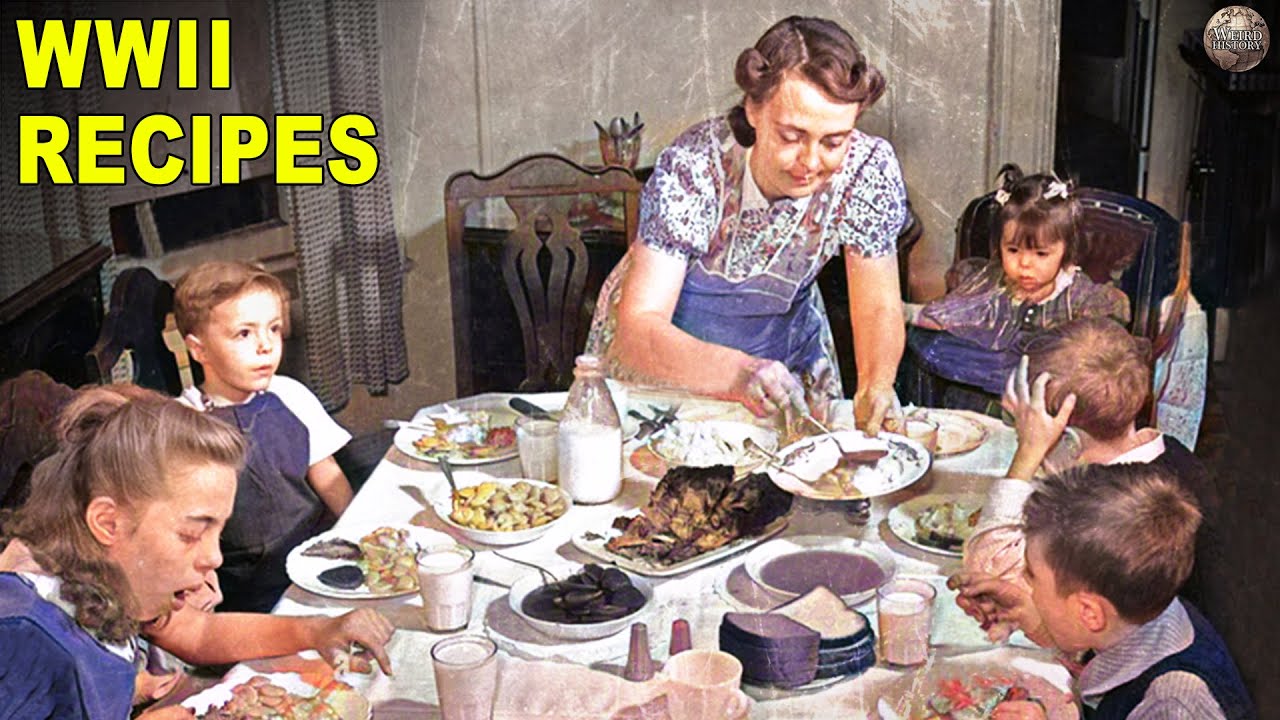
Americans who stayed home during WWII were asked to make sacrifices to support troops overseas. People changed jobs, took on new responsibilities at home, and even changed their diets. Food rationing was a must. The military got the best meat, coffee, and nonperishables, while everyone else tightened their belts and made do. Instead of grumbling about it, people got creative.
#WWII #FoodHistory #WeirdHistory
During World War II, Americans were asked to make sacrifices, to support troops overseas. People changed jobs, took on new responsibilities at home and even changed their diets. The military got the best food while everyone else tightened their belts and found ways to make do. But instead of grumbling about it, people got creative. So today we’re going to take a look at what people ate to survive during World War II. But before we get started, be sure to subscribe to the Weird History Channel. After that, we’d appreciate it if you would leave a comment and let us know what other food related topics you would like to hear about. OK get your bib, it’s time to chow down on some World War II vittles. [MUSIC PLAYING] As World War II kicked into high gear, the United States government quickly realized that the military would be competing with the general population for resources like food, metal, rubber, paper and various other materials. In order to make sure the armed forces got what it needed to win the war, a system of rationing was imposed. Here’s how it worked. The government gave every citizen, adults and children, a certain number of points. Those points would then have to be spent, along with money, on any item restricted for use in the war effort. So for example, in 1943, a pound of bacon would cost seven points, in addition to its monetary price, which was about $0.30. The points took the form of stamps which the government would distribute in books. The Office of Price Administration or OPA would have volunteers distribute the books and explain their purpose to merchants and consumers alike. The first product to be rationed was tires, followed by automobiles, and then gasoline. Then in May 1942, the government began putting food products, including sugar and coffee on the list. A few months later, meats, fish, canned milk, fats and cheeses were also deemed restricted. Any time a new item was added to the list, hoarders would clean the stores out, leading to shortages. Inevitably, many of the restricted goods would be traded on the black market. Despite these problems though, the system functioned well enough. Similar restrictions were also imposed in the homelands of America’s European allies. With so many basic staples being rationed the public was going to have to get creative with cooking. [MUSIC PLAYING] Sponge cake is a simple delicacy and although many people don’t realize it, it’s actually been around since the renaissance. The secret to its staying power is that it’s delicious and easy to make, but during World War II, the ingredients, flour, sugar, butter, and eggs were in heavy demand by soldiers. Eggs and sugar were especially in short supply in grocery stores around the world. The Welsh version of the sponge cake had to be made sans eggs, but with a lot of margarine, syrup, and milk. Jam was usually spread in the middle of the cake’s two layers. It wasn’t as fluffy as what modern diners are used to, but if cooked properly it still took on a golden hue. [DRUMMING SOUND] During World War II , a sobering 25% of the population of Poland was wiped out in the fighting. Germans snatched up all their land, which meant the Polish people had to do their best with what limited ingredients they still had access to. Not every meal however, was a thing of drudgery. Potato flour sour cream, for example, was meant to be served with blueberry dumplings, which was a favorite of Polish children. The sour cream was made of milk, sugar, and potato flour, which some of you will no doubt note is similar to a standard recipe for whipped cream. Maria Karpowiczowa, a woman who grew up outside of Warsaw, collected World War II Polish recipes. Instead of the potato flour sour cream, "The kids indulge themselves because they can cover the dumplings with a copious amount of the cream." In England, cooks did their best to keep some semblance of dietary normalcy. One of the ways they did this was by frying what came to be called mock fish fillets. The fillets were cooked in the same way as an actual fish fillet, but with rice. To make mock fish fillets, they mixed rice and egg into a half inch thick pan of fried rice, chilled it, then cut it into fillets. They breaded the fillets, if bread was available. And then they were fried again until they had a golden appearance. [MUSIC PLAYING] Demand for meat during World War II, as one could imagine, was extremely high. Those on the front lines received most of the meat. So things had to change back home. Restaurants started using meatless menus on certain days of the week and advertisers took to sharing meatless recipes, including things like creamed eggs over pancakes and walnut cheese patties. Home chefs, for their part, started coming up with new and interesting ways to stretch what they had. Or they just outright created new recipes. For example, a staple of the early 20th century was meatloaf made from ground beef and various ingredients formed into a loaf and baked. But during World War II, cooks began substituting vegetables to make an economical meal. Rather than ground beef, this loaf contained a cup of peas, a cup of mashed potatoes, and a can of condensed tomato soup. It wasn’t quite the same as a real meatloaf but it was an efficient way to get some vegetables and use leftovers. [MUSIC PLAYING] A big part of rationing was using leftovers to make food last as long as possible. So a lot of meals were basically thrown together from odds and ends. Bubble and squeak, for example, wasn’t one specific kind of recipe, although there was one basic necessity, mashed potatoes. During rationing, potatoes remained widely available because they were easy to grow. Best of all, from a cooking perspective, they took on whatever flavors were impressed upon them. When used in bubble and squeak, mashed potatoes turned every dinner into a kind of potato pancake, usually filled with whatever meat and veggies were around. [MUSIC PLAYING] Baking without flour may sound damn near impossible. But when this staple was scarce, people living in occupied Poland found various ways to make do. In many cases, this meant using beans instead of flour. Of course beans don’t have the same taste or consistency as flour, but when boiled down and minced, they become malleable and can be sweetened and worked into a cake. Beans also don’t taste anything like flour, rather they have an earthy flavor. But the creative Polish chefs had a fix for that too. Namely, they added six tablespoons of sugar to the recipe, so it was probably quite tasty. [MUSIC PLAYING] Vegetables were plentiful in America during World War II, mainly because they couldn’t be sent to the soldiers. Fresh fruit and veggies were impossible to ship overseas without spoiling, so Americans were told to fill up on them. Eventually, the government even began to urge citizens to plant their own so-called victory gardens, reasoning that if the people were able to grow and can their own vegetables, it would free up more factory space for war related manufacturing. Onions are a prime example of a vegetable that was easy to grow and extremely hearty. And in the 1940s, cooks began stuffing them with various ingredients. Grape-nuts, everybody’s favorite bland, eardrum-piercing cereal, which for the record contains neither grapes nor nuts, and is actually made from wheat and barley, was an American staple at the time. Even though most people still consider this cereal tasteless, it still has its uses in the kitchen. For one, it gave a stuffed onion a consistency similar to an onion stuffed with ground beef. With the right amount of spices, this dish might even make a tasty appetizer today. [MUSIC PLAYING] Coffee is a must have for many people. But during World War II, pretty much every coffee bean in America was shipped overseas, making coffee one of the hardest things to ration. And what will sound like the ultimate nightmare in today’s era where at least one Starbucks is on every corner, Americans were limited to going through one pound of coffee every five to six weeks. That meant they were drinking less than one cup a day. The horror. Americans who absolutely had to have a cup of joe started making roosevelt coffee, which was named for Franklin Delano Roosevelt, who was president at the time. Roosevelt coffee was really just coffee made with reused grounds. It was typically pretty watery and was likely a mediocre substitute for the real thing, but people got creative with it. Sometimes, ingredients like chicory and postum were mixed with the coffee. The chicory added spice to the coffee while postum, as a coffee substitute, made of wheat bran, wheat, molasses and maltodextrin. [MUSIC PLAYING] A cow’s tongue is huge, rubbery and tough. Not exactly a thing a typical American family sits down to enjoy, if they had any real alternatives. But during World War II, American families were only able to buy meat products such as tongue and feet, which made for interesting twists on classic dishes. Beef tongue, for example, wasn’t just served as a big tongue on a plate. Instead it was presented in something closer to a casserole. Braised beef tongue will be fairly recognizable, one modern recipe calls for carrots, onions, celery, and tomato sauce, plus the tongue. To get the tongue into an edible consistency, it had to be boiled for two hours, then baked for another two in a casserole surrounded by vegetables. [MUSIC PLAYING] Spit soup probably doesn’t have the most appealing name in the history of culinary innovations, but the dish itself is actually tasty. The soup was created in occupied Poland as a way to make use of excess barley. Poles no longer had access to many of the foods that made the cuisine so rich. Proteins like oysters and anchovies were off the table, as were items as simple as chestnuts. So to survive during World War II, poles made a soup out of barley, a hearty cereal. But why did they give the dish such an unappealing name? Well it came about because while eating the soup, they had to spit out the husks. [MUSIC PLAYING] Chopped liver is a traditional Jewish recipe that uses schmaltz and gribenes or chicken fat and cracklings to fortify the chopped liver that makes up most of the dish. During World War II, Jewish families were advised to stretch out their food rations which might mean using breadcrumbs to reinforce meals or making a vegetarian version. This vegetarian version of this dish was made using fresh fruits and vegetables and whatever else may have been growing in victory gardens. Home chefs often swapped out the meat for green beans, peas, onions, crackers, and hard boiled eggs, if eggs happened to be available. [MUSIC PLAYING] You’re probably thinking that sawdust in this context is the name for some sort of food. But it’s not, it’s just regular, ordinary sawdust. You see people living in England and Germany during World War II didn’t have the vast fields of wheat America enjoyed. So they mixed what little they had with actual sawdust, which was sometimes euphemistically called tree flour. One German recipe for black bread called for half rye grain, two parts sliced beets, two parts sawdust, and one part "minced leaves and straw." Everything was mixed together and baked like normal. It doesn’t really sound too yummy, but hey, in times of war, you eat what you have to, to survive. So what do you think? Which dish would you like to try? Let us know in the comments below, and while you’re at it, check out some of these other videos from our Weird History.
43 Comments
What WWII dish sounds the best to you?
Allegedly kraft parm cheese has wood in it even now
I was a Baby Boomer growing up in the years after WWII. I used to marvel at how my mother would create such marvelous family meals, usually casseroles, or goulash as we called it. Thanks to this video I now know how she became so creative in the kitchen. It was from all those meals she whipped up during the war.
I grew up in the woods, meats never in short supply, and niether is fish. Had a garden. And orange and lemon trees. And Suger Cane. Sooo. Life went on food wise. But no coffee or flour hardly. In America you got war coupons. And was able to buy
I love Grape nut flakes, but not grape nuts.
You still get tongues and feet in today…..in cheap hotdogs.
Thank God for potatoes….. potatoes during the depression potatoes during the war.
Thank you for the history! The UK, however, isn't interchangeably used with England – as the Scots and Welsh and Northern Irish will tell you! 🙂
It's a bit like calling the entire US Texas.
I have two menus from cafes from the 1950s that are handwritten from THE OFFICE OF PRICE STABILIZATION. One is for the Mississippi Room and the other for the Coffee Shop. They list the ceiling prices for each item served. They are framed in plain black wooden frames. I bought them at a used books store in a small town from us in 1999. The gentleman said his friend had purchased a building in a neighboring town and they were found in the attic. They have been hanging in our dining room for several years and they are a good conversation starter!
My dad and his siblings were Depression children, but he described how lucky they were. His dad was a trawlerman, and his mum basically ran the business (a common structure in the North East of Scotland). Basically any money she made would go on rent and maintaining the boat's needs, and perhaps home fuel too. She would take the catch and hawk them inland to farmers' kitchens, sometimes bartering.
This meant there was always fish, milk and potatoes (and perhaps other produce) to eat, so they never starved. Sadly he saw plenty of other children who did.
And of course he had to go to war. He might have been able to claim exemption, because he certainly joined my granda fishing, but since my granda was sunk by a U-boat in the north Atlantic and drowned, it was good that he didn't. Instead he served in Iceland, North Africa and Italy. My mum (and all her siblings served. She was in the ATS and one of her brothers was killed in Pakistan, I believe. Unlike the US, most British families were intimately involved in and suffered during WWII in ways that for many families is unimaginable. Hunger under rationing was incredibly common, though the wealthy/middle class could afford to avoid rationing of almost anything – the hardest to get was petrol, and, lordy, did they complain about that!
Soon the Democrats will make this repeat ,we are well on our way now.
Now I see why vegetarianism is met with suspiscion among old people,
The greatest generation
None!
Tree bark is not an uncommon bread-stretcher as famine food, similar to sawdust I guess. We should all acquire survival skills just in case and hope we never need them. Although with all the allergies ultra-processed foods have created, how many people would survive if their specialty foods were cut off and forced to eat normal food? I, for one, would lose control of my epilepsy if I were forced out of my medical low-carb, gluten-free diet.
We've gone from, "grow your own victory garden!" to "Banning backyard gardens because of the carbon footprint!" in 2024. xD
Cow tongue is a delicacy in Mexico. And it's very expensive now.
"The key to happiness is an Attitude of Gratitude.". 📘
Gasoline was rationed to keep people from driving unnecessary and wearing tires out. At that time rubber was imported
My husbands grampa is 96. He said he had to find and shoot squirrels to survive. They also ate alot of chicken. He refuses to eat chicken now.
My Dad remembers being a young child and ‘breaking in’ to his neighbors’ Victory Garden and eating their carrots. His neighbors never said anything. 🥺❤️🙏🏻
?9
You didn't mention the horse meat that butcher's supplied because beef was rationed.
I was a child during WWII. I don't remember any of the recipies shown on this video, but we lived outside the city limits and had chickens and eggs. We always had a big garden and my mother canned enough to get us through the winter. When ration stamps for meat were used up we had meatless meals. We had a friend who loved to fish so we often had fish dinners.
How dare you besmirch Grape Nuts – the greatest cereal ever.
Sorry, usa did not really experience rationing. Heck they didnt even enter the war until pearl harbour. The depression may be different. Having said that, weren't they ingenious, hats off😮
Just reading these stories is so humbling.
In all honesty absolutely none of that sounded any good, so I'll pass on all of it.
My mom used to fix cow tongue when i was little.now i know where she got it from.i came home one day.opened the fridge and slammed it.there was a hog head staring at me.
My grandmother had a dish called Wind pudding, she said . It was-hot air. Nothing.
My dad had a pet Nanny Goat for milk. He said it ran away. I didnt tell him, but I bet it was dinner.
My favorite meals (and my daughters) came from desperation and extreme food insecurity. Desperately trying to get her meat and veggies in each day. I still cook and eat those meals regularly
At least the saw dust isn't plastic like they feed us today
🕊🌎🕊🕊sharing🫂thankYOU 👑
SAW DUST? WHO WOULD EAT THAT? PLEASE NO MORE WAR.
My friend’s great grandfather lived during WWII. He was an avid fisherman and he said if he caught a few fish (whether it was bass, catfish, bluegill, etc) and brought them home for dinner, the whole family would act like they had won the lottery because fish was a luxury at the time!
Thank You to all soldiers on this Memorial Day weekend .God Bless our freedoms .Don't let others try to take them away.❤🤍💙
I am a Pole, You know those who killed Jews. We were fed the best fruit and reported jew to the nazis. Just so you have it on records vaginas.
Born in 1943I had my own book of stamps. Because things like Jello was rationed my mom made jello by mixing Koolade, gelatine and sweetened using my allotment of sugar. If you owned or rented a house with land you put in a victory garden. Now I wonder if apartment dwellers grew veggies in flower pots.
Mexicans eat tongue in tacos w onions, cilantro. Its very delicious meat.
Onions and grapenuts sounds like my moms recession meat loaf recipe more loaf than meat.. and i grew up in the 80s and 90s with great depression poverty but we had a roof and clean clothes and food and my grandparents helped raise me they survived the depression and WW2..and told me to be great full for what you have..i still use my grannys recipes
Spit soup sounds like one of my mamies ( grandmas ) recipes she'd use quick barely and its not too terrible..i wondered where she got it..shes American but has polish roots and probably got it from one of the relatives..as usual good video weird history
how. about. slave. food