
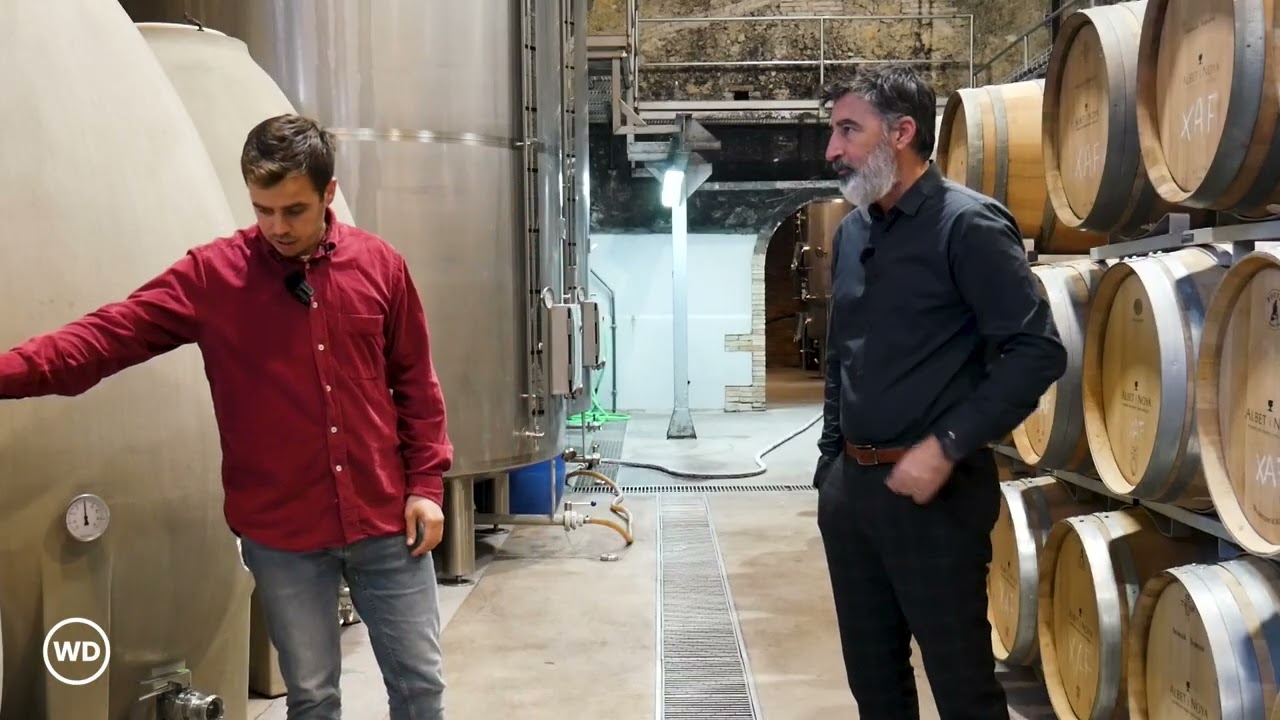
In 1903, during the phylloxera crisis, great great grandfather Joan Albet i Rovirosa arrived in the Penedès to work the vineyards at the Can Vendrell de la Codina estate, in Sant Pau d’Ordal. For five generations, the Albet family, tenant farmers of Can Vendrell, have farmed, loved and watched over the vines that are now the protagonists of their wines. Albet i Noya bacame pioneers in organically farmed wines in Spain in 1978 and have since dedicated strong efforts into researching and recovering of ancestral varieites (like the “new varieties” used for the elaboration of their outstanding wine Albet) and varieties with enhanced resistance against vine diseases (translated into their new white wine La Volada).
[Music]
it is a Mediterranean climate this in
general terms as it’s touching the
Mediterranean but it gets up to 900 M of
altitude which brings also some
continentality the Mediterranean climate
is typically dry winter and summer
seasons and rain in spring and
[Music]
fall we are around 300 to 400 over sea
level it is not the highest Zone there
is another Zone on the other side of the
valley where they arrive to 900
M what we have here as a difference from
the Central Valley is shallow
soils with less organic matter and
Parcels are
interes this leads to a more complicated
viticulture
these are usually lomy soils but then we
have textures with a lot of sand and
textures with very little it is very
important to know well the terrain as
each soil is worked with a different
level of
humidity soils with more sand can handle
more humidity those with little sand
will compact if you work them with high
humidity you were the first in Spain to
focus on sustainable and ecologic
biculture
can you tell us how this started with
your
father historically The Grapes were sold
to large producers of sparkling
wineology at that time was something
very far away nobody practiced it in the
Iberian Peninsula there was demand for
it in other countries more
environmentally conscious and there was
this importer who wanted ecologic wines
from the Iberian Peninsula with an
ecologic
certificate back then my father was
vegetarian not anymore
now and they proposed him to try
it you’re a vegetarian and perhaps you
like
this and he started making a small
production for that
importer then we decided to do it for
all our production and we were the
[Music]
first but you have gone even farther you
have started projects to recover and
Cals aous varieties you focused on
developing new clones perhaps that is
not the world more resistant to disease
and minimize the use of chemicals yes
this started 20 years ago around the
year 2000 my father was looking for
ancestral varieties that were not
planted anymore in the
area he was looking for resistance to
Disease an ecologic with use some much
lower level of chemicals than in
conventional viticulture the products
are less aggressive but we still have to
use them to some extent we still need to
apply some we realize that many of these
old varieties in the forest have
survived in the wild resisting
diseases if they have survived it’s
because they have
resistance they had no have
treatments but when you place them in
Vineyards they would become weaker and
would get
diseased we are now developing a project
run by my father to look for varieties
resistant to
fungus that need almost no treatment or
no treatment at
all we are in the room where we
elaborate our white fure this is a wine
of teroa from a set of contiguous
Vineyards a 100% chello from one of the
highest zones that we have in the ortal
mountains we produce it in three
different ways and then we blend
them on the one hand we use stainless
steel as inert as
possible with low temperature
vinification what about the
G with respect to yeast we do several
kinds of wines for some we use selected
autous yeast and for others commercial
yeast then the concrete eggs without
Steel
they have a egg shape because they help
to maintain the leaves in suspension
these wiins are worked with the leaves
in suspension with
[Music]
bonage the egg shape helps these leaves
to stay longer in
suspension as a result of
convection and then you have baras of
Oak and aasia yes we use Oak and Acacia
we use Acacia particularly with our
whites as we want a low impact of the
wood in the wine looking for wines
displaying the fruit characteristics but
then with Foo from chello we do some
part in
Oak with the traditional Bara French Oak
and medium toasting level and then the
Acasia that is not toasted to bring more
floral
Aromas so aasia does not provide that
much wood impact why no it allows micro
oxygenation but it’s a wood where less
aromatic Marti we’re now in the Run of
your red wines tell me how you work here
here we use mainly French Oak and some
American Oak as
well the process of passing through
barik depends on the type of wine the
top wines generally after malolactic
conversion get directly into barik we
taste them and we blend them on a
coupage some wines age all the time in
barik
and we work with five different
[Music]
Koopas you made several Reds which one
would you put apart anyone a little more
special
perhaps well the star of the house is
the Reserva
Marti it carries my
name my father created it when I was
born basically Cabernet and Mer and a
bit of marcan which is a grape from the
south of France that we grow
here we play Solan knowledge in the
selection of the vineyard selection of
berries called
mation and then direct to bars New
2-year bars it spends a long time here
and the wine acquires lots of
structure it’s not a wine with too much
Oak it is very balanced we always look
for balance we avoid having too much
wood
[Music]