
Half-Baked Colloquia By Culinary Mind Series – Winter 2020.
Alison Suen (Iona College, USA), Ethical Dining in the Age of the Pandemic.
Webinar recorded on the December 11st 2020.
Department of Philosophy “Piero Martinetti”.
The our last uh talk for the health picked series for the fall 2020 and today i’m really happy that we have we are with us uh elizon soon who’s assistant professor of philosophy at iona college just upstate new york and she received her phd from vanderbilt university and her research
Interests are primarily in the areas of animal ethics and feminist philosophy so we thank her for being with us today and the title of her talk is ethical dining in the age of the pandemic or actually pandemic eating you know in the shortened version we will be recording the talk
Uh but not the q a if any of you has questions during the talk you can also write them in chat so that she can collect them for for the discussion elizon thanks again for being here so the floor is yours okay thank you uh thanks for being here today and i
Want to say that i really enjoyed listening to the three papers earlier this semester and uh i’m grateful uh that you know you’ve invited me to give a paper as well and i look forward to hearing your comments and questions out so as you know today uh i
I want to talk about pandemic and eating pandemic and food and there are two objectives um for my presentation today the first is to consider um you know different ethical issues related to food that arise because of the pandemics and the second is to think about how these issues might affect our identity
As eaters so i apologize for the noise outside i hope it’s not distracting so let me give you a little bit of a context here and that would also explain the noise because i live in uh i live in new york um i live in a pretty crowded area in new york um
In little italy chinatown area and as you know new york new york was a hot spot for coronavirus back in march and april and we were under a pretty extensive lockdown in fact the city has only started to allow indoor dining at a reduced capacity at the end of september
And i think that they will stop indoor dining uh next next monday because of the you know the rising cases again so uh my talk is very much informed by my own observations and personal experience and some of the issues that i discuss may be more culturally and geographically specific and from the
Very beginning of the of the lockdown i noticed that food featured prominently in my daily efforts to adjust to the new reality well first of all i have to stock up on foods and for the lockdown and possible quarantine and the supermarket turns out to be the site
Where i realized the gravity of the situation so this is a picture that i took uh when i was um when i went to whole foods which is a popular chain you know a supermarket uh here uh this is at the beginning of march and you can see that you know the
The the canned food areas uh this is a pre empty shelf i’ve never seen anything like this and as you can see even during the pandemic no one seemed to want to panic by canned pumpkins so here’s another picture of of empty shelves in the supermarkets the pasta aisle is being cleared out
And uh and you might have heard of the toilet paper shortage and it looks like this family um scored a lot of uh toilet paper at the end so good for them all right uh so now i will say more about um uh you know a little bit more about this later on
For now i just want to point out that um not everyone sees the horror of the pandemic first hand especially if you are not working at the hospital you may read the news but it’s not like you see bodies pile on this uh piling up on the street
So it is actually you know the empty shells at the supermarket or the deserted streets that give people a really concrete sense of the impending doom so there are three ways i want to look at how the pandemic intersects with food politics the first the first two are both about both about justice
One has to do with um equity when it comes to food distribution and the other has to do with our ethical responsibility to those who provide this food and then finally i want to look at how the pandemic may change the way we see ourselves as eater
So uh let’s begin with the issue of food insecurity and especially how the lockdown has disrupted access to food so in the united states 20.5 million jobs were lost in april 2020 alone and over 40 million workers filed for unemployment benefits between march and may 2020 foot banks saw an unprecedented increase
Of needs and one foot bank based in las vegas was spending an extra 300 to 400 000 a week to buy foods and another food bank in san antonio has doubled the number of people it was feeding right from 60 000 pre-covet to 120 000 in may um
Uh 2020. okay and this is a picture uh you can see a picture of cars lining up for food in san antonio texas here so this is one way you know the lack of employment employment has pushed a lot of people to have to line up for for food
Um so that’s one way you know uh the pandemic exposed or you know introduce food insecurity another way the uh pandemic has exposed um issues of food insecurity is through closing school school closer students in new york public school receive breakfast and lunches and many low-income families rely on
These meals to feed deaf children so there are no when there are no in-person classes what is at stake is not just the quality of the education it is also foods it is also about food security now new york city actually continues to provide meals for the students even with the school closing
Right shutting down students and families they can go to school buildings to pick up their meals but one of the problems with these grab-and-go meals is that they are usually cold and pre-packaged and so they are not particularly appetizing um a lot of students ended up get uh you
Know just skipping meals because they can eat you know so much hummus yogurts and sandwiches whereas pre pandemic students were fed fresh hot meals in the cafeteria now they are left with a much more limited manual so it seems that in the pandemic not just exposes existing food insecurity it also
Introduces new problems so um just sticking this second side okay um so the first point that i the first point that i uh on first in security that i want to draw attention to is related to restaurant closure and specifically the ban on indoor dining now obviously the the livelihood of those
In the industry you know is at stake and i’ll say more about that in a moment but in terms of food insecurity the lack of indoor dining means that there is now a lot less food in the trash which means that rodents now have the main source of a food supply cut off
Now the rats and mice have to go somewhere else for food in other words whereas pre-pandemic they mostly live off food waste you know in the commercial areas now they have to go to the more residential areas for food in fact back in may the cdc issue iran
A the cdc issue a warning saying that the pandemic is causing rodent infestation uh in residential areas and not just that these hangry rodents are getting more aggressive and i suppose that’s understandable right the hungrier you know they get the more aggressive they need to be
In order to secure food and um and so uh this this last point i thought is actually very on brand for 2020 rodents are starving so much that some of them are cannibalizing others and so i think that uh the thing to keep in mind is that
When uh when it comes to food insecurity it affects not just you know humans but also straight animals and you know even with rodents as well okay so uh the second uh food justice concern that i want to talk about is equitable distribution of resources and specifically what the uh
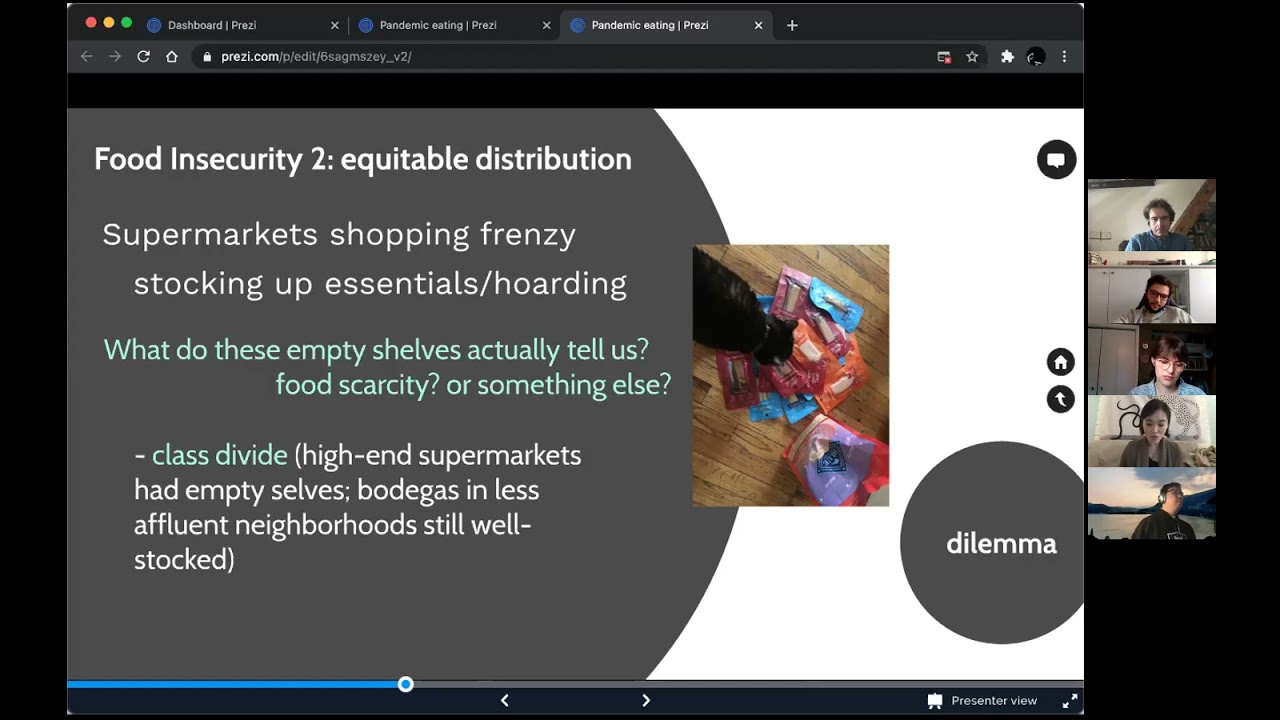
What the panic shopping you know uh tel tells us right uh the with stocking up foods and hoarding and as you can see uh this is my cats linguini inspecting her her stash of treats at the beginning of the pandemics and as i said earlier um the moment
I felt the gravity of the pandemic was seeing all the empty shells in the supermarket before that i was aware of the problem my parents live in new york and they experienced the 2003 stars outbreak and um and so uh so i followed the news pretty diligently
But even then my worry was still very much on an intellectual level um yes i got some hand sanitizers and instant noodles because my mom told me to but i really i didn’t really feel feel that urgency it wasn’t until i see people panic shopping for pasta canned food and
Toilet papers in the supermarket that i register uh the anxiety of the pandemic so now i want to look at this question um what do these empty shelves on the supermarket in the supermarket actually tell us okay what does it actually say um i spoke with a friend a few weeks
Into the lockdown and i asked her if she managed to to get supplies at the stores before they run out and she and her response was really surprising to me is she said well no the bodegas here are still very well stocked i have no problem getting my supply now
My friend live in a uh less affluent neighborhoods in the city where people typically shop at bodegas rather than you know the fancy supermarket with organic foods and bodega um you know in new york typically you know small convenience stores they are usually owned by uh operated by the owner and they are
Not part of you know a national chain um supermarkets right in any case i was surprised by my friend’s uh comment and i was like wait what are you saying right are you telling me that people in your area don’t panic shop you know uh uh you know don’t don’t stock up or
Anything and my friend was like well they can’t afford to even if they wanted to uh they live paycheck to paycheck so uh they just don’t have the extra money to buy 50 cans of beans and i thought um you know what i thought was significant about this
Shopping frenzy is once again the structural economic inequality that that it exposes you need disposable income in order to buy in bulk so the very possibility of holding foods and other essential is for the most part we serve for individuals who have the extra money to spend
In other words uh in a somewhat counter-intuitive way the empty shelves the empty shelves in the in the well-to-do neighborhoods are actually indicative of excess and not a lack so whereas whereas on the other hand when you see the well-stocked you know shells in lower income neighborhoods they are actually more indicative of
Poverty or the hardship of the neighborhood so one of the points about stocking up or hoarding in the more affluent neighborhood is that a lot of times these hoarders or panic shoppers they are not even doing the shopping themselves they outsource the risk of infection by paying someone else to go to a
Crowded uh supermarket to do the shopping they use platforms like amazon or instacart uh you know to hire shoppers when i was uh at the store back in march i would say that 50 percent of people shopping there were actually shopping for someone else and you can tell
Because uh they are they all shop with the same paperback with an amazon logo so the empty shelves in these fancy supermarkets are actually um more indicative of the economic and class privilege than the actual shortage of food supply in fact when i what i learned later is that supermarkets like whole foods
Are not out of food they have plenty of canned beans in the bathroom they just didn’t have enough people to restock the shelves they just couldn’t restock the shelves fast enough because as soon as they put something on the shelf someone would come and clean it out in
Fact at one point in march uh the store that i go to had to significantly reduce their hours in order to give the employee time to restock so once again i think what this somewhat counterintuitive picture invites us to ask a different set of questions so instead of asking are we going to
Rent out the food maybe the more pressing question is are we having an equitable food distribution okay so pandemic are not we have to eat if we go to the grocery store we are increasing traffic and exposure if we hire someone to shop for us we are outsourcing the the risk
We are essentially paying someone else to show the burden for us so it seems that we are caught in this impossible ethical dilemma this brings us uh to the next section so in this section on food justice i want to focus on our ethical responsibility to those who provide us food what exactly
Uh you know do we owe to those who who feed us and once again i think some of what i’m about to say here might be more geographically and culturally specific it has a lot to do with the culture of restaurant dining in new york city at the beginning of the lockdowns uh
Restaurants were only doing take out and delivery at the time the take out versus delivery debates is very similar to the grocery shopping uh debates right we have a very similar dilemma if we pick up food um you know from the restaurants ourselves then we are increasing traffic and exposure
Right but uh if we uh rely on delivery people then once again we are outsourcing a health risk so at least at the early stage people were concerned with the sort of responsibility that we owe to those who deliver food to us but i think most people believe that
It is still an acceptable practice from the public health perspective the less people are out and about the more likely we can curb the spread of the virus another reason in favor of outsourcing risk is that it provides employment opportunities even though you know they obviously don’t want to get sick the delivery
People also need to make a living and if no one order uh if no one orders delivery then they would lose income so that doesn’t seem helpful so some people at least you know according to some people right it seems that the more reasonable thing to do is just to be more conscientious
Wear your mask when you receive the delivery leave a substantial tip to compensate for the service it doesn’t really take away the unsavoriness of outsourcing health risk but that seems to be the least wrong thing to do so um so a few months into the lockdown
Uh new yorkers were pretty sick of uh staying home there’s a tremendous pressure to for the city to reopen restaurants for dining for dining in around that time the positivity rates in new york was pretty low about one percent and people were really sick of being stuck at home many of them were
You know really sick of cooking for themselves as well so now the debate becomes um is it responsible to start dining out the game now the main reason in favor of using delivery service can be applied here which is well we want to support local businesses
And so dining at the restaurant is one way to do it also even though uh the doing delivery would allow delivery people to keep working we also have to consider the waste staff the way staff like the delivery people would also like to make a living now the downsides
Of course downsize one of them is that for one thing indoor dining is partly responsible for the search of virus cases in other parts of the country and that shouldn’t be surprising we can’t wear a mask when we eat and eating and talking in proximity with others increase you know the risk of
Transmission and weight staff are particularly vulnerable because even though they are required to wear a mask when they serve the diners are not required to wear a mask and unlike a delivery person the wait staff has to interact with the diners so they are certainly more at risk at
Getting sick so once again uh you know this highlights the plights of many frontline essential workers they have to choose between health and income between lives and livelihood so one solution is outdoor dining you can see in this picture here restaurants have set up you know little bubbles to uh
To set the diners apart by early june restaurants in new york city were finally permitted to do outdoor dining indoor dining was still you know banned at the time but restaurants can at least put some you know tables outside and surf the rationale is that with outdoor
Dining waste staff and diners are less likely to get infected because it is easier for the aerosol to disperse but this obviously cannot be a long-term solution and there are several problems uh the first is that outdoor dining is very weather dependent no one wants to eat in the rain
And new york winter can be pretty cold and i don’t think a lot of people would enjoy eating out when it is zero degree out second not all restaurants can benefit from it for example many small immigrants own restaurants especially in my neighborhood in chinatown and
To italy they cannot afford to buy you know additional tables and chairs that are outdoor appropriate and building these plastic bubbles and buying heats them for the winter can be very costly they are already struggling because of the loss of revenue and many of them just cannot afford to
Set up the outdoor dining for business so it seems that uh even the solution itself uh there’s even the solution seems to privilege the fancy expensive restaurants and not the kind of restaurants that are more likely to be owned and frequent by the lower income population so it seems that even the solution
Is fraught with ethical issues okay so um one other thing that is worth uh you know uh considering is how the um uh is how the uh uh pandemic affects the meat the meat industry as you may know there have been major outbreaks in meat processing facilities um
Uh in april and may more than 17 000 workers were infected and almost 10 100 of them died just in those two months workers in the slaughterhouses and the meat processing facilities are particularly vulnerable because they often work in proximity close proximity and they work for long hours
It is also worth mentioning that uh pointing out that the majority of these workers are racial and ethnic minorities many of whom are undocumented workers who don’t have a proper work permits and and this has several implications the first is that many of these workers many of many of these workers may be
Less inclined to disclose symptoms when they get sick because they don’t want to get penalized or lose their employments the second is that the immigrant workers are typically housed in uh overcrowded you know dormitory and many of them don’t have a vehicle or driver license and they rely on
Overcrowded buses to vary them back and forth to work third is that many of them have no health insurance or easy access to medical facilities which means they may not receive medical attention until until it until they get really sick if they receive any attention at all at this point
It should become clear that when we talked about responsibility of what we owe to essential workers during the pandemic we can’t just fixate on our individual responsibilities the debates cannot be confined to should i eat out or order delivery should i hire someone else to do my grocery shopping
Of course these questions are important each of our actions you know can directly affect the well-being of others if i order my food at a restaurant without wearing a mask i am putting the the waist up at risk right but these questions on individual responsibility should not obscure the larger discussion
On our collective responsibility or institutional responsibility and what these outbreaks show us is that a responsible health policy may involve a reconsideration of our immigration policy and labor laws as well now at this point i have talked about various groups of individuals who feed us people who deliver groceries
And take outs for us the waste staff at restaurants and workers at the meat processing factories the last group of stakeholders that i want to talk about is animals that are being used as food so they are feeding us in a literal sacrificial and non-consensual manner
As with the pandemic a lot of food has gone to waste simply because of the disruption of the supply chain when there is an outbreak in the foods when there’s outbreak in a meat packing facility or a slaughterhouse they have to close down the facility for deep cleaning
So what this means is that farmers who raise animals for the slaughterhouse have nowhere to send the animals and the farm animals keep reproducing right so many of them many of these farms run out of space to house these animals or the money to feed them which means that
Uh a lot of them ended up having to euthanize you know uh uh these uh you know animals of that were raised for food in may 2020 the minnesota pork producer producers association estimated that they have to destroy 300 000 pigs just in the state of minnesota alone
And this is uh happening all over the country so uh this brings me to the next to the you know question right what do we owe to these animals and i think there’s something especially strange and unsettling about this last group of stakeholders when we talked about what we owe to
People who feed us such as waste staff at restaurants delivery people or workers at the mid packing industries we can think of ways to mitigate the adverse effects caused by the pandemic but what do we owe to animals that are raised in uh the race to be slaughtered
And eaten as someone who doesn’t really think that we should raise animals for food i am not entirely sure what to make of this i’m hesitating to go call this a waste in part because i don’t i don’t know i don’t want to legitimize the idea of factory farming
Uh especially the way you know uh that is typical in the united states and from the perspective of of cow of the cows and pigs it doesn’t really matter whether they end up being eaten or being useful they won’t suffer less simply because simply with the knowledge that they will end up um
You know getting eaten and depending on how they euthanize euthanize the animals in the farm these animals may end up suffering less than being killed in the slaughterhouse but it seems strange to say that we owed it to the animals to consume them so they don’t die in vain
Um although you know occasionally you know i i do i mean i i do find myself saying something like that especially with my cats um she is transitioning to a new diet and so you know i’m i have to try to get her to try different type of foods
And uh every time you know she wastes food i i want to say to her linguini you are know you have to eat this food because you know the chicken died in vain for you but it seems strange you know to think about it in that in that way that
We owed it to the animals to eat them um so so i think but i don’t really have a settled feel on that and and i would like to really like to hear what you what you might think about this in the q a um so the final section of my
Presentation is on the uh on the question of identity how does the pandemic change the way we understand who we are and what our communities is so um let me first apologize for this shameless plug for my forthcoming book before the pandemic i was procrastinating on a project that
Has nothing to do with food at the time i was writing a book defending slackers people who are unmotivated people who just don’t care to make themselves useful and then the pandemic hits and all of a sudden i started staying at home a lot more much to the delights of linguini and i
Ended up writing an entire chapter on uh pandemic slackers and what i ended up arguing in that chapter is that the kind of existential anxiety induced by the pandemic is bound up with work and being useful this is why we see countless recommendations on how to remain productive
In the lockdown recommendations on how you can still make yourself useful even if you lose your job or stuck at home so how is it related to food well you may wonder well interestingly a lot of these activities that are supposed to keep us productive has to do with food or cooking
For example people were baking so much that there was a shortage on flower and east at the stores and sourdoughs apparently was particularly popular and enough people started raising you know their own chicken in the uh in the backyard that there was even you know a shortage on
You know chicks so making our own sourdough bread and even raising our own chicken becomes a way to keep ourselves busy to to to maintain you know our productivity to make ourselves feel like we are still doing something another interesting way um uh uh another interesting way people try to be
Useful or try to make a difference during the pandemic is also food related right for example when restaurants were forced to close at the beginning of the pandemic of the lockdown many of them started to cook and deliver food to the hospitals for the um for the healthcare professionals often for free
Some of these restaurants initially were just trying to use up their perishable perishable in the pantry but many of them see also see this as a way to do their part to make a meaningful contribution to the pandemic relief efforts similarly there are numerous grassroots efforts to deliver foods and grocery to
The elderly and other vulnerable individuals um feeding others then is a way to stay productive i’m not suggesting that people uh help out and other just to feel good or just to you know you know feel productive about themselves but the pandemic has made many of us feel powerless
Right and that we we don’t have control over so there are many things that uh that we cannot do because of the pandemic so maybe that’s why even baking a loaf of you know sourdough bread gives us a sense of accomplishment even delivering a meal to someone in
Need may help us regain a sense of control so i want to end my presentation by pointing out that um the pandemic affects not just our individual identity as a productive citizen who can make a difference it affects even the identity of an entire city for many new yorkers restaurants and
Bars are such an integral part of the city’s cultural landscape that the pandemic presents nothing short of an identity crisis so i’ll show you a headlines of three new york times article the first asks what is new york without new york bars the second is more specifically about chinatown in manhattan
In my in my neighborhood who are we for how how the virus is testing the identity of chinatown right so uh the article itself is about you know chinatown restaurants specifically um uh the the sort of people that they serve and how they might you know uh keep up with
You know time and enterprises and finally in these uh in this opinion piece can anyone save new york’s bars and restaurants the author who owns two bars in brooklyn points out the following independent restaurants and bars are a defining elements of a city’s very identity
So at stake is not just the identity of individual new yorkers but the identity of the city as a whole for many without restaurants and bars new york is not even recognizable so this is uh this is what i have today and thanks for listening thank you thank you