
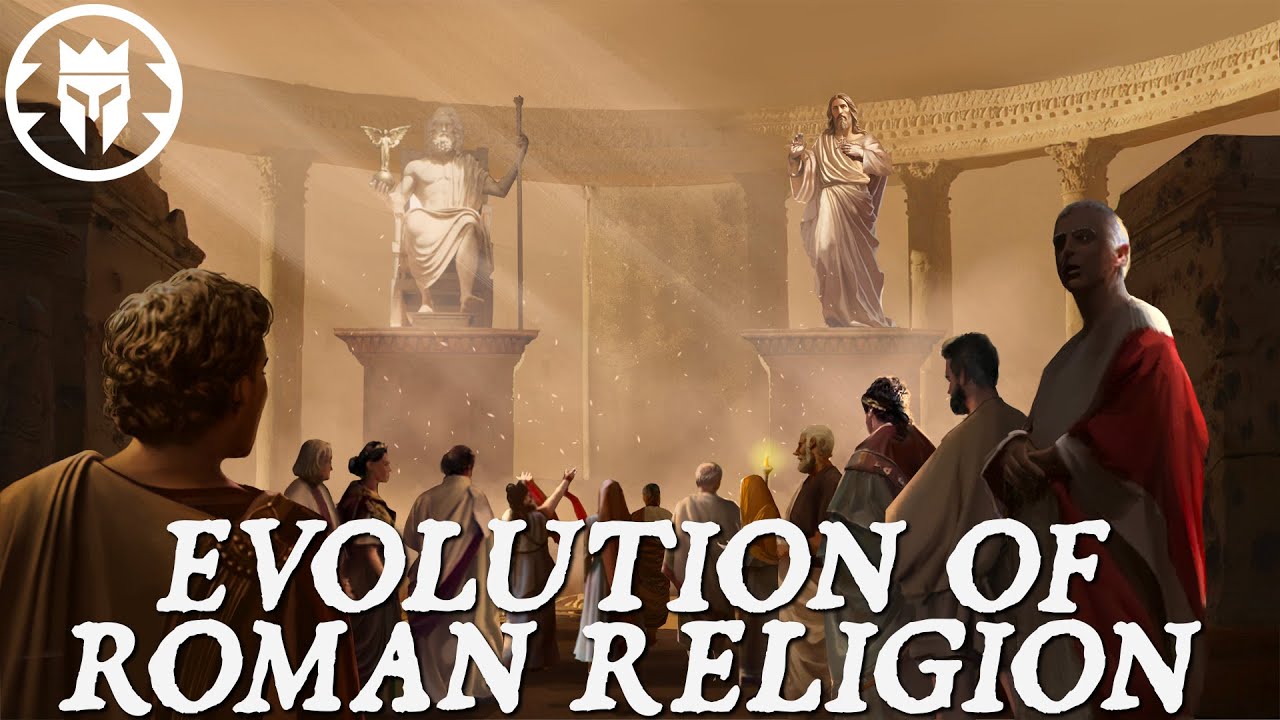
Kings and Generals’ historical animated documentary series on the history of Rome and ancient civilizations continues with the second video on the Roman religion. We will talk about the religious practices of Rome before the Greeks, how the Romans adopted the Greek gods and how the Roman religion was Hellenized, how the Ancient Romans deified their rulers as well in the form of the Imperial Cult, but they had a unique approach towards the concept compared to other Empires that preceded and followed them. So how did the Roman rulers became God-Emperors? And how did Christianity took over Rome despite all the persecutions?
🎥 Join our YouTube members and patrons to unlock exclusive content! Our community is currently enjoying deep dives into the First Punic War, Pacific War, history of Prussia, Italian Unification Wars, Russo-Japanese War, Albigensian Crusade, and Xenophon’s Anabasis. Become a part of this exclusive circle: youtube.com/channel/UCMmaBzfCCwZ2KqaBJjkj0fw/join or patron: https://www.patreon.com/kingsandgenerals and Paypal https://www.paypal.com/paypalme/kingsandgenerals as well!
What Happened In Rome After Caesar’s Assassination: https://youtu.be/jfBsb_-h-_M
Battle of Mutina: https://youtu.be/3Qdi0VUOn3Q
Octavian and Antony: the Monsters: https://youtu.be/D9duJSBBs14
Caesar in Gaul: https://youtu.be/LRV185XaMIM
Caesar against Pompey: https://youtu.be/_O5DshzvUsk
How Caesar Won the Great Roman Civil War: https://youtu.be/o8F8IajtW9U
What Happened In Rome After Caesar’s Assassination: https://youtu.be/jfBsb_-h-_M
Medieval Battles: https://www.youtube.com/playlist?list=PLaBYW76inbX46r95D4BjCxiJz7-OeyOtW
Roman History: https://www.youtube.com/playlist?list=PLaBYW76inbX6WrNCeL_AdR36ZIODiGNzq
Rise of the Vandals: https://youtu.be/-IpbeEW6I9Y
Marcus Aurelius: https://youtu.be/cLtDWIsOs1E
Aurelian: https://youtu.be/YQHNaemGOoI
Commodus: https://youtu.be/nVW5RJj6CTo
Claudius: https://youtu.be/bPbZFzJpSY4
Sejanus: https://youtu.be/f2iFXVdkw4w
Milvian Bridge: https://youtu.be/VbFtMXytMj8
Origins of the Germanic Tribes: https://youtu.be/_KFzDlhT6bs
Julian and battle of Strasbourg: https://youtu.be/ZshHmtmtsDs Arminius: https://youtu.be/logbxY7_FCw
Cimbrian War: https://youtu.be/5FpcDpYBFW8
Teutoburg: https://youtu.be/imEyKWMDM2o
How the Fall of Rome Transformed the Mediterranean: https://youtu.be/32a6sAvi2j8
Support us on Patreon: http://www.patreon.com/KingsandGenerals or Paypal: http://paypal.me/kingsandgenerals or by joining the youtube membership: https://www.youtube.com/channel/UCMmaBzfCCwZ2KqaBJjkj0fw/join We are grateful to our patrons and sponsors, who made this video possible.
Script: David Muncan
Animation: Lucas Salatiel
Illustration: Lucas Salatiel
Narration: Officially Devin (https://www.youtube.com/channel/UCU0-VII-V376zFxiRGMeZGg & https://www.youtube.com/channel/UC79s7EdN9uXX77-Ly2HmEjQ)
✔ Merch store ► https://teespring.com/stores/kingsandgenerals
✔ Patreon ► https://www.patreon.com/KingsandGenerals
✔ Podcast ► http://www.kingsandgenerals.net/podcast/
✔ PayPal ► http://paypal.me/kingsandgenerals
✔ Twitter ► https://twitter.com/KingsGenerals
✔ Facebook ► https://www.facebook.com/KingsGenerals
✔ Instagram ►http://www.instagram.com/Kings_Generals
Production Music courtesy of Epidemic Sound: http://www.epidemicsound.com
#Religon #Documentary #RomanHistory
Throughout history, religion has been a core pillar of most human societies. This was also true for the ancient Romans. Although the Roman Empire was known as a bastion of Christianity for the last millennium of its existence, it is better known for the polytheistic religions
That preceded it. From the patricians, to the plebeians and the lowliest of slaves, the Roman people were deeply religious. They honored many gods and strived to be pious, so as to appease them and not make their own lives more difficult. Welcome to our video on
The evolution of religion in Roman society: From the earliest Roman religious practices to the Greek influence to the rise of the emperors and the adoption of Christianity. This video is made available for free thanks to our Youtube Members and Patrons. We fund our free
Content through our program of exclusive videos made for our members and patrons, who get two documentaries per week not available to the public. We’ve got a growing collection featuring the First Punic War, the History of Prussia, the Italian Unification Wars, and a review of the classic text:
Xenophon’s Anabasis. We’re now covering the Russo-Japanese War and Albigensian Crusades, not to mention our massive Pacific War week by week coverage, and a massive pool of other projects. All this is made for, and with generous donations from, our backers. So if you’re
Enjoying our content and want to both see more and support the cause of history, consider becoming a youtube member or patron. You’ll also get early access to public content, a spot in our lively discord server, and behind the scenes info and goodies.
We rely on our backers to support our growing team pumping out these videos, so thank you to everyone already involved, and we hope you’ll consider joining in too. As Rome conquered new lands, many different peoples became part of the state, and their
Beliefs and customs influenced the Roman religion itself. Indeed, the most well-known form of the ancient Roman religion was in itself an amalgamation of mostly the old Roman faith, the Etruscan religion, and Greek polytheism – most notably the latter. The primeval
Roman religion was very different from the cast of Gods we associate with Rome today, which would be the one influenced by the Greek’s Olympian pantheon. The point at which the original Roman faith begins falling under intensive Greek influence and drastically transforming
Into its recognizable shape is a matter of scholarly debate. Most historians, however, speculate that the religion began evolving in that direction at some point during the 4th century BC. At that point, the Romans had conquered most of their non-Greek neighbors in the Italian
Peninsula, and without Etruscan and Campanian influences keeping a certain balance, the Greek religion had become the dominant outside factor. Most of the information which exists about the Roman faith before its deep syncretism with the Greek Pantheon was written much later,
By men like the 1st century BC historian Livy. These records are generally unreliable: It is possible that these Roman writers may have purposefully omitted less than ideal details about Rome’s cultural past, while alternatively, knowledge of these archaic Roman rites may have
Been lost to time by the late Republican era. Direct historical sources on Rome’s earliest period are scarce, and all that exists from that age are a handful of difficult epigraphical texts and scant archeological evidence. The origins of the Roman religion are
As obscure as its foundation and early history, but we can glean clues of how it functioned and developed by observing the archeological record. In Latium in the 10th and 9th centuries BC, there is no evidence of organized religion, images of gods or even the existence of temples and priests.
Nevertheless, some forms of rituals were present, as places for sacrifices are commonly found. In those places, looms, ceramic bowls and other items of everyday use were gathered. Additionally, with the spread of cremation and urn cultures to Italy, burial grounds and necropolises
Started appearing in the sterritory of Rome as well. By the late 7th and early 6th centuries, however, burials had become increasingly rare, having been replaced by public buildings. As the Iron Age continued, Greeks started colonizing the Italian peninsula, all the while
The Phoenicians and Cypriots started spreading their trade routes to ever more distant parts of the Mediterranean. The influence of these cultures on Roman religious practices can be seen as early as the 8th century BC. The aforementioned burials became extravagant, particularly in so-called
Princely burials, such as the great tombs of Praeneste outside of the city of Rome. This early Greek and Phoenician impact on Roman religion was as much economical as it was cultural. The trade that they had facilitated greatly increased Rome’s prosperity and led to rising levels of luxury,
Especially among the ruling elites. Other major sites that coincide with the expansion of Greek and Phoenician influence are temple complexes at Satricum and St. Omobono. The religious significance of St. Omobono can be seen even to this day, as a Christian church is
Present at the site. Meanwhile, the temple at Satricum was dedicated to Mater Matuta, the predecessor of the goddess of dawn, Aurora. It is also evident that temples had communicated with each other, as the one at St. Omobono was dedicated to the goddess Fortuna, the partner of
Mater Matuta. The temple at Satricum is surrounded by large buildings which archeologists believe to be dining halls. Communal dining spaces adjacent to cultic sites were present in the Greek world, further indicating the rise of Greek influence in Rome. As Roman society and politics developed
In the first centuries after its founding, religion also became increasingly complex. Much like the early Roman state and other aspects of their religion, the gods themselves have mysterious beginnings too. The English historian H.S. Rose states that the Roman gods may have
Evolved from more primitive religious views. According to him, supernatural and divine acts, or a very divine presence, were given the name numen. The direct translation of numen is “that which is produced by nodding” – in a less literal sense meaning an act that represents the product
Or expression of power. Since numen is found in a variety of places, it is attached to a myriad of phenomena, things and even people. For a large period of time, before the religion became more organized, the numen was a personal affair for every Roman, rather than possessing any collective
Identity. According to H.S. Rose “If they were strong, and especially if they were regular in their occurrence, the natural conclusion would be that they were produced by a kind of person who had much numen and was ready to display it for the benefit of those who approached him in
The right manner”. This “person” is believed to have gradually evolved into one of the many Roman gods and goddesses, however, that evolution was slow. In accordance with this theory, early on, Jupiter was nothing more than a flint and Mars was represented by a simple spear. As
To why the Roman gods started out this way and were only later given human characteristics, Rose simply states that it was due to a lack of artistic maturity within Roman culture. Another thing worth mentioning about the early Roman religion is its apparent lack
Of an expansive mythology, such as the one that the Greeks and Indians had created for their gods. Due to lack of evidence, it is difficult to say whether the mythology was forgotten and lost to time or whether the Romans had simply never created one in the
First place. This is another reason why it is deemed possible that the Roman gods did not initially possess human characteristics. At the end of the Etruscan period, when the three Capitoline gods were united in a single temple, it wasn’t even certain that Jupiter
And Juno were even seen as husband and wife. Some of the old Roman gods have received more detailed mythologies after the Romans started modeling their religion after the Greek one. Nevertheless, several important gods did not receive the same attention, and their mythologies
Remain mostly unknown. For example, Quirinus, who is believed to be the opposite of Mars, is today sometimes even misidentified with him. Though the worship of Quirinus became nearly extinct by the time of the Empire, the Roman hill named after him, the Quirinal, continued
To be considered one of the most important places in the country. Mars, as an exception to the rule, went through relatively little change, unlike the majority of the other gods. His role was perpetual and stable, the typical role of a war god. A goddess whose importance likewise dwindled
As the centuries passed is the aforementioned Mater Matuta. This primordial “mother figure” goddess held great importance during Rome’s early days. During her feast day, the Matralia, women that were married for the first time would gather and feast together,
After which, they would ask for blessings for their children and the children of the other women that participated. She is generally believed to be the goddess of dawn and that she was later made equivalent to Aurora. One myth surrounding her has been recovered and George Dumezil recounts
It in his book “Archaic Roman religion” – “Dawn suckles or licks the child who either belongs to herself and her sister Night in common or to that sister alone. Thanks to this care, this child, the Sun, which has emerged from the womb of Night, arrives at the maturity of day”.
One of the things which the archaic and late Roman religion had in common was that Jupiter was the principal god. Although Rome’s Capitoline triad of gods consisting of Jupiter, Juno and Minerva is well known, the hierarchy of the gods was very different in Rome’s early days. The so-called
Archaic triad consisted of Jupiter, Mars and Quirinus. Initially, Jupiter is believed to have been a sky god and the master of the thunderbolt. Unlike his Greek counterpart, Zeus, Jupiter seems to have been much more down to Earth. Zeus, as the grandson of heaven, remained fully celestial and
Retained a connection with the heavenly bodies. On the other hand, in the early Roman religion, there was little interest in the Sun and moon and virtually none at all in the stars and the firmament. It is also speculated that Jupiter was the master of rain, with the ritual of Nudipedalia
And the ritual of lapis manalis, both intended to bring rain, being connected with him. As god of the sky, he was also deeply involved with the process of augury, something which can be seen from a legend dating to the very founding of Rome. Before Rome was even founded, Romulus and Remus
Could not even agree about the place where they would build the city. Remus proposed the Aventine hill, as it was easy to defend, while Romulus recommended the much less strategically viable Palatine hill. Unable to come to an agreement, the two of them decided to test
Their skills of augury. While Remus only saw six vultures, Romulus saw 12 on his side. Therefore, the heart of Rome was built on the Palatine hill. Another famous legend surrounding Jupiter and Rome’s early days are the negotiations between the god and Rome’s second King, Numa Pompilius. In the
Myth, Jupiter asks for a sacrifice – “Cut off a head”, to which Numa replies, “an onion”. Jupiter rejoins with “A man’s”, without mentioning the head again. The King, seeing another opportunity, answers with “A man’s hair”. Jupiter once again repeats his mistake and demands, “A life”. Numa,
Unwavering to the very end, interrupts with “of a fish”. As a result, Jupiter rewarded Numa for his shrewdness and did not ask for anything more. This myth also illustrates the attitude of the Romans in their religious and social life. According to George Dumezil, the Romans strived
“to speak without imprudence, to say nothing and above all to use no formula by which the god or his human spokesman might benefit at his expense, nothing which would irritate the god, or which might be misconstrued or misunderstood”. Speaking of the legendary king Numa,
The establishment of most of ancient Rome’s religious institutions are attributed to him. One of the most famous of such institutions are the Vestal Virgins – priestesses of Vesta, which tended to the fire of Vesta. Vesta was the goddess of the hearth and it was believed
That while her fire burned, Rome would be immortal. In case the fire ever went out, it was forbidden for it to be relighted with the flames from another fire. Instead, a new fire was created by the Vestal Virgins. Although Numa may have established the Vestal Virgins in Rome,
The cult itself is believed to be much older. In fact, some sources state that Romulus and Remus’ mother was a priestess of Vesta in Alba Longa. That being said, she most likely was not a virgin. The Roman calendar is also believed to have been established by king Numa. This calendar consisted
Of 355 days, with a biennial addition of 22 days. On average, this calendar was extremely precise for those times. Numa Pompilius is also credited with having established Rome’s priesthood. The official highest title in the Roman priesthood was that of rex sacrorum. The rex sacrorum made
A sacrifice on the Kalends of each month, and announced the respective month’s festivals on the Nones. Following the rex sacrorum, the next most powerful priests were the Flamines Dialis, Martialis and Quirinalis – the high priests of Jupiter, Mars and Quirinus. The position
Of pontifex maximus was only 5th in this religious hierarchy, however, for most of Rome’s existence, it had the most power. Whether the pontifex maximus was envisioned to be the most powerful from the very beginning, or whether the position acquired its power at some
Point in later centuries, it is not yet known. One interesting topic, which is unfortunately still relatively unknown, is the relationship between the early Roman state and the many domestic Lares and Penates. Every home had its own such deities – the Lares were often
Envisaged as guardians of Rome, while the Penates were identified with sacred objects brought to Latium from Troy by Aeneas. Another thing worth mentioning is that the Etruscan influence on the Roman religion could very well be greater than the Greek influence.
It is speculated that during the rule of the Tarquin kings of Rome, who were of Etruscan origin, the Roman religion adopted many Etruscan properties. Even the Capitoline triad of Jupiter, Juno and Minerva could have been derived from the Etruscan triad of Tinia, Uni and Minrva. However,
Since the Etruscan religion also came under heavy Greek influence, this may all be a moot point. Just like every other world religion, the Roman religion changed and evolved heavily during the course of its existence. Despite the fact that the Greek pantheon had an overwhelming
Influence on the Roman one, the two of them were not identical. The Roman people had their own unique beliefs and the more we uncover about the origins of their faith, the more we can learn about their history as well. Greek culture had always been in Rome’s general
Neighborhood, with the Hellenes having set up colonies in Southern Italy as early as the 8th century BCE. By the 4th century BC, Rome had emerged as the biggest player in the peninsula, coming to dominate other Italian peoples like the Etruscans and the Samnites, and by the 3rd
Century BCE, had brought the Hellenes of Magna Graecia into their domain. Consequently, educated Greeks slaves were taken in by Roman families to serve as tutors, introducing new generations of Roman children to the Greek religion. Considering the fact that Hellenic culture in Greece proper
Was reaching its apex during the 3rd century, it is of no surprise that the Roman religion came under such extensive Greek influence. The impact of Greek religion on Latin beliefs can be observed in the transformative effect it had on the mythological canon surrounding Roman
Gods. While the early Romans had some mythology in their religion, the overwhelming majority of it was concerned not with their Gods, but with their mortal founders, Romulus and Remus, and the second king, Numa Pompilius. As we have mentioned previously, early Roman gods did not
Have any specific personalities or relationships with each other, and it is uncertain whether they were even depicted with anthropomorphic human forms. On the other hand, the Greeks had a well-developed and expansive mythology dating back as far as the previous millennium.
As such, Romans began identifying their Gods with the Greek ones, and used Greek mythological canon to answer new questions about their Gods’ aspects and personalities previously left blank by older Roman folklore. Similar to Zeus, Jupiter became the god of the sky, wielding thunderbolts
And having an eagle as a companion. Juno was his sister-wife and the goddess of fertility, wealth and community – in essence she was the equivalent of Hera. The last of the Capitoline triad, Minerva, was equated to the Greek goddess of wisdom and strategy, Athena. Other Greek gods
Became the basis for their Roman counterparts as well – Neptune became the Roman version of Poseidon, Mars became the equivalent of Ares, Dis Pater the equivalent of Hades, and so on. The Divine twins of Greek mythology were also directly adopted by the Romans,
Retaining their original names – Castor and Pollux. The Dioscuri, as they were known, were the patrons of sailors and appeared to men at sea through a weather phenomenon known today as St. Elmo’s fire. For the Romans, they were also connected with hospitality and horsemanship.
One notable exception to all of these parallels is Apollo. Apollo was not given a Roman “identity” but was treated instead as he was in Greek mythology. This may be due to the fact that the Romans had already known of Apollo from as early as the 6th century BC, with there being a
Shrine or temple dedicated to him in Rome at the time. The myth surrounding the arrival of Apollo in Rome is connected to the Sybil of Cumae. During the reign of Rome’s last king, Tarquin, the Sybil of Cumae, who presided over the oracle of Apollo, arrived in Rome. She brought with
Her 9 books of prophecy and offered to sell them to Tarquin. Deeming her price too high, the king refused. The Sybil promptly burned 6 of the 9 books and at that point, Tarquin reconsidered. He bought the remaining three. The Romans consulted these books in times of crises.
They were, however, when, a millenia later, the western half of the Empire collapsed in 476AD. Although it is easy to assume that, at some point, the Roman gods became exact copies of their Greek counterparts, the reality was slightly different. In spite of their identification with
The Greek gods, Roman gods still had far less elaborate and colorful mythologies. For example, there is relatively little known about Jupiter’s childhood, whereas Zeus’ childhood is known in detail. Jupiter’s proclivity for sexual escapades is also less emphasized than his Greek parallel.
This is not due to the fact that the Romans lacked the creativity to add those stories, but due to a lack of interest. Ever the pragmatists, the Romans were not particularly interested in the gods’ personalities and what their origins were. Instead, they focused on pietas – piety. For the
Romans, their priority when it came to religion was that they perform their duties towards the gods as correctly as possible in order to appease them and receive good fortune. As for morality, the Romans did not derive it from the dogma of their religion. Nevertheless,
They still had certain norms as to what can be considered appropriate and inappropriate behavior. Another way by which the Greeks influenced the Roman religious landscape was their contributions in jumpstarting the popularity of many local cults devoted to foreign Gods,
Both Greek in origin, or from further afield in Africa and Asia. The most notable of these cults were the cults of Mithra, Bacchus, Cybele, Isis and Serapis. Some of them did quite well. Cybele, a mother goddess from Asia Minor, found its way to Rome after spreading throughout the Greek
World. Initially, the cult was banned due to some unsavory practices, such as the castration of its priests, but the Romans adopted her cult after the Sybilline oracle recommended doing so in 205 BC, renaming her as Magna Mater. Magna Mater was later reinvented as a Trojan goddess, giving
Her a great amount of legitimacy. Other cults did not see the same success. The cult of Bacchus was extremely popular at the end of the 3rd and beginning of the 2nd century BC. His cult was most likely derived from Dionysus, the Greek god of wine. Followers of the Bacchus cult regularly
Engaged in hedonistic acts. Bacchus’ festival, the Bacchanalia was a period of great disinhibition and depravity. In fact, the word Bacchanalia is used for acts of debauchery to this very day in many languages. In 186 BC, the Roman senate decided that the cult was dangerous and had a
Corruptive influence on Roman society. The cult of Bacchus was subsequently suppressed and as many as 4000 people in Italy were executed in the purges. As Greek influence protruded deep into every crack of Roman religion and myth, it also came to influence how the Romans understood their own
History as the cornerstone of Greek mythology, the Iliad, was woven into the founding of Rome itself. According to Roman mythology, the Homeric hero Aeneas came to Latium after the fall of Troy and married the daughter of a local king. Their descendants were the legendary founders of Rome.
As Aeneas’s mother was thought to be Aphrodite, it meant that Romulus and Remus were also descended from the Greek counterpart to Venus. Aeneas also is said to have brought with him the Palladium, a cult image of Minerva (Athena). This Palladium represented one of Rome’s pignora imperii, or
Pledges of rule in English. They were supposed to guarantee the continued power of Rome. An object believed by the Romans to be that very Palladium was kept in the inner sanctum of the temple of Vesta. Indeed, these relations between humans and gods did not stop there. Servius Tullius, one
Of the kings of Rome, was thought to have been a lover of the goddess Fortuna, the Roman equivalent of Tyche. Julius Caesar, tracing his roots back to Aeneas, was also stylized as a descendant of Venus, the goddess of love and beauty. Let us take a brief aside to talk about religious
Architecture: Contrary to popular belief, Roman temples were not overly similar to Greek temples. The only noticeable Greek influence on Roman temples is the columns. The arches, however, were usually built in the older Etruscan style. Roman temples, though generally larger than Greek
Ones, had much smaller inner chambers. This is likely due to the fact that the insides of Roman temples were not accessible to the wider populace, as public ceremonies were generally outside. The temples were also considered to be the dwellings of the gods themselves, so it is of
No surprise that only a select few were allowed to enter. Temples in Rome were sacred places, but it is worth noting that what the Romans considered sacred may differ from what people in the modern world consider sacred. For the Romans, anything action, secular or religious, that was
Done for Rome or its people was considered sacred. As such, government and faith blended seamlessly, as the senate would occasionally hold meetings in a Roman temple if the topic discussed concerned the god or gods in question. State economics were also bound up in state spiritualism,
As the Roman treasury was housed in the temple of Saturn, the god of time, wealth and abundance. With the evolution of the Roman Republic and the city of Rome, the Roman religion’s rituals underwent great expansion, refinement and improvement. The Roman gods became more complex,
And standards and norms became formalized for rituals regarding those gods both in state and personal religious practice. Grand rituals required a great number of participants and people would flock from distant parts of the realm to take part in them.
The rituals could not be held if favorable auspices were not observed by two persons working in tandem. Both for public and private religious matters, the ritual would start at the beginning of the day. An exception to this is sacrifices, which were considered magic,
And usually took place at night and in secret. At first, the celebrants would wash themselves and put on their special ceremonial robes. Special ceremonial robes, according to Roman rites, consisted of a citizen toga, draped so that the arms would be free and the head would be
At least partially covered. Once all preparations were complete, a procession of the faithful moved towards the altar of the god that was to be honored. The celebrants poured wine and incense into a portable hearth. The hearth represented the identity of the celebrants, indicating to the gods
Who was honoring them at that specific ritual. This part of the ritual is known as the praefatio. The second part was known as immolatio, and was when the actual sacrifice would take place. The animal victims were usually cattle, pigs, goats or sheep. In the vast majority of cases,
The sex of the animal had to correspond to the sex of the god. Most male gods required a castrated male animal to be sacrificed, but Mars, Janus and Neptune were offered beasts with their genitalia intact. The gods of the upper world received white furred animals,
While gods of the underworld, like Dis, were associated with dark coated animals. Plants, liquids and incense were also considered suitable sacrifices. The age of the animal victims depended on whether it was a public or private ritual and on the social standing of the celebrant.
The animal’s back was sprinkled with a type of salted flour known as mola salsa, and wine was poured to run along its brow. The celebrant then ran the sacrificial knife along its spine. This represented a transfer of the animal from human property, which the mola salsa represented,
To the property of the gods, which the wine represented. Once this transaction was completed, a sacrificer would strike and bleed the animal. If the animal showed any fear or panic during this process, it would be considered an ill omen. Once the animal was dead, it was placed on its sides
And disemboweled. If the entrails were intact, the sacrifice was accepted by the gods. In the situation that there were abnormalities with the entrails, the sacrifice would be annulled. During certain rituals, the entrails would also be inspected for the act of haruspicy.
The entrails, which were considered to belong to the gods, were subsequently cooked. Depending on which gods were honored, those entrails were later either burned in the altar’s sacrificial fire, thrown into the sea if they were for an aquatic God, or in a ditch if they were
For a god of the underworld. This entire process was accompanied by prayers, which unambiguously specified who was conducting the sacrifice, who was honored in the sacrifice, and what benefits were expected from the sacrifice. After the sacrifice, a sacrificial banquet would be held.
As Roman religious rites became more and more elaborate, the ability of powerful individuals to leverage religious influence for political power grew. As mentioned previously in this video, the position of the Pontifex Maximus, or High Priest, was the most powerful position in the
Religious hierarchy of Rome, and by the time of the 1st century BC, also came to represent one of the most powerful positions in the Roman Republic itself. Presiding over religious matters meant that the pontifex Maximus also presided over vast parts of Rome’s social life. Julius Caesar
Used this power to fix a matter which had been causing significant problems to the Roman state, the calendar. In 46 BC, Caesar, together with Sosigenes of Alexandria, devised one of the most useful and precise calendars in history. The basis of this calendar was the Egyptian calendar,
Which consisted of 12 30-day months and an additional 5 days in the end. This totaled 365 days. The 5 additional days were distributed over some of the months. February, considered to be an unlucky month, was also shortened by 2 days, which were added to other months. Because they
Calculated the actual length of the year to be 365 days, one day was added every 4th year. The dates were still out of sync with this calendar, so in order for it to be properly aligned, Julius Caesar added another 3 intercalary months to that year. This made 46 BC the longest year
In history, standing at 445 days. The Julian calendar, as it became known, represented one of the most precise calendars in history, being used to this day with only slight modifications. The Roman religion underwent drastic changes from its archaic form during the last half
Of the 1st millennium BC. The Republic and its expansion ensured that the religion would have an organized structure and a deep influence on Roman society, however, it also ensured that the religion would be as inclusive as possible towards the new people that joined the Roman
Realm. By the time Julius Caesar had instated his revolutionary calendar, the republic was already on its deathbed. In the tumultuous decades that followed, the Roman world and religion itself would undergo even more drastic changes – changes that could see mere mortal men become gods.
With the Roman Republic undergoing seemingly endless territorial and economic expansion in the 3rd and 2nd centuries BC, it also entered a state of perpetual civil unrest and political instability. The intrinsic system of the Republic was designed so that no man or
Faction would become too powerful, however, as Rome’s power and territory grew, so too did the power of certain outstanding individuals. This disparity between theory and practice in Roman society only grew wider after the military reforms of Gaius Marius, which effectively ensured that
Roman generals would command a great deal of power. Ironically, it was Marius’ bitter rival, Lucius Cornelius Sulla that made great use of this situation. Sulla’s victory over Marius in the first great civil war in the Republic’s history positioned him as the first man of Rome. However,
In spite of the fact that he used his newfound dictatorial powers to change laws and purge his enemies, he left the political institutions of the Roman republic fundamentally unchanged. Significant changes to the system may not have been done, yet the Republic’s façade of stability
Was permanently crippled. Indeed, it took not even three decades for Rome to descend into chaos again. Much like his predecessor Sulla, Julius Caesar fought a civil war and became the head of the Roman state. Be that as it may, this is where the similarities between the two end.
Unlike Sulla, Caesar had much greater ambitions, and retiring to live a quiet life in the country was not one of them. Whereas Sulla only went as far as to be called “favored by Venus”, Caesar had portrayed himself as a descendant both of the goddess of love Venus and of
Rome’s founder, Romulus. In doing so, Caesar created a cult of worship around himself which would become the foundation of the deification of later Roman Emperors. According to Ittai Gradel, there were three phases in the creation of Caesar’s cult. After
His victory at the battle of Thapsus in 46 BC, the Senate decreed that a statue of him would be placed on the Capitol, with an inscription stating that he was a demigod. Caesar’s victory at Munda was followed by the placement of a statue of him in the temple of Quirinus,
With the inscription reading that he was an unconquered god. In the final stage of Caesar’s cult, he was equated with Rome’s official gods, with his cult being given an official name: Divus Julius, as well as a priest and temple. The last phase did not materialize, as Caesar
Was assassinated on the ides of March, before his flamen, Marc Antony, was inaugurated as priest. Octavian, though quite young at the time of Caesar’s death, was wise enough not to follow in some of his stepfather’s footsteps. Believing that Caesar’s incessant honoring of
His own person was the cause of his undoing, he steered clear of self-aggrandizement after his rise to power. Octavian was planning to rule Rome for slightly more than a few years, and approached the matter of his spiritual legitimacy carefully and patiently. In 29 BC, he dedicated a temple
To Divus Julius at the site of Caesar’s cremation, thereby cementing his position as Divi Filius, the son of a god. While Octavian would not refer to himself as a god openly during his entire reign, he did little to hinder others from considering him as such. It was this fine line that Octavian
Walked in politics as well, never positioning himself as a dictator or a pseudo monarch, but as a Princeps, a primus inter pares. Agrippa intended to dedicate a new temple on the Campus Martius to the first princeps, with his cult image inside it. Augustus prohibited Agrippa from carrying
Out this plan, and the temple, later known as the Pantheon, was dedicated to other purposes. Two words which perfectly describe the Roman religion after Octavian’s ascension to power are tradition and innovation. Following nearly a century of strife in Rome, Octavian had brought
Long-desired peace. Since the Roman state and religion were inherently linked, this was not just an earthly peace but the peace of the gods. All of the temples, shrines and buildings which Octavian had rebuilt were not dedicated to himself. Instead, he chose a rather subtle approach
By ensuring that the people of Rome knew while the buildings themselves weren’t made in honour, the initiative to rebuild them had been his. Moreover, these buildings were formally dedicated on dates that were important to him, such as birthdays and anniversaries of important victories. Meanwhile, Octavian also expertly maneuvered through Caesar’s controversial connection
With Romulus and the Roman Kingdom. He restored and reformed the old priesthood, which boasted about its mythical connection with the founder of the Eternal City, who was considered a divisive figure during the late Republic, since Romulus had been a King, and the Romans of the Republic hated
Kings. Although Octavian would have loved nothing more than to associate himself with Romulus, he decided against it due to the fact that a monarchy stood in stark contrast with everything that the Republic, and therefore he, officially stood for. In the end, Octavian’s advisors discovered that
He could be partially a god and a king, yet neither at the same time. As Octavian had restored the peace of the gods through “august augury”, a divine technique that Romulus used when founding the city, he was given the honorific epithet Augustus, an adjective
With substantial religious notes yet also unburdened by any direct allusions to kingship. Once Lepidus had died in 12 BC, Augustus formally became pontifex maximus, a title that would become hereditary after his death. He restored Rome’s old priesthoods and also reorganized Rome’s
Neighborhoods, or vici, in such a way that the majority of the community leaders, or vicomagistri, were freedmen and other commoners. This made him extremely popular with Rome’s lower classes and had a great influence on the Imperial cult becoming a household and community cult.
In Rome, Augustus respected the sentiments of the senate and accepted a compromise that did not allow him to directly establish a cult for himself. The situation was completely different outside of the city. Numerous local cults that treated Augustus akin to a god are
Believed to have been unofficially sponsored by the state, however, in state religion, Augustus was not officially deified preceding his death. In fact, when writing about his death, Tacitus makes no mention of Augustus as a god, devoting only a minor remark about his burial,
“once it had been completed according to custom, a temple and rituals typical for celestial beings were decreed.” These local cults were enthusiastically accepted in the rest of Italy, over time becoming household cults. One example of this is Forum Clodii, in Northern Italy,
Where inscriptions related to the cult make it clear that they equated the worship of Augustus’ divinity to the worship of Augustus the god. Outside Italy, the situation differed in each province and municipality. For the most part, outside of Rome, Augustus was directly
Worshiped as a deity, especially in the Greek provinces, where the Imperial cult was viewed as a continuation of the cults of the Hellenistic rulers of Alexander’s Diadochi. Although people generally did not directly equate him to the existing pantheon of Roman gods, Augustus
Was given godlike honors. When Augustus shared a temple with other deities, the Greeks were careful not to represent him as the gods’ equal. In peripheral provinces, such as Gallia Lugdunensis and Germania Inferior, the Imperial cult did not begin thriving until decades after
It did in Italy, Spain or Asia Minor. However, due to the strong military presence in those regions, military commanders in those provinces would occasionally establish shrines to Augustus, which slowly introduced the people of those areas to the Imperial cult.
Before we continue, it is worth mentioning that Emperor worship had nothing to do with personal deities that could guide people to salvation. The Roman religion was not a religion of salvation, and the rituals of the religion were regarded with much higher importance than the dogma. That being
Said, it is possible that certain people viewed Augustus as a deity who brought salvation from many decades of war and instability. The Imperial cult was also not exclusive to the Greco-Roman religion, as worshippers of various other pantheons in the Empire also honored the Emperors,
Often more than the Romans themselves. One of Augustus’ greatest legacies was that he left the Roman state in a more unified condition than that in which he had found it and scholars believe that his cult was one of the driving forces behind it. Augustus was posthumously deified, which did not
Change much for Rome’s religious landscape, owing to the fact that Tiberius rigidly kept the system that his predecessor had established. He not only refused to be deified while still alive, but also refused many of Augustus’ godlike honors. Caligula’s accession was far more complicated,
As he was chosen as a co-heir with Tiberius’ grandson, Tiberius Gemellus. Due to the fact that Gemellus was still a child, the Senate had rendered Tiberius’ will invalid. Under these circumstances, Caligula could no longer claim principate by the auctoritas inherited from
Tiberius. Therefore, the senate had to invest him with imperial powers by decree. This was, in essence, the first formal admission of the Roman state that it was, for the first time in over five hundred years, once again a monarchy. Later in the same year, the senate had ordered
That sacrifices should take place to honor the new Emperor. Caligula, uncharacteristically, refused this honor, as well as an offer to have a state temple dedicated to himself. However, later into his reign, his good relationship with the senate, as well as his moderatio began
Deteriorating heavily, and he began to humiliate the very institution that had granted him this power. There is no doubt about the fact that Caligula endlessly emphasized his limitless power. What is a matter of scholarly debate, however, is whether he claimed to be a god or was simply
An eccentric. For example, the writer Philo, views Caligula’s tendency to dress up like certain gods in public as an act of blasphemy, while Dio and Suetonius view it as the comportment of a lunatic. Archeological findings show absolutely no evidence of Caligula ever being deified by the Roman state,
Which is in contrast with the modern view of him as a megalomaniac. Nevertheless, most future emperors steered clear of any dalliances with the divine, if not for any other reason, then because of the obvious links between death and divinity. Many parallels can be drawn between Caligula and
Domitian and Commodus. Referring to themselves as dominus et deus and Romanus Hercules, respectively, they drew the ire of many of their contemporaries, along with modern scholars, though there is no clear proof that either of them had used those titles and honors outside
Of private settings and in an official capacity. The rule of another eccentric Emperor, Nero, represented a great challenge for the Imperial cult, not just because of his damnatio memoriae, but also for the reason that his death meant that the Julio-Claudian dynasty was no more.
The new Emperor, Vespasian, could in no way claim descent from the ancient Kings of Rome, gods or even the previous Imperial family. To compensate for this, the senate immediately started drawing similarities between Vespasian and Augustus, such as how both of them restored peace to Rome,
How both were victorious in a civil war and how both of their lives were marked by a myriad of good omens and oracles. On one hand, Vespasian publicly made great effort to further this cause, while on the other, he was known to boast about his obscure origins in private. Ironically,
Several Jewish scholars, such as Josephus considered Vespasian to be a messianic figure of Judaism due to the fact that he was “the man from Judea who ruled the world”. Vespasian approached his death and future deification with a sense of humor, with Suetonius remarking that his last
Words were “I think I’m becoming a god”. As we have previously mentioned, the Imperial cult quickly became a household cult. Unfortunately, owing to insufficient evidence, we know very few details about how it functioned in the average citizen’s domestic life. Wall
Paintings and mosaics that were found in private houses from archeological sites in cities like Ostia or Pompeii scarcely ever contain any reference to the Emperors. Certain scholars do not consider this lack of evidence as a confirmation of the absence of a household
Imperial cult. This merely suggests that the imperial cult was focused on living rulers, rather than deceased ones. Proof of this can be found in a letter from Fronto to his pupil, Marcus Aurelius, which mentions that his likeness can be found in many private houses and businesses,
Though painted badly. The little archeological evidence that exists is mostly represented by small sculptures of Emperors and members of the Imperial family. In one peculiar case, however, a life-sized silver bust of Galba was found at Herculaneum, which was, presumably, left behind
After the eruption of Vesuvius in 79 AD. The fact that the Imperial cult had been disseminated so quickly throughout the Empire begs the question: how did it spread so far and so quickly? This is an especially interesting question, considering the fact that the vast
Majority of Emperors rarely left Rome and Italy, so only a handful of citizens had the opportunity to meet or see them. In these circumstances, the fabricated image of the Emperor was used as a substitute for his presence. Coins were minted, statues were raised, and pictures were painted
With their likeness, and for the followers of the Imperial cult, the conviction that a statue of the Emperor was just as powerful as the Emperor himself was more than just a primitive belief. From the late 2nd century AD, inscriptions started appearing where it is said that an individual or
A group of people dedicated themselves to the Emperor’s divine power and his majesty. The priests of the Imperial cult were no less ordinary than the flamen of any other Roman god. Their dress reflected the latest Roman fashion, and they would have many of the same
Duties as their colleagues that tended to other cults. A notable exception to this is the priests of the Imperial cult in the Eastern provinces, who were usually extravagantly dressed and wore a golden crown with the image of Caesar on it. The rituals likewise followed the Roman model.
When Augustus was first consecrated, his birthday, along with the birthdays of Tiberius and his wife, Livia, was marked by the sacrifice of an ox to Jupiter. Similarly, during the reign of Nero, the Emperor’s birthday was celebrated with sacrifices to the Capitoline Triad,
The Emperor’s genius, Concordia and Salus Publica, which translates to public welfare. Rome’s transformation into an Empire may have saved it from a premature collapse and unified the different peoples of Rome behind its rulers. This was greatly aided by the Imperial cult, which
Was accepted by people of many faiths and although it caused certain problems over the centuries, it also proved to be a bastion of stability that Rome oftentimes desperately needed. The Roman Imperial cult proved to be both resilient and malleable, surviving many a bad Emperor, the Year of the
Four emperors, the Crisis of the 3rd century and other tumultuous events. Nevertheless, it did not survive its confrontation with a religion almost as old as the cult itself – Christianity. To contextualize Christianity’s rapid spread within the Roman Empire, we must understand the
Relationship between Rome and the many foreign religions it encountered during its expansion. As we have already mentioned previously, the Roman state was open to the incorporation and adoption of foreign deities and religious customs into their own. The first known influences were from the Greek and Etruscan religions, but through Rome’s expansion,
Many new pantheons and beliefs became part of the Roman state. Oftentimes, the state itself had a hand in the adoption of new religious practices. However, it is also possible that the state simply sanctioned religious practices that were already prevalent by that time. This happened frequently
During times of great crises for Rome. By sanctioning certain religious practices, the Roman state ensured that it could eliminate features that it deemed dangerous without suppressing the religious practices completely. To quote Dionysus of Halicarnassus: “Even though Rome has imported certain rites on the recommendation of oracles, she celebrates
Them in accordance with her own traditions.” One of the most serious religious conflicts that Rome had was with Judaism. Although initially, the relationship between the Roman and Jewish communities was amicable, and Jewish communities prospered throughout the Republic and Empire,
That all changed during the first half of the 1st century AD. The fundamental conflict between Jewish monotheism and the Roman Imperial cult, alongside intolerance and the destabilizing reigns of Caligula and Nero, precipitated the First Roman–Jewish war of 68 AD to 74 AD. It was during
This war that Christianity was first mentioned as a separate religion from Judaism. In the year 70, the Jewish Tax was introduced, and due to the fact that Christians did not pay it, it was later deduced that they were not Jews. The very first Christians were indeed Jews,
And were known as Jewish Christians. This first version of Christianity was in practice very close to Judaism and was predominantly localized in Judea and Galilee, where the historical Jesus of Nazareth held his ministry. After his execution, his followers began spreading Christianity
Throughout other parts of the Roman Empire. It is worth noting that this second version of Christianity was in many ways more liberal than the original. Subsequently, the majority of the new converts were Gentiles – non-Jews. The observing of the Sabbath, kosher food practices
And circumcision, among other things, were not required of these Christians. The fact that Jesus was also presented as human, as well as divine, deepened the conflict between Christianity and the strictly monotheistic and unitarian Judaism. On the other hand, it was also what
Made Christianity feel less foreign to the rest of the Greco-Roman population, who were used to their gods having physical forms in one way or another. For the early Christians, the form of Christianity which they adopted depended, for the most part, on the person who converted them. If they were
Converted by a person who followed the stricter Jewish Christianity and adhered to the Mosaic laws, they would likely practice their religion in such a strict manner as well. Nevertheless, in between the liberal, so-called Gentile Christianity and the rising Rabbinic Judaism, both
Of which opposed it, Jewish Christianity virtually disappeared by the end of the 1st century AD. In spite of the virtually insignificant number of followers, Christianity proved to have an impact on life and politics in the empire almost from the start. According to Jörg Rüpke,
“The main way in which this manifested itself was in conflicts within the Jewish community, which could escalate and cross into society at large when hostilities broke out between rival Jewish groups.” Another instance of Christians catching the attention of the public and higher
Echelons of Rome’s ruling class was the fact that they were blamed by Nero for the Great Fire of Rome in 64 AD. This resulted in the first known persecution of Christians in Rome. The very first Christian church is believed to be the Cenacle, the room where the Last Supper
Supposedly took place. Otherwise, until Christianity was legalized by Constantine the Great, Christians gathered for services and worship in private houses. These house churches were convenient due to the fact that they looked like any other ordinary houses, which enabled
Christians to gather in private without fear of persecution and reprisal. One of the oldest house churches discovered was in Dura-Europos, in Syria. It contained several rooms and a baptistery, which is the style of the majority of churches to this day. The first known genuine, purposely-built
Church was discovered in Aqaba, modern day Jordan. Ironically, it was built near the end of the 3rd century, shortly before the beginning of the severe Christian persecution under Diocletian. The reason it survived is generally attributed to the church being at the periphery of the Roman Empire.
The persecutions were, for the most part, caused by the disruptive influence of Christianity on the Roman way of life and the functioning of the state. The main conflict here was between Christianity’s seemingly individualistic nature and the focus on state, city or society by the
Roman religion. For example, there were several instances where Roman state officials complained that due to an increasing number of conversions to Christianity, the Roman temples were emptying. This was a problem, as they feared disturbances to the pax deorum, the peace of the gods, and also
Because fewer people visiting the temples meant that there were fewer offerings and donations. Although the Neronic and Diocletianic persecutions are the most famous, they were not isolated cases. That is not to say that state-sanctioned persecutions were a rule or a perpetual practice,
As most cases were localized and authorized by provincial governors or lesser state officials. The next persecutions happened during the reigns of Domitian and Marcus Aurelius. Following a lull in such activities during the next century, the persecutions resumed under Decius. He
Made it illegal not to offer sacrifices to the Roman gods and to the Imperial cult, exempting only the Jews from this law. Although these persecutions were severe, they were much harsher on paper than in practice. Many Roman governors were wary about creating more martyrs
For Christianity and preferred to turn a blind eye to what was happening within their lands as long as the offences were not particularly grievous. This was not the case with the aforementioned Dioceltianic persecutions. Starting from 303, Diocletian and the other tetrarchs signed
Various edicts aimed at curbing the spread of Christianity and punishing Christians. Executions, torture, imprisonment and the confiscation of property were commonplace during this time. How pervasive and harsh the state’s measures were is a matter of intense scholarly debate. While some historians argue that many accounts of the persecutions were exaggerated in order
To create a cult of martyrdom for Christianity, others consider those accounts to be correct. Contrary to popular belief, Christianity was not already the religion of the majority of the population prior to being officially recognized. By the beginning of the reign of Marcus Aurelius,
There were tens of thousands of Christians in the empire. Christianity underwent explosive growth during Commodus’ unstable reign and the Crisis of the 3rd Century, thriving during chaos and conflict. By the year 300, Christians represented as much as 10% of the population.
This apparent success of Christianity can be attributed to many factors. Without a doubt, one of them is the religion’s missionary nature. The very nature of Christianity was to actively proselytize and seek new converts whenever and wherever possible. Additionally, it was a universal religion, which means that the possible converts were not
Discriminated against based on ethnicity, prior religious beliefs and social class. Christianity also seamlessly melded into Roman cultural and social life. The Christian gospels were written with a vocabulary that would resonate with the majority of the Roman populace. The most notable examples being Soteria – salvation, Soter – saviour, and
Dominus – lord. Even the very word for the gospel – Euaggelion, was a common staple of the Imperial cult’s propaganda during the times of Augustus. Another reason for the rise of Christianity during times of great crises was Christian charity work. Wars and pestilence brought
Forth innumerable injuries and illnesses to the people of the Empire. While the state’s response to the people’s suffering was adequate, Christian communities provided aid beyond their meagre means. When certain cities were suffering from an outbreak of illness, Christian communities offered curative and palliative aid to those afflicted. Doubtlessly, this considerably
Influenced the swelling of their numbers. Additionally, unlike their Roman counterparts, Christian priests were mostly available to the wider public and not considered a social elite. Virtually any commoner could seek out a priest for a confession, advice or aid. It was this personal
Nature between the clergy and the devotees, as well as regular gatherings, that fostered a sense of community within the Christian population. Until the late 20th century, the relationship between paganism and Christianity within the Roman Empire was believed to be one of a constant
Struggle, with Christianity coming out as the sole victor by the end. The reality was not even remotely so simple. In reality, Christianity grew and expanded at divergent tempos through the centuries. Even when Christianity was promoted to being the official religion of the Empire and many
Romans converted to Christianity themselves, paganism still had a great influence. As the centuries passed, Christianity adopted many traits from paganism. The date for Christmas was chosen to coincide with Saturnalia, the holiday of the god Saturn. In fact, just as the Christmas
Holidays are referred to as “the most wonderful time of the year,” so did the Romans think of Saturnalia as the best time of the year. Even the tradition of gift-giving, which we closely associate with Christmas, was a phenomenon adopted from Saturnalia. Many Christians also engaged in
Dance before and after mass and sang hymns during religious processions, which was pagan behaviour. In Southern Gaul, the bishop Cesarius wrote of “the wretches who dance and caper about before the churches of the saints themselves, … and if they appear at church as Christians, yet they leave the
Church as pagans-for that custom of dancing is still with us from pagan ritual”. After it became the official religion of the Empire, the changes to architecture that occurred were significantly less drastic than it is commonly believed. Slight aesthetic changes were dominant instead. Roman
Temples were transformed into Christian churches, and the statues of Roman gods and Imperial figures in palaces, temples and other important places were replaced by crosses and the chi ro. The turning point, or rather the point of no return for Christianity in Rome,
Was Constantine the Great’s conversion and the issuing of the Edict of Milan. Whether Constantine’s conversion was complete, earnest or symbolic is debatable, however, its effects were monumental. As the Emperor was someone that the people admired and looked up to, many decided to
Follow in his footsteps and adopt the new religion themselves. This was also pronounced among the aristocracy, many of whom became Christians in order to get into the Emperor’s good graces. With Christianity officially recognized as a religion, certain problems arose that were
Not as evident in previous centuries. As the religion was decentralized and communication between various religious centers was lacking, many different schools of thought developed in different regions. The first major schism to develop within Christianity was the Donatist controversy. Donatism developed during the Diocletianic purges in Africa, as some Christians
Falsely or earnestly renounced their faith to avoid persecution. This was done by turning in their scriptures to the state. This earned them the label of traditores: traitors. The Donatists accused them of apostasy and argued that the clergy could not accept any of them as members.
Due to other controversies and several divergent beliefs, several ecumenical councils were called. The first such council was the Council of Nicaea in 325, which led to the adoption of Nicaean Christianity as the official creed and its separation from Arian Christianity. The
Council of Ephesus and the Council of Chalcedon, in 431 and 451, respectively, led to the Church of the East and the Oriental Orthodox Church splitting off from Chalcedonian Christianity, which was adopted as the official version of Christianity in both parts of the Roman Empire.
With only a handful of exceptions, most future Emperors and pretenders to the throne were Christian following Constantine’s conversion. Near the end of the 4th century, Emperor Theodosius declared Christianity to be the official religion of the Roman Empire. With the
Edict of Thessalonica in 380, paganism entered a period of terminal decline. The change in society was great, yet the new church adopted many of the traits of the pagan religious institutions. During the time when Pope Damasus was bishop of Rome, the Papacy gained a large amount of temporal power. By
The fall of the Western Roman Empire, the power of the Papacy in Rome surpassed that of even the Senate. Much like the pagan religious leaders of Rome wielded massive power during the times of the Republic and early Empire, so did the Christian church end up wielding. Furthermore,
Just as religious leaders were frequently chosen from prominent families when Rome was pagan, Christian bishops were also chosen from powerful families, oftentimes through bribes. During its many centuries of existence, the religious outlook of Rome changed numerous times,
Both through osmosis and by force. In the year 476, after many years on its deathbed, the Western Roman Empire fell. Although Christianity played a significant role in the latter stages of the Roman State’s existence, it is safe to say that Rome, its culture and previous religion exerted
An equally great influence on Christianity itself, with numerous customs and traditions that we see today being able to trace their origin back to Roman culture. The Roman Empire may have died, yet aspects of Roman culture survive to this very day, and an important reason for that is that the
Final Roman religion, Christianity, survived the Empire and kept some of its traditions alive through the centuries. More videos on cultural, social and religious history are on the way. To ensure you do not miss it, make sure you are subscribed and press the bell button. Please,
Consider liking, subscribing, commenting, and sharing – it helps immensely. Recently, we have started releasing weekly patron and YouTube member exclusive content, consider joining their ranks via the link in the description or button under the video to watch these weekly videos,
Learn about our schedule, get early access to our videos, access our private discord, and much more. This is the Kings and Generals channel, and we will catch you on the next one.
36 Comments
🎥 Join our YouTube members and patrons to unlock exclusive content! Our community is currently enjoying deep dives into the First Punic War, Pacific War, history of Prussia, Italian Unification Wars, Russo-Japanese War, Albigensian Crusade, and Xenophon’s Anabasis. Become a part of this exclusive circle: youtube.com/channel/UCMmaBzfCCwZ2KqaBJjkj0fw/join or patron: https://www.patreon.com/kingsandgenerals and Paypal https://www.paypal.com/paypalme/kingsandgenerals as well!
annoying POP to illustrate points on a map seems needless and incessant
1 + 1 + 1 sounds like Polytheism to me
There’s basically 3 schools of thought when it comes to conversion of Constantine to Christianity:
Constantine didn’t actually convert
The supporters for this argument mainly cite the facts that Constantine never formally attended Mass, and wasn’t baptized till he was on his deathbed. Both of these facts are misunderstood. The early Christians didn’t require Mass nor baptism to be considered Christians.
One has to understand that Christianity was a banned religion for most of the centuries prior to Constantine. People kept their faith secretly and avoided any public displays. Baptism was delayed until right before death as it was seen both as a way to cleanse oneself right before ascending Heaven, and also because it made the potential downside of getting caught much less pressing.
Constantine converted but primarily for political reasons
I’ve never quite understood this argument. There doesn’t seem to be any logical premise behind it. Constantine, who started out ruling the Western most quarter of the Empire, would have enjoyed no practical benefit from conversion. The Western provinces of Gaul and Britain were the least Christian areas of the Empire, and some of the last ones to convert. We don’t have a solid estimate for the percentages but anything between 10–5% seems plausible.
The argument that there was a higher proportion of Christians in his army also seems implausible. His most important units were made up of Germanic tribesmen, Franks mainly. And the Franks didn’t convert in any significant number until the time of Clovis I some two centuries later. Even then Clovis was met with considerable resistance from his own people who still overwhelmingly venerated the old pagan gods.
Constantine converted because he was a true believer
This is the only one that makes any sense to me. I think historians often dismiss this theory because many of them tend to view everything through a lens of utter cynicism (which, is not hard to understand if you make a career from analyzing human history).
For us living in the modern world, the idea that a politician can be a true believer of anything other than power and money seems absurd and naïve. But Constantine didn’t live in the modern world. In his world, the vast majority of people, especially the Christians, were indeed true believers.
One of the strengths of Christianity over the competing pagan religions was that it didn’t require its priests to become self-aware scam artists. Most other pagan priests practiced some form of divination, bullshitting on an epic level. There’s no way those priests were not self-aware that their elaborate con was just that, an elaborate con.
The prime example is the Oracle at Delphi. The oracle and its priests were regularly caught accepting bribes from anyone and everyone (they were equal opportunity bribe takers). You can’t tell me that the hundreds of priests and priestesses who worked there didn’t know what was really going on.
Christianity doesn’t attempt divination (at least not regularly). The most metaphysical act it attempts is miracle healing, which in most cases was probably just healing with an extra dose of placebo effect. This can be pulled off with both parties still believing in the divine, neither has to become self-aware of their own bullshit.
What this all means is the deacons and bishops spreading the faith in the early Church were willing to go the extra mile and really sell the hell out of their own bullshit because they actually believed in it for reals, they weren’t just out to make a quick copper off the nearest gullible fool.
Constantine’s father didn’t make any attempt to enforce the purges against Christians in his quarter of the Empire, meaning that Constantine more than likely was influenced by Christian missionaries from a young age.
I believe it’s quite likely that Constantine had wanted to openly declare his Christian identity for a long time but held off until he had gained the decisive advantage in the field against the other 3 Emperors.
Later on we know that there was at least one priest in his private circle going into the Battle of the Milvian Bridge, and it was this priest who interpreted Constantine’s dream of “by this sign, you shall conquer”. Both the dream and the subsequent actions are entirely plausible.
Finally there is Nicea. Cynics can argue that Constantine’s main motivation to host Nicea was to unify the Church to head off civil unrest and even civil war. This is just rationalization with the benefit of hindsight. In Constantine’s day there was no such thing as a religiously inspired civil war. Christians were still very much a religious minority, so kind of hard to have a civil war when 90% of the population has no stake in the issue of contention.
Constantine called Nicea to unify the Church because he believed in the inherent sanctity of unity. He was a secular Emperor who ruled over a unified Empire, thus God should also be a unified concept to rule over a unified Church. We see Constantine’s willingness to go out of his way even for minor Christian schisms even before Nicea in the way he dealt with the Donatists.
The Council of Nicea, the First Ecumenical Council, was called into session by Constantine himself with all expenses paid by the state. Constantine was the central figure though he technically didn’t have an opinion.
Do you know why I was baptised in roman Catholic Church? Because I was very small and weak to fight against it 😢😂
Originally, the Romans worshiped noumena, or spirits. The original religion of the region was animistic. With time, the Romans adopted a number of deities. The cult of Vesta, for example goes back to before the founding of Rome, as Rhea Silvia, the mother of Rome’s founders, Romulus and Remus, had been a Vestal. The Salian Rites, honoring the God Mars, also go back far into Roman history. Lupercalia, the feast celebrating the she wolf who suckled Romulus and Remus as infants, is a fertility rite that goes back to shortly after Rome was founded. Other native gods were Janus, Saturn, and the Bona Dea, a cult specifically followed by women.
The Romans also borrowed a number of gods from the Greeks. Jupiter is probably borrowed from the Greek Zeus, Neptune from Poseidon, Minerva from Athena, and Diana from Artemis. Some deities were borrowed without changing the names, such as Apollo, Castor and Pollux.
Roman priests consulted the Sibylline books, especially in times of turmoil. During the Second Punic War, when Hannibal was laying waste to much of the Italian peninsula, they consulted the Sibylline books and determined that if they were to win the war, they must bring to Rome a large rock representing Cybele, the Mother Goddess. They sent their most worthy young man, a cousin of Scipio Africanus, to Anatolia to retrieve the goddess. The Romans also routinely consulted the Greek Oracle at Delphi.
Some Romans had an affinity for foreign cults. The cult of Bacchus (Dionysus) was popular early in the second century BCE and was persecuted by more traditional elements of Roman society. Later on, some Romans adopted the cult of Isis. In the early years of the Empire the cult of Mithras was very popular with legionaries.
When the republic ceased and Rome became a monarchy, the Caesars came to be deified. Cults of worship sprang up around these deified Caesars. Part of the problem with Judea was that the Jews refused to worship Caesar as a god because they were monotheistic and were not permitted to worship any but their own God. This led to a series of revolts. Other Roman provinces had no problem with worshiping the Emperors because they were polytheistic and to a polytheist adding one more god poses no dilemma.
The Romans were generally tolerant of other people’s religions, the exceptions being the aforementioned cult of Bacchus, and the Druids. The Druids posed a barrier to Roman occupation, and the Romans condemned them, accusing them of human sacrifice. In 60 AD the Roman General Gnaeus Julius Agricola destroyed the Druid stronghold on the Island of Mona.
Did the Romans ever practice human sacrifice? It was frowned upon but there is at least one incident mentioned in Livy in which two slave couples, one Greek and one Celtic were buried alive in the Forum Boarium. This took place during the Second Punic War when the threat from Hannibal was at its height. It may be argued that gladiatorial contests in the arena and public executions in the arena may have derived from, or been justified by Roman religious customs even if they were not considered to be human sacrifices.
The Romans were generally tolerant of various religious practices, incorporating a multitude of gods and religious customs from the vast territories they conquered. However, this broad-minded approach had its boundaries, primarily defined by the Roman state's interests. The Romans revered their traditional gods and considered the worship of these gods a civic duty that underpinned the welfare and stability of the state. The Pax Romana ("Roman Peace") wasn’t only a political or military concept but also had a religious dimension. The "pax deorum" or "peace of the gods" was essential for the prosperity and success of the Roman state, and citizens were expected to participate in the state religion to maintain this divine harmony.
Now, those who diverged from the established religious paths, such as the Jews and the Christians, The Jews, with their monotheistic beliefs, were granted certain exemptions and allowed to practice their religion, but not without challenges and conflicts, especially in regions like Judea, where tensions often flared.
Christianity, emerging as a new religious force, presented a more complex challenge. Christians were initially misunderstood and often conflated with Jews, but as their numbers grew and their beliefs became more distinct and widespread, the Roman authorities viewed them with increasing suspicion. Christians’ refusal to participate in the imperial cult and worship the emperor as a divine figure was seen as an act of subversion, a refusal to conform to the essential civic responsibilities that bolstered the state.
Periods of persecution against Christians were sporadic and varied across regions, influenced by the disposition of different emperors and local authorities. Under emperors like Nero and Diocletian, Christians faced severe persecution, were painted as enemies of the state, subject to arrest, torture, and execution in the grisly spectacles of the arena.
However, the conversion of Emperor Constantine to Christianity in the 4th century AD marked a dramatic shift. Christianity transitioned from the shadows of persecution to eventually becoming the state religion.
So basically Romans were dickeaters
The Roman pagans would not be especially pleased to imagine anyone thinking that 'Christianity' – a form of atheism to them – would come out of (evolve from) their highly ingenious (and at times disingenuous) religions. No, Christianity was and is still an affront to the religious sentiments of the Romans; however, Catholicism had no such animus toward ancient wisdom .. the Jewish prophets, the Greek poets, the Roman moralists, the German custom-ists, etc. It is here that Rome – and its genius – became the still existing Rome .. of the Church; a kind of catholicism that is still a stumbling stone for many purists and puritans, and an affront still to the religion of man's own will, a universal (and until recently a universalist) repudiation of the spirt of : 'Do what thou wilt shall be the whole of the law' (the basic polytheist premise and atheistic model of .. religion, and all irreligious religion; btw, this latter format is the prevailing 'religion' of Western Man).
God bless. ;o)
Julian Calander and its corrected form Gregorian Calendar are not the most accurate calendars. Gregorian calendar rounded 5 hours 48 minutes and 46 seconds to 5 hours 49 minutes and 12 seconds. They limited error to 0.12 days in 400 years, but it still gets 1.2 days error in every 4000 years. They are most accurate predictable calanders.
There are more precise calanders such as Hayyam's calander. However, Hayyam's calanderr is not predictable since it depends on observation.
This was a fantastic video. It went far more into minute detail than I expected. Great job!
jews? Judea? Christians? i thought it was called Palestine and Jesus was a Palestinian 🤔😉
nice video, complex subject and i know you could not put everything in there.
some questions i am left with:
1. I know the Romans worshiped ancestors, when did this start and end?
2. Did the priests of Mars have a problem with the cult of Mithades, which seemed to supplement them? Were there any other conflicts between the cults and established gods, besides Bacchus?
It’s “Nice-ea”, not “Nee-kay-ah”
Nice one! I’d like to see a video about the Cult of Mithras in the furture. You could also debunk some of the myths surrounding this organisation
Devolution*
Do NOT create a video like this on Islam.
The Romans' had a fairly narrow idea of what constituted a "proper" religion and were highly intolerant of any that did not fit these ideas. These included religions that practised human sacrifice and any "new" cult that they considered to be a superstitio.
So the Druidic cult within Celtic religion was savagely repressed and ultimately wiped out by the Romans. There were also the periodic outbreaks of Bacchanalian cults, which were subjected to savage persecutions in the Second Century BC on the grounds they were "impious" and a threat to the Roman state. Cults that were more or less like those of the Romans were tolerated, though sometimes foreign cults were periodically expelled from Rome itself or placed under restrictions.
Christianity fell into the category of superstitio on the grounds that it was a "novel cult", since for the Romans the more ancient a religion was the more legitimacy it had. It was for this reason that Christian apologists stressed the Jewish origins of their faith, since Judaism was tolerated by Rome on the grounds of its antiquity, despite its odd monotheism. What really brought Christianity undone though was not just its novelty (since the Romans generally didn't buy the Christians' argument about the Jewish origin of their sect) but its refusal to practice sacrifices for the good of the Empire.
Ancient religion was generally based on orthopraxis rather than orthodoxy. In other words, what you believed didn't matter to others as much as what you did in the practice of your beliefs. Regardless of what you believed, if you sacrificed or made other offerings for the health of the Emperor and the safety of the Empire, the Romans left you alone. The fact that Christians, or at least the more zealous ones, refused to do this was the main thing that brought down the wrath of the Empire on Christianity, though active persecution was only intermittent and patchy.
Judaism was not actually persecuted by the Romans. As noted above, it was generally respected and tolerated as an ancient faith and therefore a religio licitia. What was not tolerated was political insurrection against Rome, which the Jews engaged in vigorously on several occasions. The Romans crushed these rebellions with great force both in 66-70 AD and again in 132-136 AD. By the time of this second major uprising the Romans realised that much of the political resistance to Roman rule by the Jews was religiously inspired and their razing of the Temple and depopulation and destruction of Jerusalem was in response to this recognition, but the Romans never made Judaism illegal or persecuted it the way they did with the Bachannals, the Christians or the Manichaeans.
The idea that the Romans were totally tolerant when it came to religion is a myth perpetuated since the Enlightenment. They tolerated faiths sufficiently like their own or which were sufficiently ancient, but were savagely intolerant to faiths that did not fall into these parameters. That included Christianity but it did not include Judaism.
PS: The specific offense for which the Roman government executed Christians was the Christian refusal to sacrifice to or even burn incense to the "genius" or soul of the Roman emperor. Pagan Romans considered this ritual an oath of allegiance; Christians considered it blasphemy. But Christian apologists who wrote in Latin (except Tertullian) were at pains to make clear that they indeed prayed for the health and success of the emperor but could not sacrifice to him. In Greek, the entire New Testament, except the Book of Revelations (Apocalypse), is colored by the Christian defense against Roman charges of disloyalty.
A further detail: Christian anti-Semitism probably began in response to an act of the Jewish (Sanhedrin) Council of Jamnia (Yavnia?) in about 77 A.D. There the Sanhedrin declared that Christians were not a Jewish sect and so not part of the "religio licita" which was the Roman legal basis for Roman tolerance. Once the Sanhedrin (recognized by the Romans) authoritatively declared that Christians were not 'Jewish,' the Christian refusal to deify the emperor could not be legally tolerated (as it was for the Jews). Then the Roman persecution began in earnest (Nero's persecution was a one-time event limited to the city of Rome).
Christians did a number of things which annoyed the Romans. For example, in much of the ancient world, religion was something you did as part of a community. You worshiped the gods of your city and your nation because that’s part of what defined that community. The Christians didn’t participate in that, which looked to the Romans like shirking their civic duty. Religion was also something done out in the open. Greco-Roman temples were essentially sacred warehouses for images and tribute, but the actual worship happened outdoors. Christians, however, held there ceremonies indoors, in private, where they were surely (to the Roman mind, anyway) engaging in orgies or something indecent like that.
That said, the persecution of Christians has been greatly exaggerated by Christians as part of their historical narrative. There were brief periods of broad imperial persecution against Christians under Nero (Christianity was legally categorized as superstition rather than, like many other faiths including Judaism, a real religion entitled to protection) and again late in the empire and there were periodic local persecutions, but for most of antiquity they were more or less free to practice their religion.
There were many celebratory days in ancient Rome, including probably the most famous one, the Saturnalia, a predecessor of Christmas, the ancient Roman festival of Saturn in December, which was a period of general merrymaking, gift-giving, feasting, and letting the slaves be masters for a day. Then there were rather bloody feast days, such as the Equus October, the October Horse. Two-horse chariot races (bigae) were held in the Campus Martius, the area of Rome named for Mars, after which the right-hand horse of the winning team was transfixed by a spear, then sacrificed. The horse's head (caput) and tail (cauda) were cut off and used separately in the two subsequent parts of the ceremonies: two neighborhoods staged a fight for the right to display the head, and the freshly bloodied cauda was carried to the Regia for sprinkling the sacred hearth of Rome tended by the Vestal Virgins. But perhaps one festival stands out among the rest because of its spurious association with a modern celebration of love.
Lupercalia
The festival of Lupercalia was observed in the city of Rome between 13–15 February to avert evil spirits and purify the city, releasing health and fertility. Lupercalia was also called dies Februatus, after the instruments of purification called februa, which gave February (Februarius) its name.
The name Lupercalia was believed in antiquity to evince some connection with the Ancient Greek festival of the Arcadian Lycaia, a wolf festival (Greek: λύκος, lýkos; Latin: lupus), and the worship of Lycaean Pan, assumed to be a Greek equivalent to Faunus. According to ancient narratives, there was a cult image of "the Lycaean god, whom the Greeks call Pan and the Romans Lupercus," described as nude, save for a goatskin girdle. It stood in the Lupercal, the cave where tradition held that Romulus and Remus were suckled by the she-wolf (Lupa). The cave lay at the foot of the Palatine Hill, on which Romulus was thought to have founded Rome.
Each Lupercalia began with the sacrifice by the priests known as the Luperci (”brothers of the wolf”) of goats and a dog, after which two of the Luperci were led to the altar, their foreheads were touched with a bloody knife, and the blood was wiped off with wool dipped in milk; the ritual required that the two young men laugh. The sacrificial feast followed, after which the Luperci cut thongs (known as februa) from the flayed skin of the animals, and ran with these, naked or near-naked, along the old Palatine boundary, in an anticlockwise direction around the hill.
In Plutarch's description of the Lupercalia, written during the early Empire,
…many of the noble youths and of the magistrates run up and down through the city naked, for sport and laughter striking those they meet with shaggy thongs. And many women of rank also purposely get in their way, and like children at school present their hands to be struck, believing that the pregnant will thus be helped in delivery, and the barren to pregnancy. Plutarch, Life of Caesar.
One interesting historical event took place during the festival. The story of Caesar being offered a crown is recorded by Plutarch, who explains (in chapter 61 of his life of Caesar) that Caesar was offered a crown several times by Marcus Antonius (Shakespeare's Antony), who was one of the runners at the Lupercalia in 44BC.
Now, what about the connection between Lupercalia and Valentine’s Day? The coincidence of the calendar has led to frequent speculation that the Lupercalia festival is one of the earliest ancestors of Valentine’s Day. The ancient festival’s association with fertility rituals has only added to that idea. But in fact, the relationship between Lupercalia and Valentine’s Day remains unclear — and some historians argue that there is no relationship at all. Fanciful claims have grown around the celebration, such as that of Alban Butler in “The Lives of the Fathers, Martyrs and Other Principal Saints ("Butler's Lives"),” where he writes of a practice during Lupercalia in which men and women would place their names in jars and the names would be drawn to create pairings, which was the start of the ritual of exchanging Valentine’s Day love notes. However, there is no evidence linking Valentine’s Day to Lupercalia, or to the practice of pulling names to pair men and women into couples.
The earliest record of Valentine’s Day as a celebration of love and fertility so far as is know is from the 14th century. In 1382, Geoffrey Chaucer authored “ Parlement of Foules,” within which he wrote:
For this was on seynt Volantynys day
Whan euery bryd comyth there to chese his make.
This translates to “ For this was on St. Valentine's Day, when every bird cometh there to choose his mate.” There has been an assumption that Chaucer was referring to February 14 as Valentine’s Day, but there are many arguments under which Chaucer could have been referring to any number of days during the year. For example, it is unlikely that birds in the area would be choosing a mate during the winter month of February.
Another possibility for the origin of Valentine’s Day involves Christian priest, St. Valentine. It is alleged that at one point, Roman emperor Claudius II banned marriage to prevent young men from avoiding the draft by marrying. Valentinus, a Christian priest, agreed to perform secret marriages for those who wished to become married. However, it has been argued that no such ban on marriage ever took place, and that Claudius II, in fact, urged his men to take multiple wives.
In the end, the link between a day of chocolates and roses and romance with sacrificing dogs and goats and then using thongs made from their hides to have naked young men run through the streets striking women with the bloody whips seems very incongruous.
-Augustus! He fought some wars to bring us peaeaeaeace!!! The gawd!
– Uhmm… Wouldn't a god use magic to settle such matte…
– BURN this modaffukka heretic!
never underestimate the power of religi0n. It is not just stition. It is SUPERstition.
Can i know what is the resource of maps used
The idea that we are of sole human descent is wrong, as every human group on the planet has acquired the characteristics of its race from influences that came from the cosmic depth, so each belongs to another place, and this difference is real.
Don't leave anything for later.
Later, the coffee gets cold
Later, you lose interest
Later, the day turns into night
Later, people grow up.
Later, people grow old.
Later, life goes by.
Later, you regret not doing something…
And you had the chance.
Guys please make a series on the Haitian revolution
Explore Golgumbaz Deccan india 🇮🇳
This video Has a bias
29:00
Fascinating and well made as always. The long format is great too. One friendly suggestion though, the audio clip of a crowd of people shouting that played frequently throughout was distracting and seemed out of place. It also made the narrator hard to hear. I personally feel that it detracted rather than added to the video. Just my opinion.
You made a mistake with Saturnalia. It was held on December 19 (or 17 depending on the time period) and most academic experts on early Christianity disagree that Christmas is related to Saturnalia as the earliest source that claims this was a document written by an Orthodox monk complaining about Catholics sometime during the 800 A.D. several centuries after Saturnalia ceased to be an important holiday in the Roman Empire.
@KingsandGenerals Correction on Christmas and Saturnalia. Traditionally Christmas was on December 25th because the Early Christians believed that The Annunciation to Mary and Christs Death by Crucifixion took place on the same day and when you add 9 months to Easter you get Christmas. Saturnalia was celebrated on the 17th of December and was later extended to last until the 23rd of December. The idea that Christians had secret pagan origins, snuffed out the "real teachings" or somehow stole the pagans homework is a form of persecution. That's fine if that's what your into but if you are trying to be historically accurate you've been misled and should check for some original source materials. I admit that It makes for a clever sounding story and is often the joke ignorant Atheists tell each other for giggles, but there is no truth to it. All you need to do is dig slightly deeper than the fact that they occur during similar times of the year. Hell even, Hanukkah would have made a more convincing argument. At least Christians claim to worship the same God as the Jews, Christian source material all came from the Jews and Jews give gifts over Hanukkah, and the 8 days of Hanukkah often overlaps with Christmas. Don't get me wrong, there are plenty of Non-Biblical traditions and forms of celebration that take place around Christmas that I'm sure Christ abhors but the idea that Christmas got it's start by replacing a pagan celebration which includes idol worship, drunkenness, orgies and human sacrifice is on another level of stupid to the point of being offensive. So if you can tell me how the Romans went from offering dead Gladiators to an idol of Saturn, to celebrating the Birth of Jesus in a barn after Joseph and Mary couldn't find a place to stay in town I'll hear you out but you should remove this garbage as it isn't worth the space on your hard drive. It is nothing more than a soft form of Christian persecution.
What about the prayer of father, son, holy spirit.
Or the cross, or Trinity,
or why do Christians pray on sunday lords day, why is it not on saturday like in the bible.
All this important Details are not mentioned in the bible
Christianity is roman
All Christianity is from the Romans.
Oh man, Christ was asking his followers to surrender to Caesar.
Based on these words, I cannot even consider him a good man. Perhaps he is an agent of Caesar to stop the Jews from revolts, but they started using it on other peoples as a good idea.😂
Great video. But you forgot to mention Sun God. This religion had great influence in the army.
Thank you for yet another excellent educational video! I'm happy to hear that one important reason for Christianity's spread was the kindness Christians showed to others during hard times. Jesus said the most important things are to love God and love your neighbor.
God be with you out there, everybody. ✝️ 🙂
I believe the video should have ended actually in the great schism btw Greek Orthodoxy and Latin Catholicism and not when western rome fell, since the empire continued to live on in the east. It's just very dishonest to kinda ignore the east being the Roman Empire and it was from this part that Eastern Europe got Greek Orthodoxy as did the Western Europe got Latin Catholicism from the fallen western rome. This point is actually the last evolution of the actual official religion of the Roman Empire.
Primitive Roman religion resembles Japanese Shintoism