
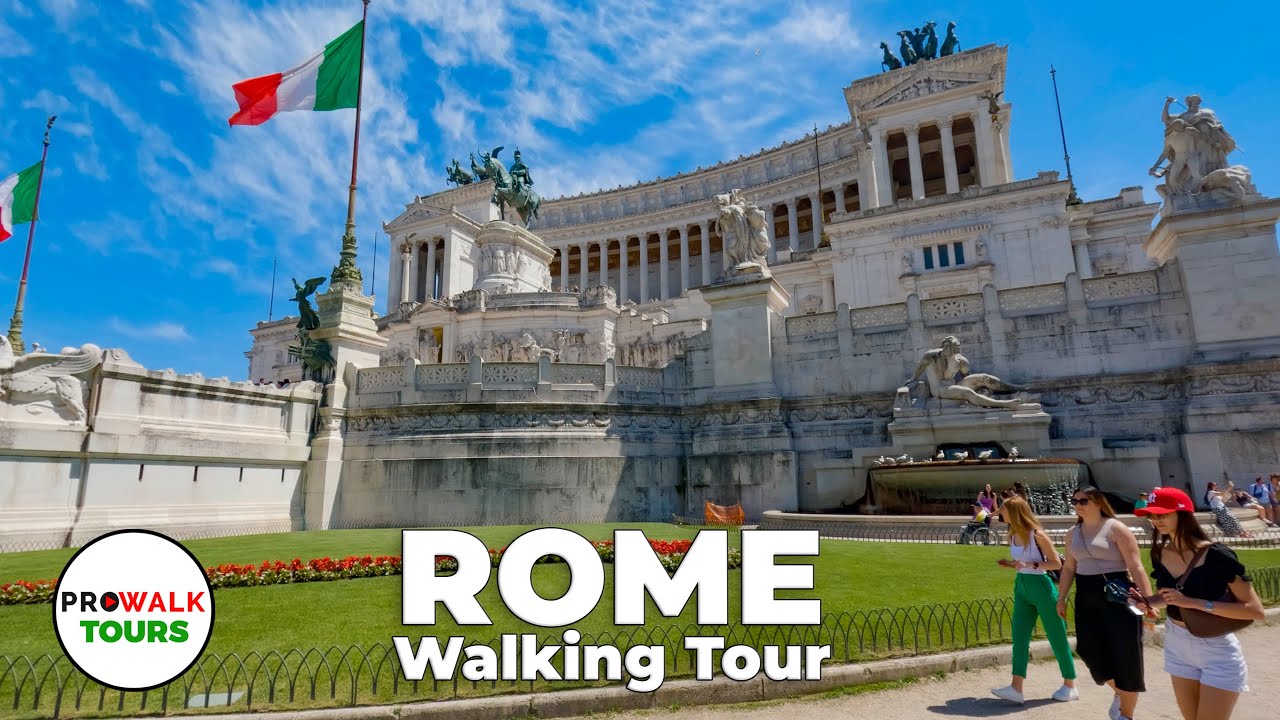
This walking tour of Rome, Italy was filmed on Saturday May 14th starting at 11:10 AM at the Spanish Steps. Click on the link below to see a map of the walk.
🗺️Map of the Walk – https://www.google.com/maps/d/edit?mid=1zzTsqE1ZSlkRA2KBlw5AXWGo9kHsJr0&usp=sharing 🗺️
🔻𝗩𝗶𝗱𝗲𝗼 𝗧𝗶𝗺𝗲𝗹𝗶𝗻𝗲 𝗟𝗶𝗻𝗸𝘀🔻
0:00 Intro and Map
1:25 Spanish Steps
32:11 Trevi Fountain
49:39 Piazza di Pietra
55:18 Pantheon
1:11:00 Church of St. Louis of the French
1:19:51 Piazza Navona
1:32:29 Statua di Pasquino
1:39:36 Campo de’Fiori
1:59:06 Portico of Ocatvia
2:03:48 Teatro Marcello
2:10:43 Capitoline Hill
2:35:20 Altar of the Fatherland
3:01:29 Trajan’s Forum
3:12:55 Forum of Augustus
3:25:33 Basilica dei Santi Cosma e Damiano
3:37:38 Colosseum
================================================================================
🌎Complete List of Walks: http://www.prowalks.com/videos 🌎
📢 𝗣𝗹𝗲𝗮𝘀𝗲 𝗦𝘂𝗯𝘀𝗰𝗿𝗶𝗯𝗲! 📢 – https://www.youtube.com/c/ProWalks?sub_confirmation=1
🔷 Help with a donation! – https://www.paypal.me/Prowalks 🔷
🔶 Support me on Patreon – https://www.patreon.com/Prowalks 🔶
🟥 Become a Member – https://www.youtube.com/channel/UCNzul4dnciIlDg8BAcn5-cQ/join 🟥
👕Merchandise – https://teespring.com/stores/prowalk-tours 👕
================================================================================
🔷THE EQUIPMENT I USE🔷
Amazon Storefront: https://www.amazon.com/shop/prowalktours
🎥Camera1: Gopro Hero 11 https://amzn.to/3ivHgdJ
🎬Gimbal1: INKEE Falcon Plus https://amzn.to/3JWdgzF
🦯Camera Monopod: https://amzn.to/3rFzPCl
🎥Camera2: Sony a7siii:
Camera Lens: https://amzn.to/3UtuZUm
🎬Gimbal2: https://amzn.to/3FsDye5
🎤Microphone: https://amzn.to/3lYW5CI
🎧In-Ear Monitors: https://amzn.to/2DBdS1D
🎦Drone: https://amzn.to/3jYMiuR
For the best viewing experience, be sure to watch on a large smart TV like the Samsung Frame. Closed Captions [CC] which include historical facts and descriptions are available in all languages. This tour was filmed using amazing Binaural Audio 🎧 which is a method of recording sound that uses two microphones, arranged with the intent to create a 3-D stereo sound sensation for the listener of actually being there.
✔️Let’s connect✔️
➤Facebook: https://www.facebook.com/Prowalks
➤Instagram: https://www.instagram.com/prowalktours
➤Twitter: https://twitter.com/ProwalkTours
➤E-mail: travel@prowalks.com
No part of this video may be used for personal or private use without written permission from Prowalk Tours. I will not remove a copyright strike after one has been issued.
#ProwalkTours #Walkingtour #Rome
Welcome to Rome, Italy’s culture-filled capital city! We begin our walk beside the Fontana della Barcaccia designed by Pietro Bernini, father of one of Rome’s most renowned Baroque architects Gian Lorenzo Bernini. The fountain is located in the Piazza di Spagna, so named after the Spanish Embassy located here.
The square is also home to the iconic Spanish Steps, built between 1723 and 1725. The monumental staircase has 135 steps and was funded by French diplomat Étienne Gueffier. The staircase was designed by architects Francesco de Sanctis and Alessandro Specchi.
The stairway links the Spanish Embassy to the Holy See to the Trinità dei Monti church at the top. At the foot of the steps on the left is the apartment where John Keats lived, now the Keats-Shelley Memorial House. In front of the church is the Obelisco Sallustiano, moved here in 1789.
This church and the surrounding area are actually French State property. In this chapel is one of the best known paintings by Daniele da Volterra, a mannerist painter. It depicts the Descent from the Cross and was painted after drawings from Michelangelo.
The Italian Renaissance church was built in 1535 most likely by architect Giacomo della Porta, a follower of Michelangelo. This obelisk is a Roman copy of an Egyptian original.
If you are enjoying this walk so far, please be sure to leave a LIKE on this video or SHARE it with a friend. Thank you. Although tempting after a day’s sightseeing, don’t sit down on the steps as it is forbidden!
Here is the entrance to the Keats–Shelley Memorial House is a writer’s house museum, exhibiting letters, manuscripts and paintings relating to the two writers. This 19th century monument depicts the Blessed Virgin Mary atop a tall column.
Since December 1953, popes have visited the monument annually and placed a bouquet of flowers at the base of the column. The Marian monument was designed by the architect Luigi Poletti. This area is one of the most picturesque in Rome, with elegant ochre palazzi and foliage covered bars.
This 17th century church was built over a previous 1192 building. This was the national church of the Scottish people in Rome, until Scotland became Protestant in the 16th century. The sumptuous decoration of the cupola is by Pasquale Marini.
The two angels either side here are by Gian Lorenzo Bernini and were originally intended for the Ponte Sant’Angelo. However, Pope Clement IX considered them too valuable to be exposed to the elements and replaced them with copies on the bridge.
Churches and monasteries in Rome often have hidden cloisters which make for peaceful spaces to escape from the chaos of the city. The structure of the church was revamped in 1653 by Francesco Borromini, who is responsible for the apse, the tambour of the cupola.
These little newspaper stands are called edicole and are found throughout the squares in Rome. Rome is an intensely populated city with 2,860,009 residents in 1,285 km2. Rome has several nicknames including the City of the Seven Hills and the Eternal City.
Rome is considered to be the cradle of Western civilization and Christian culture, and the centre of the Catholic Church. One of Rome’s most iconic monuments is the Trevi Fountain, built between 1732 and 1762. The famed fountain was designed by Italian architect Nicola Salvi and completed by Giuseppe Pannini.
The church of Santi Vincenzo e Anastasio is a Baroque structure built between 1646 to 1650. This is probably one of Rome’s most overlooked monuments given its location beside the Trevi Fountain. The church houses the embalmed hearts of 22 popes.
The Trevi Fountain’s dramatic sculptural scene enacts the Taming of the Waters with Oceanus in the center flanked by tritons. It is common practice to throw a coin into the Trevi Fountain as legend says this means you will return to Rome one day.
Roughly 3,000 euros are tossed into the fountain each day. The coins are collected periodically and used to fund a supermarket for Rome’s poor. The fountain features in an iconic scene in Federico Fellini’s film, La Dolce Vita, when the beautiful Sylvia wades into the waters.
It is now forbidden to take a dip in the fountain but each year sees tourists try to break the rules. Roasted chestnuts are a common streetside snack in Rome. Rome is packed with tourists especially in summer, drawing around around 10 million visitors a year.
The historic center of Rome is a designated UNESCO World Heritage Site. We are now on the Via del Corso, a wide, straight street that runs 1,5 km through the historic center of the city.
In the center of this square is the marble Column of Marcus Aurelius, which has stood here since 193 AD. It is a victory column with reliefs that tell the story of Marcus Aurelius’ Danubian or Marcomannic wars, waged by him from 166 to his death.
As the nickname “Eternal City” suggests, Rome has a long history. In fact, it spans 28 centuries. Rome has been inhabited for nearly three millennia making it one of the oldest continuously inhabited cities in Europe. This narrow street is popular for its al fresco dining options.
In 145 AD, this temple was dedicated to emperor Hadrian by his adoptive son and successor Antoninus Pius. Only one side of the temple remains with eleven columns surviving, which have been incorporated into a later building.
The square’s name, which translates as “Piazza of Stone”, refers to the use of the temple’s stones to construct the space. The first residents of Rome were a combination of Latins, Etruscans and Sabines. The earliest archeological discoveries in Rome date from around 14,000 years ago.
Archeologists have found stone tools, pottery and weapons dating from the Paleolithic and Neolithic eras. The Pantheon is one of the best preserved Roman buildings in the city, mainly because it was never abandoned.
The Pantheon, whose name means “of all the gods”, was once a Roman temple and was built in 113–125 AD. The Pantheon was built by Emperor Hadrian on the site of an older temple that had burnt down.
At the moment it is free to visit the Pantheon but the city is soon introducing an entrance fee. The portico features giant granite Corinthian columns and a large pediment and behind is the rotunda, a circular structure with a massive coffered concrete dome.
Since 609, it has been a Catholic church, known as the Basilica di Santa Maria ad Martyres or Basilica of St. Mary and the Martyrs. Incredibly, the Pantheon’s dome is still the world’s largest unreinforced concrete dome, despite dating from nearly 2,000 years ago.
The name of this square derives from a temple that was once located here built by Pompey and dedicated to the Roman goddess Minerva (although other sources say it was dedicated to the Egyptian goddess Isis). The central monument is an elephant and obelisk by Baroque sculptor Gian Lorenzo Bernini dating from 1667.
The obelisk, which may have been brought to that location to be placed in the temple, was discovered during excavations in the area in 1665. This church was built in the 13th century and contains a sculpture of Christ the Redeemer by Michelangelo.
This obelisk is one of 13 ancient obelisks that can be found in the city. In the center of the Pantheon’s dome there is an oculus, a circular opening to the sky that is the only natural source of light along with the entrance door.
The height from the floor to the oculus and the diameter of the interior circle at the base of the dome are the same: 43 metres, The Pantheon is visited by other 6 million people a year. Two kings of Italy are buried in the Pantheon: Vittorio Emanuele II and Umberto I.
This monumental church built in the 16th century for the French community in the city. The exterior of the church was designed by Giacomo della Porta between 1518 and 1589. The church is dedicated to the patron saints of France: Virgin Mary, Dionysius the Areopagite and King Louis IX of France.
The interior is decorated with frescoes and paintings celebrating French saints including Saint Louis IX, Saint Denis and Clovis. This is the Contarelli Chapel containing a cycle of paintings by the Baroque master Caravaggio. The paintings date from in 1599 to 1600 and tell the stories of the life of St. Matthew.
The three famed canvases are The Calling of St Matthew (on the left wall), The Inspiration of Saint Matthew (above the altar), and The Martyrdom of Saint Matthew (on the right wall). The church also houses paintings by Francesco Bassano il Giovane, Jacopino del Conte, Tibaldi and Antoine Derizet.
Historians believe that the city of Rome developed from the merging of multiple small villages located around one larger one on the Palatine Hill. This is thought to have happened around the middle of the 8th century BC.
Piazza Navona is one of the most famous squares in the city and home to grand palaces and important works of sculpture. It is a popular place to eat al fresco, particularly at night which it is very atmospheric, but be prepared for a pricey meal!
At the northern end of the square is the Fountain of Neptune designed in 1574 by Giacomo della Porta. The oval layout of the square derives from the fact that it was built on the site of the Stadium of Domitian, dating from the 1st century AD.
In the center of the square is Gian Lorenzo Bernini’s Fountain of the Four Rivers, designed in 1651. The fountain supports a copy of an Egyptian obelisk. Around the base of the fountain are representations of the four rivers gods of the Nile, the Danube, the Ganges and the Río de la Plata.
These rivers flow through four different continents, representing the papal authority that also spread through Africa, Europe, Asia and the Americas. The head of the Nile river god is covered with a cloth symbolizing the fact that at that time the source of the river was unknown.
The fountain was commissioned by Pope Innocent X of the Pamphili family. The obelisk is topped with a dove, the symbol of the Pamphili family.
On the left is the Rio de la Plata river god who has one arm raised as though shielding his eyes from the sight of the church before him.
Tour guides commonly say this was a sly joke by Bernini because the Sant’Agnese church directly in front was worked on by his rival Francesco Borromini. In fact, the fountain was completed a few years before Borromini even began working on the church. The central figure of this fountain represents a Moor.
It was possibly meant to be Neptune originally as the figure stands in a conch shell, wrestling with a dolphin and accompanied by four tritons. The fountain dates from 1575 but the Moor was added In 1653 by Bernini.
This square is named after this Pasquino statue, Hellenistic in style and likely dating to the third century BC. The statue was dug up in the 15th century in the area.
It is known as a talking statue, because once citizens used to attach anonymous notes to the base with satirical poems that often criticized the pope or his government. On the left you can see the Palazzo Pamphili built between 1644 and 1650 by Girolamo Rainaldi.
Beside it is the 17th-century church of Sant’Agnese in Agone. The founding myth of Rome is the tale of two brothers, Romulus and Remus. Romulus and Remus were twins who, according to legend, were raised by a she-wolf.
The brothers decided to found a city, but an argument ensued and Romulus killed Remus and gave the city his name. The name of this square translates as “field of flowers” and refers to the period of the Middle Ages when the area was a meadow.
The area was not developed at the time as it was prone to flooding from the Tiber river that runs through the city. In the 15th century, the area began to be developed and buildings grew up organically around the square.
It has always been an important commercial hub as evidenced by the street names in the surrounding area. In the center of the square is a statue of Giordano Bruno, a Dominican friar and philosopher who was burnt at the stake for heresy.
The streets around the square bear the names of trades such as Via dei Cappellari (hat-makers), Via dei Chiavari (key-makers) and Via dei Giubbonari (tailors) The Farnese Palace is one of the most important High Renaissance palaces in Rome.
Its construction involved some of the leading Italian architects of the 16th century, including Michelangelo, Jacopo Barozzi da Vignola and Giacomo della Porta. It is now the French embassy. Campo dei Fiori is also famous for its daily vegetable and fish market that has been held here since 1869.
The market used to be held in Piazza Navona, where we were just before. After the founding of Rome (legendary or otherwise), the city was ruled for 244 years under a monarchical system. The first rulers of Rome were of Latin and Sabine origin, and then Etruscan kings took over.
In 509 BC, the Romans freed themselves of sovereign rule and set up an oligarchic republic. This initiated a period of infighting between patricians and plebeians, or small landowners, as well as continual struggle against other populations of central Italy such as the Etruscans, Latins and Aequi.
This square is named after the famous Italian statesman Benedetto Cairoli. In the center is a peaceful leafy garden, a nice place to take a break from sightseeing. In the 2nd and 3rd century BC, Rome triumphed in the Mediterranean and Balkans during the three Punic Wars and the three Macedonian Wars.
This led to the establishment of the first Roman provinces including Sicily, Sardinia and Macedonia. The 2nd and 1st century BC were also characterized by internal warfare as two rival groups struggled for power, the optimates, supporters of the Senate, and the populares, who fought the cause of the plebeians.
During the 1st century BC, there was a civil war between two Roman generals, Gaius Marius and Sulla, and then a major slave uprising led by gladiator Spartacus. After conquering Gaul, a large area of Western Europe, Julius Caesar became extremely powerful and popular.
As a result, a second civil war ensued during which Caesar came out victorious and declared himself dictator for life in 44 BC. The Porticus Octaviae was built by Augustus in the name of his sister, Octavia Minor, sometime after 27 BC.
This quadriportico was built to replace the previous structure, the Portico Metellus, which enclosed the Temples of Juno and Jupiter. The entire complex included a library, a school and a curia, or meeting house. A fire in 80 AD destroyed portico and another fire in 203 damaged much of the complex.
It was partially restored after the fire by Emperor Septimius Severus and his son, Emperor Caracalla. Though some of the portico was destroyed during an earthquake in 442, what remains today is primarily the work of Severus and Caracalla.
Three centuries after the earthquake, in 770, the church of Sant’Angelo in Pescheria was built into the ruins of the portico. The structure was used as a fish market from the medieval period up to the end of 19th century.
The Teatro Marcello is the remains of an ancient open air theater from the last years of the Roman Republic. The theater was the largest and most important in Ancient Rome and could originally hold between 11,000 and 20,000 spectators.
The theater is the earliest dateable building in Rome to make use of fired Roman brick. The exterior was covered in travetine and decorated with columns of varying orders. In the 4th century the theater was abandoned and stones reused for other buildings.
On March 15, Julius Caesar was assassinated by a group of senators. After Caesar’s assassination, a second Triumvirate was established between Octavian (Caesar’s grandnephew and heir), Mark Antony and Lepidus. But this led to another civil war, the last of the Roman Republic, between Octavian and Antony.
This sacred staircase leads from Piazza Venezia up to the church of Santa Maria in Ara Coeli. The basilica is located high on the Campidoglio hill. Just next door you can see the Piazza del Campidoglio.
The church houses a shrine with the relics of Helena, mother of Emperor Constantine, various minor relics from the Holy Sepulchre. This is a wide promenade providing a dramatic entrance to the square above, both designed by Michelangelo. It has very shallow steps so that it can be used both by people and horses.
The two statues at the top are of Castor and Pollux. This square sits on the Capitoline Hill on which there were once several important Roman temples. In the Middle Ages, the square began to develop a civic function which was then accentuated by Michelangelo’s design.
Michelangelo’s remodeling of the piazza took place in 1536–1546 for the Farnese Pope Paul III. This terrace is named for Palazzo Caffarelli which now houses the Capitoline museums. From here you have a splendid view over the rooftops of Rome and of the Theater of Marcellus.
From the other direction you can see the Basilica of Santa Maria in Ara Coeli and the Altar of the Fatherland. The monumental building opposite the cordonata is the Palazzo Senatorio. Two giant river gods each holding a cornucopia decorate the staircase in front.
The Roman Forum was the hub of daily life in ancient Rome, home to government buildings, a market place and temples. Archeological excavations allow us to see the remains of several of these important buildings such as the Temple of Vesta and the Arch of Septimius Severus.
The pavement of the square is decorated with a design of interweaving ovals and diamonds as a twist on the earlier Renaissance focus on the circle and square. The river god statues are ancient and represent the Nile and the Tiber. They were discovered in the Baths of Constantine and moved here in 1518.
This statue is known as the Capitoline Wolf and it represents the she-wolf suckling Romulus and Remus. The Arch of Septimius Severus is a triumphal arch dedicated in 203 A.D. The statue in the center is of Marcus Aurelius and is an ancient Roman equestrian statue.
At the bottom of the steps are two Egyptian lion statues. These are the remains of a medieval church which were discovered in 1928 while the road was being constructed. Also known as the Altar of the Fatherland, this national monument was built between 1885 and 1935.
It was built to honor Victor Emmanuel II, the first king of a unified Italy. It was inspired by classic structures include the forum and porticos with colonnades. It also houses the shrine of the Italian Unknown Soldier.
The monument was designed by Giuseppe Sacconi and is considered one of the national symbols of Italy. Presiding over the lower level is an equestrian sculpture of Victor Emmanuel II. The structure was intended as a lay temple enshrining a free and united Italy.
The monument stands in the heart of ancient Rome with roads radiating out from the square before it. In the base of the monument there is a museum of Italian unification. The external staircases have 243 steps. Either side of the wide colonnade at the top are two imposing propylaea.
One is dedicated to the “unity of the homeland”, and the other to the “freedom of the citizens.” The whole structure is 135 m wide, 130 m deep, and 70 m high. The monument occupies a total area of 17,550 m2. The monument has multiple terraces that afford magnificent views over Rome.
From here you can see the ancient ruins of Trajan’s market and Trajan’s column. There is a sunny if a little pricey bar on the terrace. In 2007 a lift was added to the structure, allowing visitors to access the roof for 360-degree views of Rome.
From here you can see the quadrigas up close with Victory riding the chariot. This terrace, the highest of the monument, can also be reached via 196 steps that start from the portico. A twin quadriga surmounts the other propylaea.
The monument is also known as the Altar of the Fatherland because it houses the first an altar of the goddess Rome. With the quadrigaa and Winged Victorys included, the height of the monument reaches 81 m. The sculptural decoration of the monument is rich in allegory often of virtues or personifications.
The process of unification was long and complicated so Victor Emmanuel II is known by Italians as the Father of the Fatherland. The monumental structure is a celebration both of Victor Emmanuel II’s achievement and of victorious Italy. The interior is filled with statues and architectural decoration referencing the might of ancient Rome.
Architect Giuseppe Sacconi was inspired by neoclassical architecture and added Italic elements. Each year, important national celebrations like Liberation Day and Republic Day are held here. During national celebrations, the President of the Italian Republic pays tribute to the Italian Unknown Soldier and those who died fighting for their country by laying a laurel wreath.
These are the remains of the Athenaeum, a school founded by the Emperor Hadrian. Trajan’s column commemorates Roman emperor Trajan’s victory in the Dacian Wars. It was completed in 113 AD and is decorated with a spiraling bas relief.
Next to it are the remains of Trajan’s Forum, the last of the Imperial fora to be constructed in ancient Rome. The forum was built using the spoils of war from the conquest of Dacia, which ended in 106. To construct the monumental forum, over 300,000 cubic meters of soil and rock were excavated.
The last of ancient Rome’s civil wars lasted from 32–30 BC and saw Octavian declare war on the Egyptian queen Cleopatra and her lover and supporter Antony. When Cleopatra and Antony sought refuge in Alexandria, Octavian besieged the city forcing the lovers to commit suicide.
In 27 BC, Octavian became ruler of the Roman Empire, despite him offering to retire from politics. In fact, the Senate asked him to remain as leader and awarded him the prestigious title of Augustus. Before us is Trajan’s market, thought to be the world’s oldest shopping mall.
It was likely built in 100–110 AD by architect Apollodorus of Damascus. The multi-level structure probably housed offices and apartments as well as shops. Augustu is regarded as the first Roman emperor and he was in power from 27 BC until his death in 14 AD.
Here is a statue of Augustus who created the Roman Principate, which was the first phase of the Roman Empire, leading to his reputation as one of the most effective leaders in history. Under Augustus, Rome enjoyed a period largely free of war or conflict known as the Pax Romana.
The the Forum of Augustus was inaugurated in 2 BC incomplete. Augustus had vowed to build a temple honoring Mars, the Roman God of War, during the battle of Philippi in 42 BC. Augustus planned to built a temple “greater than any in existence.”
Tiberius, the adoptive son of Augustus, became the second Emperor of the Roman Empire in 14 AD. Caligula became the third Emperor of Rome and his rule is portrayed as cruel and tyrannical. He is notorious for his life of spectacularly wasteful spending, incestuous relationships and terrible acts of cruelty and violence.
After the rule of Claudius, the fourth Roman emperor, another infamous ruler took power. Emperor Nero is also renowned for a rule of great extravagance, cruelty and debauchery. Under his reign, Christians were persecuted. In the forum of Nerva, one pair of columns survives in an ornate Corinthian style.
This forum was the penultimate to be built and the smallest. The ancient remains of the fora have inspired artists and architects for decades. Views of the fora appear famously in the etchings of Italian artist Giovanni Battista Piranesi and in the paintings of British artist J.M.W. Turner.
Architects of Britain’s neoclassical era studied, measured and drew precise records of these monuments to inspire their designs. Serious excavation and clearing of the Roman Forum began in 1803 headed by archeologist Carlo Fea. This basilica was built into the Roman Forum and uses some Roman buildings.
The cloister was added in 1632 by Pope Urban VIII. The most ancient part of the church is this round structure which was probably built in the 4th century as a Roman temple. These mosaics date from the early Christian period but are heavily restored. The structure became a church in 527.
The main building may have once been the library of an imperial forum. The basilica devoted to two Arabian Christian brothers and saints, Cosmas and Damian. Much of the Baroque interior decoration you see now dates from the 1632 renovation.
During emperor Nero’s reign, two thirds of the city were destroyed by the Great Fire of Rome. It happened in July 64 AD, beginning in the area around the chariot stadium called the Circus Maximus on July 19th.
The fire was brought under control after six days, but then reignited and continued its destruction for a further three days. Roman historian Tacitus reports that Nero blamed the fire on the Christian community thus sparking the first religious persecutions.
The 3rd century AD marked the beginning of a period of struggle and crisis for the Roman Empire. There were political problems as well as the threat of barbarian invasions. In the year 273, Emperor Aurelian finished his project to surround the city with protective walls, known as the Aurelian walls.
Under Emperor Diocletian in the 3rd century, Rome lost its position as the capital of the Empire and it was moved to Constantinople. Diocletian was also responsible for the last major persecution of Christians, however, Christianity had become so widespread that it was too difficult to subdue.
N 313, the Edict of Milan brought in an official policy of tolerance towards Christians. The Colosseum is Rome’s most famous ancient monument and a symbol of the city. It was the biggest ancient amphitheater ever built and would have hosted magnificent spectacles like gladiator fights, mock sea battles and mythological dramas.
Construction began under the emperor Vespasian in 72 AD and was completed in 80 AD under his successor and heir, Titus. It is honored as one of the New Seven Wonders of the World. This triumphal arch commemorates the Parthian victories of Emperor Septimius Severus and his two sons, Caracalla and Geta.
Constantine I was the first Christian emperor of the Roman Empire and ruled between 324 and 337. In 380, emperor Theodosius I declared Christianity the official religion of the Empire. 396 AD saw the separation of the Western and Eastern Roman Empire.
The seat of government in the Western Roman Empire was then moved to Ravenna. In 410, Rome was sacked by the Visigoths led by Alaric I. Although most of the architecture remained intact or could be easily repaired, many precious artworks and other objects were looted.
The city was then sacked again in 455, this time by Genseric, king of the Vandals. On August 22nd 476, Romulus Augustus was deposed, marking the end of the Western Roman Empire. Rome is the second most visited city in Europe by tourists thanks to its archeological and artistic significance.
The Colosseum draws 4 million tourists and the Vatican museums 4.2 million.
21 Comments
Can I ask what you use to stabilize the image?
MAsHaLLaH ❤️ JaRsHaM ITALY 🇮🇹 na love you ITALY 🇮🇹 MAsHaLLaH ❤️
Spettacolo Beautiful Rome❤❤❤
This was one of your best videos. Thank you very much. May i make a suggestion, please? If you walk the City, can you add the street names, please? Or just show the names on the cornerstones of the buildings, maybe. That way, one can follow your footsteps when we go to Rome self….
#Italy #statue #walking #rome #architecture #historical
Completed 4
Without Athens and the rest of Greece earth is nothing…Rome is the daughter of Athens…beautiful Rome!
THE CITY MORE BEAUTIFUL OF THE WORLD
litigate in babylon
MARAVILHOSO! Agradecida e parabéns. De Porto Alegre/ Brasil >uma caminhada encantadora
o roma roma
Muy bonito, pero no vale la pena usar audífonos con el ensordecedor murmullo de la gente.
Love from Bangladesh 🇧🇩🇧🇩🇧🇩🇧🇩🥀💕
Thank You for posting this incredible video of the eternal city. Love the crisp focus.
Questions:
1. What gear do you use?
2. Do you hold the camera or is it fastened somehow to your body?
3. Are there ever people reacting negatively to you filming them?
4k?
Roma diceva Catullo c'è forse città al mondo più bella e più grande di te tu sei la Caput Mundi l'Urbe Condita la Città Eterna.
This is wonderful😍thank you so much! What a lovely visit♥️
Thanks a lot! I've learned a lot from your sub-titles. Did you use the gimbal with your gopro and if so did you disable its stabilization? Thanks again.
We are going on an 8hr( too short just coming off a cruise) excursion there this coming May 3rd, 2024. I am assuming the temp would be almost the same as this May 14th video. Any advice would be very appreciated! Thanks!
Nessuno parla? Che peccato!
Great walking tour. You showed many things that we didn't see before. My partner has been to Rome more than few times, but me only once. We will definitely go back again. Thankyou 😊
Kudos Rome