
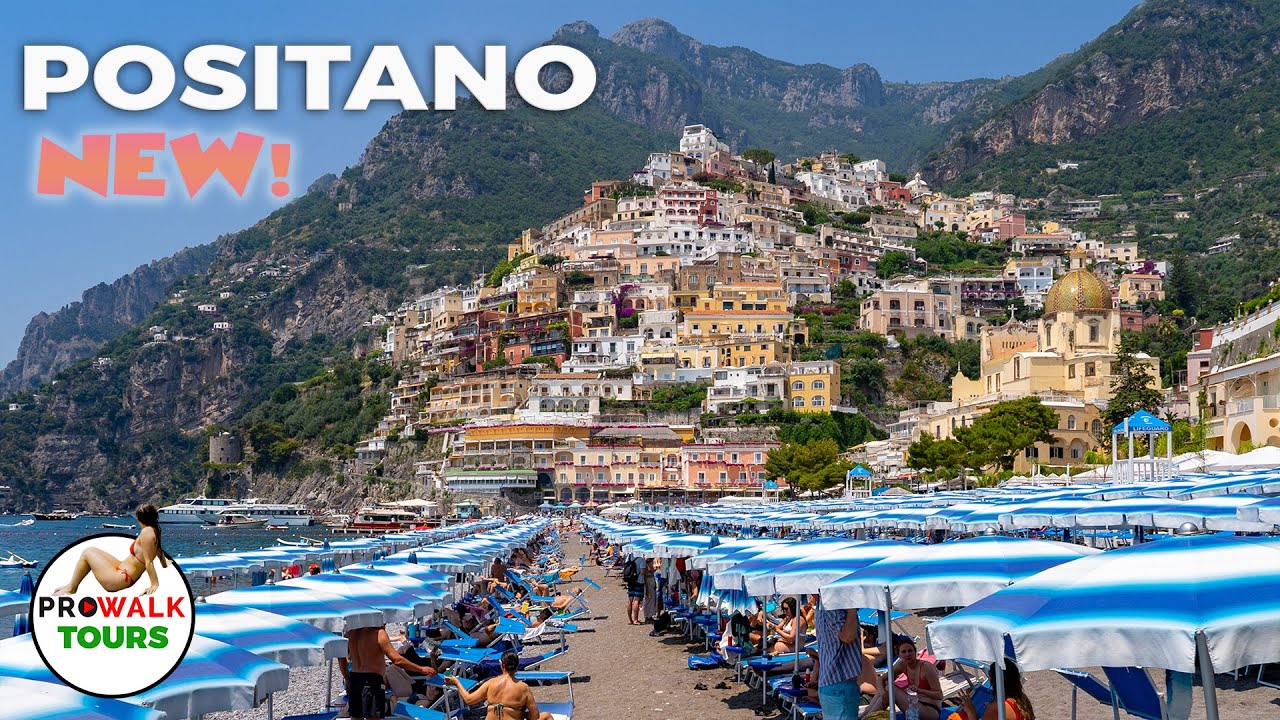
This walking tour of Positano, Italy on the Amalfi Coast was filmed on Friday July 21st, 2022 starting at 10:42 at the top of the Positano Pyramid next to the Chiesa Nuova.
🗺️Map of the Walk – https://www.google.com/maps/d/edit?mid=1OV9RYFZhRAnPPkWQdDKVWkQ5XHIn9Io&usp=sharing 🗺️
For the best viewing experience, be sure to watch on a large smart TV like the Samsung Frame. Closed Captions [CC] which include historical facts and descriptions are available in all languages. This tour was filmed using amazing Binaural Audio 🎧 which is a method of recording sound that uses two microphones, arranged with the intent to create a 3-D stereo sound sensation for the listener of actually being there.
================================================================================
🌎Complete List of Walks: https://www.prowalks.com/videos 🌎
📢 𝗣𝗹𝗲𝗮𝘀𝗲 𝗦𝘂𝗯𝘀𝗰𝗿𝗶𝗯𝗲! 📢 – https://www.youtube.com/c/ProWalks?sub_confirmation=1
🔷 Help with a donation! – https://www.paypal.me/Prowalks 🔷
🔶 Support me on Patreon – https://www.patreon.com/Prowalks 🔶
🟥 Become a Member – https://www.youtube.com/channel/UCNzul4dnciIlDg8BAcn5-cQ/join 🟥
👕Merchandise – https://teespring.com/stores/prowalk-tours 👕
================================================================================
🔻𝗩𝗶𝗱𝗲𝗼 𝗧𝗶𝗺𝗲𝗹𝗶𝗻𝗲 𝗟𝗶𝗻𝗸𝘀🔻
0:00 Intro and Map
1:03 Chiesa Nuova
5:02 Scenic Lookout
7:57 Via Pasitea
21:19 Via Fornillo Viewpoint
48:31 Piazza dei Mulini
49:19 Chiesa Santa Maria del Rosario
51:32 Via dei Mulini
1:00:42 Piazza Flavio Gioia
1:01:52 Chiesa di Santa Maria Assunta
1:19:27 Shopping Street
1:22:31 The Beach (Spiaggia Grande)
1:35:45 Ferry Port
1:45:07 Beach Walk
1:56:24 Path to Fornillo
2:03:48 Fornillo Spiaggia
2:18:54 Path to Positano
2:25:00 Spiaggia Grande
2:29:11 Path up to the road
🔷THE EQUIPMENT I USE🔷
Amazon Storefront: https://www.amazon.com/shop/prowalktours
🎥Camera: Sony a7siii:
Camera Lens: https://amzn.to/3UtuZUm
🎬Gimbal: https://amzn.to/3FsDye5
🎤Microphone: https://amzn.to/3lYW5CI
🎧In-Ear Monitors: https://amzn.to/2DBdS1D
🎦Drone: https://amzn.to/3jYMiuR
✔️Let’s connect✔️
➤Facebook: https://www.facebook.com/Prowalks
➤Instagram: https://www.instagram.com/prowalktours
➤Twitter: https://twitter.com/ProwalkTours
➤E-mail: travel@prowalks.com
No part of this video may be used for personal or private use without written permission from Prowalk Tours. I will not remove a copyright strike after one has been issued.
#ProwalkTours #Walkingtour #Positano
Welcome to Positano, located on the Amalfi Coast in the Campania region of southern Italy. A “comune” is the third level of the administrative division of Italy, after regions (regioni) and provinces (province). A comune can also have the title of città (‘city’).
We are now near the peak of what is known as the “Positano Pyramid,” which can be seen in whole from the beach below. Positano, as we know it today, began as a small fishing village and is now one the most popular and romantic tourist destinations in Europe.
The road below, known as the Amalfi Drive, splits in two here at this spot in Positano. The road ahead, Viale Pastiea, is a one-way which leads down to the base of the Pyramid.
This tour ends at the spot where the Amalfi Drive meets back up with Viale Pasitea at the edge of town further down the coast. See the bend in the road below? From there, you can walk down steps to the Fornillo beach below.
From here you can see the Amalfi Drive that leads into town. We are going to walk down Viale Pasitea to the beach at the base of the Pyramid, and then walk a path over to Fornillo Beach.
I really love these Ape 50s! I meant to buy one while I was living here in Italy but I never did. This one looks amazing!
A map of this walk can be seen by clicking on the link in the video description below. The map includes the same titles as seen in the video. This road, Viale Pasitea, is named after a nymph from Greek mythology. According to legend, the god Poseidon gave this land to Pasitea.
This small statue is of the Reverend Charles Thomas Underwood (1922-1985), a Christian minister from Kentucky. Positano is also known as “The Vertical City” as it begins high up in the hills and continues down the steep mountains to the coastline.
We will take the road most of the way down, but there are also stairs to the bottom which can be a faster way of reaching the beach. Positano become popular with tourists in the 1950s after author John Steinbeck wrote a piece about it for Harper’s Bazaar.
We will arrive at the beach in an hour and ten minutes, but don’t skip ahead. The walk down is pretty amazing too! The steps down to the beach continue here.
While the true origin of the name Positano is unknown, according to one legend, it was named after Poseidon, God of the Sea. It is believed that the Greeks first visited this area around 500 BC.
By 100 BC the Romans had settled here and they built many grand villas, one of which can still be seen below the church of Santa Maria Assunta. When Mt. Vesuvius erupted in 79AD, it not only buried Pompeii but it also destroyed the villas all along the Amalfi Coast.
The Benedictine Friars arrived here around 800 AD and formed their own independent community. Parking is limited here in Positano but there a few parking garages like this one. Parking is around €8 per hour. There goes my favorite Ape 50!
Up ahead is one of Positano’s permanent nativity scenes located in one of the Fornillo Caves. Its position gives it a unique charm as it runs along the road where it can be seen by all the passersby. This is the bend in the road we saw earlier from the scenic lookout.
The path leads down to the Fornillo Beach. I’ve actually never walked down from here. You can see the dome and bell tower of the church where we started this walk in the upper right.
Some people think of Positano as a tourist trap that should be avoided, but I think it is one of the most beautiful places on earth. There are a lot tourists here though and most arrive by ferry from Salerno, Amalfi and Positano.
Positano is also popular with locals as well. Most of the people at the beach are Italians. Many buildings here have covered domes of sand on their rooftops which act as insulation.
The town of Positano was officially founded in the 9th century AD, and it quickly became an important center for trade and commerce, thanks to its strategic location on the coast. During the Middle Ages, Positano was a prosperous town, with a thriving fishing and boat-building industry.
In 1131 AD, the Normans attacked nearby Amalfi and destroyed its naval forces. As a result, Positano’s own naval forces expanded which attracted some unwanted attention. These steps are another shortcut down to the beach.
In 1137, both Amalfi and Positano were attacked and defeated by the naval forces of Pisa. Not long after in 1343, a tidal wave nearly destroyed what was left of Positano. In time, trade with the Middle East turned Positano into a wealthy market port.
From the beach below, this café up ahead appears to be near the top of the Positano Pyramid. Positano faced continued hardships as the small town was frequently raided by pirates. The 18th century marked a period of economic independence for Positano.
It was during this time that many of the colorful houses with large terraces looking over the sea were built. However, in the 19th century, the town’s economy declined, and many of its residents emigrated to other parts of Italy or to other countries.
Between 1820 and 1978, 5.3 million Italians immigrated to the United States, including over two million between 1900 and 1910.
New York City has the largest population of Italian Americans in the United States of America as well as North America, many of whom inhabit ethnic enclaves in Brooklyn, the Bronx, Manhattan, Queens, and Staten Island.
Like the influx of Irish immigrants escaping the potato famine in the 1840s, the masses of Italians arriving in America were fleeing hardships at home. Italy came under one flag in 1861, but that did not mean that the land and Italian people were unified.
Decades of internal strife had left a legacy of violence, social chaos, and widespread poverty. The peasants in the primarily poor, mostly rural south of Italy and on the island of Sicily had little hope of improving their lot.
Diseases and natural disasters swept through the new nation, but its fledgling government was in no condition to bring aid to the people. As transatlantic transportation became more affordable, and as word of American prosperity came via returning immigrants and U.S. recruiters, Italians found it increasingly difficult to resist the call of “L’America”.
During WWI, the town did not fare well and many of the inhabitants were lost during the conflict. Today, Positano has a population of around 3,700 residents and tourism is the town’s main industry.
Positano has served as the backdrop for several Hollywood films including Only You, Under the Tuscan Sun and The Talented Mr. Ripley. From July 1967 and through most of the 1970s, Positano was home to singer-songwriter Shawn Phillips and where most of his best-known work was composed.
Here on the right is the last parking garage before leaving town. We are now at what can be considered the center of town. On our right is the Church of Maria SS. del Rosario, an ancient Dominican monastery, founded in 1614.
The church was suppressed in 1652 by Pope Clement X due to the limited number of friars and the state it was in. So the church, stripped of most of its treasures, was transformed into a court. Later, returned to worship, it became the seat of the congregation of the SS. Rosary.
Following the collapse of the Sacristy due to the 1980 earthquake, the Church was once again forbidden to worship and finally reopened in 2006. This path, Via dei Mulini, is the main road through the town that leads down to the beach.
It is a pleasure to stroll and browse in all the art galleries, boutiques and various shops. These steps ahead lead back up the main road. Here at the Sapori E Profumi Di Positano you can find lemon everything, candles, chocolate, perfume, shower gel, candy and of course limoncello.
The next set of steps on our left lead up to a small grocery store where you can buy food at a good price. This is the Hotel Palazzo Murat and right here we are walking into their lounge bar, Le Petit Murat.
If you want to stay here, be sure to book months in advance. Three nights in their Sea View Presidential Suite costs about $8,500. The average cost per night at a hotel here in Positano is around $550 for two adults.
Don’t let that discourage you! You can still visit Positano without emptying your bank account. The city of Salerno is located about 25 miles away at the end of the Amalfi Coast and there the average cost of a hotel is only $107 per night!
So here is what you do. Fly into Naples and catch the Ali bus right outside the airport exit. The airport is small and the bus is easy to find. The Ali bus only makes three stops, Airport, Train Station and Ferry Station.
Take the bus to the train station. It will take you about 20 minutes to get from the airport to the train station. Then, catch the next train to your hotel in Salerno. The trip takes about 35 minutes.
Drop off your suitcases at the hotel and walk down to the ferry terminal and from there, you can take a 1 hour ferry to Positano. It’s very easy. You can do it! After visiting Positano, the next day you can easily visit Amalfi and Atrani.
The following day, take the train into Naples and spend the day there. The day after that, take a ferry from Salerno to Capri. It only takes about an hour and 45 minutes.
The next day, take a train to Pompeii. The train ride takes about 35 minutes and it drops you off at the entrance gate. But wait! There’s more! You still need to visit Ischia, Procida, Sorrento, Herculaneum, Pozzuoli, Capua, Mt. Vesuvius, and the Caserta Palace!
These places are all easily accessible by train or ferry, and you can do it all from your hotel in Salerno. If you have any questions, just let me know and I’ll try to help. This church was originally built in the 7th-century but has undergone numerous transformations over the centuries.
In the 12th century, a pirate ship was sailing nearby carrying plunder, including a painting known as the Black Madonna. According to legend, the pirate ship was on the verge of sinking but the painting cried out “Posa, posa” meaning lay me down.
The ship made it safely in to the harbor and the Saracen pirates, who were in awe of what they had just witnessed, all became Christians. Some locals believe the town took its name, Positano, from the words “posa, posa.”
The Black Madonna now hangs above the altar of the church. The bell tower was built in 1707 and hanging above the door is a Romanesque relief scavenged from the original church.
The shop at the bottom of these stairs is called Ceramica Assunta. They produce and sell handmade pottery that is typical of the Amalfi Coast. Since 1948 they’ve been producing and selling handmade pottery objects in Positano in three beautiful stores in the heart of the city center.
Do you remember the shortcut down to the beach that I mentioned earlier? This is where the end. We are going to walk up just a ways to get a nice view of the church.
The last time I was here filming a walk, I parked at the first parking garage we saw on the walk down. I didn’t want to pay for another hour of parking so I ran up these steps with my gear.
It only took me about 10 minutes to get back to my car from here…walking as fast as I could. I often get asked about what is my favorite place I’ve been to on my travels.
It is hard to choose, but Positano is probably my favorite city to visit..after Naples of course. My family and I would come here often just to go swimming for the day.
We only lived about 50 miles away so were able to come here anytime we wanted which meant we could easily avoid peak tourist season. The best time to visit Italy is either in June or September. The weather is great and it outside the peak tourist season.
If you must travel during summer, go in July. Avoid August is you can! Not only is August Italy’s hottest month, it is also when Italians go on their summer vacation, which means a lot of businesses are closed. Positano was a relatively poor fishing village during the first half of the twentieth century.
It began to attract large number of tourists in the 1950s, especially after John Steinbeck published his essay about Positano in Harper’s Bazaar in May, 1953. “Positano bites deep”, Steinbeck wrote. “It is a dream place that isn’t quite real when you are there and becomes beckoningly real after you have gone.
The town’s rapid growth from a small fishing village to an international destination is credited to the rise of the tourism industry. This is the “Positano Pyramid.” This narrow section of beach without umbrellas is the “spiaggia libera” or free beach of Positano.
This is where we always eat when we visit Positano, but we sit in back at some tables near where the pizza is cooked. Beach chairs usually cost around €25 each, while the front row chairs are €30. Umbrellas cost extra, but they are worth it.
This is the La Caravella Hotel and apartments. Rooms start at around $455 per night. Apartments start at about $1,000 per night. We will follow this path, Via del Brigantino, to the end of the beach and back.
The path to our right leads right back to that small piazza where the steps lead down from the hilltop. This path leads down to the ferry terminal. The ferry from Salerno also makes stops at Cetara, Maiori, Minori, Amalfi and then finally Positano.
From Positano, you can take a ferry to Sorrento, Castellamare di Stabia, the island of Ischia or the island of Capri. If you want to go to Naples, it would be faster to take the train from Salerno.
From Naples you can take a fast train to Rome and be there in less than 1 hour. This ferrry, the PositanoJet, goes to Capri. The journey time varies between 30 and 50 minutes.
The nice thing about getting your hotel in Salerno is that you can visit all these places without dragging your giant suitcase with you. You can also take a bus between towns here on the Amalfi Coast but I wouldn’t recommend it, especially with suitcases. This could be you taking a selfie! 🙂
So what are you waiting for? I think it’s time to book a flight to Naples, get your hotel in Salerno, and spend two weeks here having the best time of your life!
So here is an important piece of Positano information: the public restrooms are located here. I think the cost is 50 cents. The time is currently 12:30 PM, and it’s time to stop for lunch. I got a slice of pizza. The time is now 12:52 PM.
We are now going to walk down the beach and back. This area is the free beach. This is why you come to Positano! The water is warm and you have one of the best views in the world! Right now we are looking east towards Salerno.
Here at the end of the beach is a private beach club called Music on the Rocks. The island of Capri is 13 miles (20 Km) directly west of here.
There are about thirty defensive towers built along the Amalfi Coast that tell the story of eight hundred years of struggles by the local populations against the frequent and bloody Saracen raids. You can see two of the towers from here at the end of each point.
Many of the hotels have stairs leading right down to the beach. This area is another free beach. This path will take us over to Fornillo Beach.
For centuries, the inhabitants of the Amalfi Coast had to defend themselves from pirate raids that, with unprecedented ferocity, plundered the villages leaving behind a red trail of blood, rubble and imprisonment.
Some of these episodes have remained in history, such as the massacre of Conca dei Marini in 1543, the attack suffered by Cetara in 1534 or the Turkish invasion of 1587.
There are two types of coastal watch towers: the first and oldest have a cylindrical shape and date back to the Angevin period in the 13th century.
The tower up ahead, Torre Trasita, built in 1567, is now a historical residence with rooms to rent, starting at around $800 per night for a room without a window. The Junior Suite which offers a terrace overlooking the sea costs about $1,000 per night.
The defensive towers are all tall and thin with small openings at the top. The towers functioned as an alarm system that allowed residents to send signals down the coast in the event of an attack.
Fires on top of the towers were lit in succession all down the coast which gave the inhabitants time to seek shelter in the woods or caves.
With the intensification of the raids, in the first half of the sixteenth century, the viceroy of Naples don Pedro of Toledo ordered the construction of even more towers. These new towers, the second type, have a square shape and are much larger which allowed them to be fortified with artillery.
These fortifications, therefore, had the task of sighting, signaling, sheltering and active defense, through the use of weapons whose range allowed to them hit a ship near the coast.
During the time of Emperor Tiberius (14 AD to 37 AD), this beach had a series of ovens used for baking bread. The beach gets its name Fornillo, from the Italian word for oven “forno.”
Many of the new towers fell into disrepair within 30 years on their construction. With the Bourbon restoration of 1815, most of the towers were disarmed and used for other purposes (housing, light houses or telegraph signals).
I didn’t want to point my camera directly at the people who were lying in the beach chairs. I stopped here and rested for about 15 minutes before finishing the walk. The only downside to visiting Positano by ferry, or bus, is the risk of missing your ride back to your hotel.
Another option is just rent a car. That would be best! Driving the Amalfi Coast is amazing. Anyone can do it. Don’t let those travel websites scare you. Or better yet, you could rent a scooter in Salerno and ride the Amalfi Coast!
Whatever you do, try your best to avoid using busses. It can be a headache! We are now going to walk back up Via dei Mulini back to the main road and continue to the bus stop where we meet back up with the Amalfi Drive.
At the time of this filming, I had officially moved out of my house in Italy. I still had my car though so I was able to drive here to Positano.
For those of you that are new to the channel or don’t know my story, my family and I moved to Italy in 2014 from WA state. I worked as a high school math teacher near Naples for 8 years.
In June 2022, we decided to moved back to WA state so our kids could be closer to family. I stayed in Italy until August 2022 so I could finish up filming some walks before the move.
If you are interested in what daily life is like here in Positano, you can check out the Youtube channel Nicki Positano. She is from the UK and has been living in Positano for 20 years.
Here on the right are the steps that lead up to the road. We will see the top of these steps in a few minutes. After the piazza, Viale Pasitea turns into Via Cristoforo Colombo. Christopher Columbus was born in Genoa, Italy.
Here are the top of the steps we just saw on Via dei Mulini. Have you been to Positano? What was your experience like? Leave a comment below and share some helpful tips and stories for others. If you have enjoyed watching this tour, please share this video with a friend.
I would also greatly appreciate it if you would leave a LIKE on this video and subscribe to the channel if you haven’t already done so. Subscribing to the channel is free and tells Youtube that you would like to see more Prowalk Tour videos on your Youtube homepage.
Thanks for watching this tour! This is the local bus stop. The time is 2:15 PM. The road to the right leads back up to where this walk began. Ciao! Ciao!
22 Comments
I like your pace and focus
Wow this was so beautiful to see. I hope next year i get to witness this in person.
OH MY! Stunning view of Positano , Italy.
Incredibly beautiful indeed.
Thank you and huge like for an awesome tour video!
the parking per hour at 19 minutes is for cars yes? if so, how much for motor bikes?
buon pomeriggio e complimenti per i tuoi meravigliosi video. quanto pesa la tua attrezzatura ? portarsi il materiale in piena estate e sulla sabbia è estremamente faticoso credo. like 11612.
Wow ! Great video ! Amazing Vistas with all those home built into the mountainside
Ciao EE visto ifiori Adoro fiore 💞💞💞ciao Abbraccio ilcaffe buono ☕
Si po' fare dai ciao Arribo e 🌹🌹🌹🌹💕🌹ciao Bacci
Ciao sareve Bello viaggio stupendo de Dio tanti cuori una pioggia 🌹💞🌹saludos tesoro mio sei sempre Bellissimo 💖💖
Ok Bavene Grazie mille notimanca la Italia unpo chino nostalgia 🎄☀️🌲👍ciao
Ролик необыкновенной красоты и качества съемки! Спасибо большое!!!❤
❤❤❤
Adorei a caminhada, perfeita 😊😊😊
ПРАВИЛЬНО, МНЕ ПОЗИТАНО БОЛЬШЕ ПОНРАВИЛОСЬ, ЧЕМ АМАЛЬФИ ЗДЕСЬ ПОСВОБОДНЕЙ И БОЛЕЕ УХОЖЕННЫЕ ДОМА, А ПОЧЕМУ В СЫРЫХ МЕСТАХ НЕ ЗАКЛЕИВАЮТ ВСЁ КЕРАМИКОЙ ВЕДЬ В ИТАЛИИ КАК НИГДЕ РАЗВИТА КЕРАМИЧЕСКАЯ ОТРАСЛЬ!!!????? АНАТОЛИЙ –АРХИТЕКТОР -ДИЗАЙНЕР.
ЕДИНСТВЕННОЕ ЧТО ПРОТИВНО РАЗДРАЖАЕТ КОГДА НОСЯТСЯ РЯДОМ СО СТОЛИКАМИ И ЛЮДЬМИ ЭТИ МОТОЦИКЛЫ И СКУТЕРА ДА ЕЩЁ ГАЗУЮТ НЕТ ЧТОБ ПРОЕХАТЬ СПОКОЙНО !!!
Sushmita: in my 'next life' this is where I want to be ❤ Beautiful content… Uniquely and Tastefully done alwats ✔️ 🎉
Fabulous footage! I can’t wait to visit in person!
Странно что в Италии так много не ухоженных зданий
Estou assistindo agora. Boa tarde! Achei fantástico bem completo e amei suas dicas e informações para essa viagem Parabéns pelas orientações muito bom, obrigada❤❤❤❤❤
❤❤❤❤❤❤❤🎉
Beautifull I like I am from Indonesia country
Спасибо ! за красоту💕