
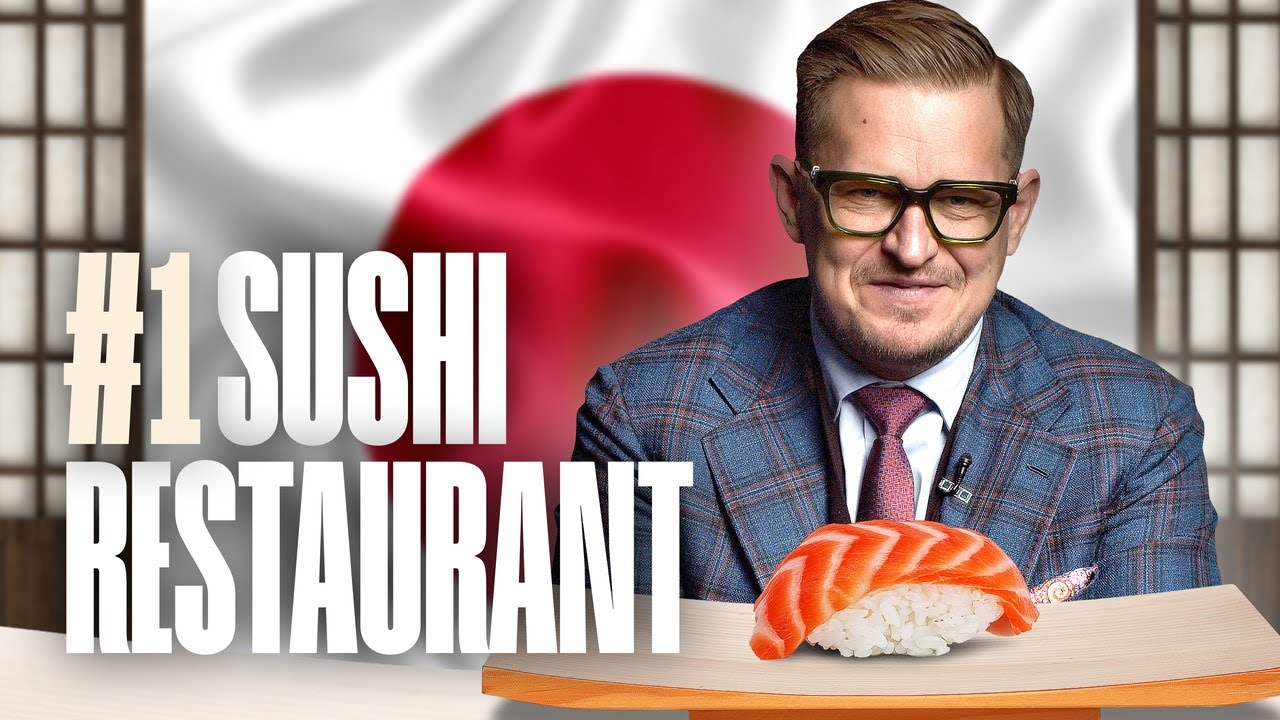
Join me in Japan, Tokyo at the best sushi restaurant, Nihonbashi Kakigara-cho Sugita. Led by master chef Takaaki Sugita, this episode explores the art of Edomai sushi and the chef’s journey from apprentice to sushi virtuoso. A unique journey into the heart of Japan’s best sushi destination.
Do you want more content from the world’s top restaurants?
Instagram – https://www.instagram.com/alexandertheguest
My name is Alexander. I’m the co-owner of a ONE Michelin star restaurant, and I’m on a mission – to find inspiration in gastronomy. I love fine dining, good wine and sharing what I know with other people.
Check out my restaurant:
https://www.instagram.com/42restaurant/
#Sugita #TokyoSushi #michelinstar #BestSushiJapan #EdomaiSushi #JapaneseCuisine #SushiArt #TokyoDining #GourmetJapan #TakaakiSugita #MichelinStarSushi #SushiExperience #TokyoFood #CulinaryExcellence #JapaneseTradition #FineDiningJapan
It’s been voted best in Japan for six years running. That means getting a reservation is gonna be a pain in the ketsu, if you catch my drift. Say hello to Tokyo. It’s a city of extremes. With 37 million people, it’s the world’s largest city by population. If you think New York never sleeps,
You should try this place. When it comes to food, you cannot do much better than Tokyo. There are more options here than you can shake a chopstick at. And more michelin star restaurants than anywhere else on earth. For me, it’s a tough decision. There are so many great choices here
But today, I will not be using Michelin as my guide. I’m using the Japenese restaurant and food guide called Tabelog. The ratings come from Japanese customers, not inspectors. And since we’ve come so far, it only makes sense to go straight to number one.
In the top spot is a place called Nihonbashi Kakigara-cho Sugita. Or just Sugita for short. This is Takaaki Sugita. He’s the owner and Itamae, or head sushi chef. The inspiration came in high school when he got hooked on a TV drama about a guy who becomes an apprentice at a sushi restaurant.
It pushed him to take a part-time job as an apprentice, and there he spent the next 12 years! Working on his knife skills and learning Edomai sushi from the inside out. It’s the traditional Tokyo style sushi that dates back to the 19th century.
It features small servings of fresh fish or seafood on top of small beds of rice. So after apprenticing for 12 years, something amazing happened. His boss threw him the keys to one of his restaurants. It was Sugita’s to run. And he did just that for the next 10 years.
After a decade of running his own spot, he was ready. At the age of 40, he took over the restaurant owned by his wife’s family and made it his own. The name would come from his surname Sugita. To not confuse it with other Sugita restaurants, he added the name of the neighborhood
Nihonbashi Kakigaracho. It was an instant hit. In 2017 he got the first Michelin star, In 2022, the second one. But in the latest Michelin guide for Japan, you cannot find this restaurant anywhere. The fine dining community is buzzing about it all over the internet.
And it seems the reason is because of how difficult it is to get a seat. Reservations are taken on a monthly basis and open up the first Monday of each month. And they do it the old-fashioned way by phone. Most of the seats are taken by regulars,
And if you know one of them, this is the best way to get a reservation. This is how I got here. Kentaro “Henry” Nakahara. Henry is a chef and restaurant owner with a grilled meat restaurant and a burger place here in Tokyo. He eats at Sugita every month.
If you don’t know a regular, then a well-tipped concierge from a luxury hotel is your best bet. And the best way to catch the newest Alexander the Guest episodes is to be a subscriber. If you haven’t done that yet, go for it. It will help us a lot.
Reservations at Sugita are so low in supply and high in demand, it’s created it’s own black market. People have paid up to 2000 euros just to get a seat at Sugita-san’s counter. But don’t get any sneaky ideas. You need to bring your ID to prove you’re you.
And if they catch you scalping your reservation, you will never get another one. All of this funny business with reservations was likely a turnoff for the Michelin inspectors. And they simply dropped the restaurant from the guide. Which is not uncommon here in Japan. Two other famous sushi places had a similar fate
When they kept reservations away from the general public. Sushi Saito is one. The other is Sukiyabashi Jiro. This is where Obama famously went. You might remember it from the 2011 documentary Jiro Dreams of Sushi. Let’s forget about Michelin and other restaurants and get back to Sugita.
All you really need to know is they won a boatload of awards and have been ranked number one sushi restaurant six years running. If you manage to get yourself a reservation, there are some rules you need to follow. They are listed on the website, but let me paraphrase for you.
First one is no surprise. Dress up a bit. No shorts, flip-flops, jerseys, or other casual clothes, and for god’s sake, take your hat off. And save your sprays. No strong fragrances are allowed. You gotta go with the flow. If you have a long list of allergies OR food dislikes,
Your reservation might be refused. Because more than 15 minutes late means no sushi for you. Your reservation will be cancelled. Finally put your phone away. We had to ask permission very very nicely. From the outside, you would not know this place was famous. In fact, you would likely walk right by it.
Sugita is well hidden on a quiet side street. There are no G-Wagons or Aston Martins outside to give it away either. Only the chef’s humble Honda scooter waits for his return. Entering through the curtains, it opens up into a cozy but welcoming space.
It has a minimalist design which is no surprise for a traditional Japanese restaurant. An elegant counter made of hinoki wood is ready for action. And in front, space for 9 lucky people, each with a front row seat. If you want a more private experience, there is also a side room for four people.
That’s a total of 13 seats. Once inside, we steady ourselves for the best sushi in the world. 5 to 8 bite size appetizers and 11 or 12 pieces of nigiri sushi are coming. All this for 340 euros. Before the show,
We see the staff working hard to make sure everything is perfect and ready to go. Here we see a sous chef grating wasabi root to go with tonight’s meal. Wasabi root is insanely expensive for a good reason. It is near impossible to grow.
It needs shade, rich soil that is moist but not wet, and steady temperatures between 9 and 16 degrees. It’s grows naturally in river valleys in Japan, South Korea and parts of Russia. That means most of the world’s wasabi is imitation. The green stuff in those little packs is
Horseradish, mustard, food coloring and a tiny amount of wasabi dust. Fun fact about grating wasabi root. First of all, the top of the board must be made of shark skin. And grating should be done with an inward movement, because inward means balance. The meal begins with some snacks.
This is like the opening act and we really see the chef show off his knife skills. And THAT is a knife. Here Sugita-san is preparing our first dish. Braised abalone. It’s a type of sea snail. It’s also known as sea ears. And that makes sense.
It’s buttery and salty and has the chewiness of calamari but the texture more like scallop. It has nice earthy umami flavors. As you can see, everything is done with beautiful precision. Every slice, every motion, it’s mesmerizing to watch. And you can tell Sugita-san has done this hundreds of thousands of times.
Up next is surf clam. This is found in northern Japan and can live more than 30 years. Even the clams live a long healthy life here! You’ve probably seen this before. The Japanese traditional way of fixing glass and pottery. They use lacquer to put it back together
And decorate the break with gold,silver or platinum. They do this to highlight the special event in its history. It’s called kintsugi. It’s not a quick fix. The process can take up to three months. It’s part of the Japanese philosophy of accepting what’s not perfect.
It reminds us that we will all be broken at some point. But not to give up. These events become scars in our lives. And we shouldn’t try to hide them. The chef’s is preparing his signature maki roll. Each piece was a party of textures with crisp seaweed paper,
Soft rice, the delicate crunch of fresh chives and ultra tender sardine. Together with the fresh wasabi and salty soy they created a beautiful harmony of flavors I understand why it’s a signature dish. It was incomparable. Next we have sea urchin and salmon roe We also try monkfish liver with hinotori sake
Sugita has 30 different kinds of sake here, from all over Japan. Without question only the best quality ever makes it to my cup. Can you mix champagne and sake? Not in the same glass of course. I found the sake made my palette more sensitive.
So when I went back to champagne, I saw a totally new side of it. Such a bonus! Coming shortly after is grilled seabass with citrus. It’s so delicious that Henry is moved to tears. I reach out with a bit of support. Our final appetiser is chawanmushi with herring roe.
This looks like soup but it’s actually steamed egg. It’s umami-rich and the texture is luxurious. Appetisers done. Now it’s time for nigiri. balls of rice topped with raw fish. Our first one is Iwashi, or Japanese sardine. Sugita-san is so elegant. He has rhythm like he is dancing
And every move he makes seems to be in slow motion. As you can see, we are eating nigiri the traditional way with our hands. When it hits my plate I reach confidently… And I fumble it. Shit. I hope Sugita-san didn’t see! Although the presentation was ruined, the nigiri itself was still absolutely perfect.
Warm tangy rice and the most tender, delicious fish you ever tasted, with a hint of saltiness. This is a fascinating world, but there are many things I don’t know. Like what exactly this is. Or this. And I can’t really describe what is happening on my tongue.
So I silently respect the depth of this cuisine to which I can no longer see. What I do know is that each of these is gorgeous in many ways. The delicate flavors, the elegant textures, the careful presentation will be seared into my memory for life.
It’s as close to tradition and perfection as you can get. The fact that this sushi has been made exactly this way for over 200 years is really special. Every move, every cut has been passed down for generations. Here I can connect with it through the food. On a personal level, this is important.
I was also lucky to share the table with an expert. Henry not only translated but filled in the knowledge gaps. Making it a history lesson and food experience in one. I loved unlocking a new side of champagne using the sake to loosen up my tastebuds.
It was great fun to experiment with these two magical potions. In this traditional, quiet place, I actually had a lot of fun. At times I felt like a fish out of water, but still I was very comfortable here. Maybe because I knew I was in such good hands.
The result was a wonderful experience. And memories I will treasure for years.
34 Comments
U ate uni
I've watched a lot of your videos now. And I can't help but feel underwhelmed after each of your reviews. Throwing out adjectives such as "it's beautiful" "the acidic is nice" and "it's really good" doesn't really do much for the understanding of the food. Couldn't you go more in depth surrounding the flavours, describe the textures more and how the plating/utensils affect the flavour profile. Maybe it is because english isn't your native language but you are very good at it and you sometimes do great reviews of food, but more often than not you fall back to the basics.
One of the best Channel on youtube , 🙏 thanks
Greatest restaurant channel on youtube. Deserves more than a million subs.
Uni is the best
Won't lie that ensemble you wore in the intro, should get you into any pretentious restaurant. No different than a guy with a helmet, safety vest, and clipboard could get you into any industrial facility without question 😂
Whoa. He was really excited about this restaurant, so he spoke waaaaay too fast! Please slow down your speech just a bit. Your accent is VERY hard to understand. I’ve got to watch with the closed captions on.
Your accent is crazy thick can't understand half of what you're saying
the best experience are always in the alleways 😀 you're missing out on even greater experiences 😀
Why you take Nigiri (Food) with Left hand?? As you know in Southeast Asia Left hand is only use for wash your Ass after Poop!so.. Please use your Right Hand!!.
but…he only cuts raw fish ! no cooking at all
Other than the reservation system, I find the lighting super sterile…No warmer hues? Strange.
I like sushi but this looks super gross
actually so pleasantly surprised by the quality of this video and the clear depth of effort. the pronunciations, the digging beyond western michelin guides, not orientalizing japanese culture while still highlighting unique aspects, just all around amazing video. way better than any ive seen in this genre
Show more, talk less please.
You know that one of the best wasabi in europe is made in poland 😀
Tokyo is so safe..safer than new York for sure…
If you are American, do not smell like a hospital. My Japanese friend told me that some Americans go to far with smells from things very strong deoderants and antibacterial soaps that can make Japanese people sick.
JAP-IN… got it lol
OR just go to the Mcdonalds
Looks incredible. Anyone who lives in philly who likes this kinda stuff go to royal izakaya and try omakase
So it was meh and weird. But great atmosphere, presentation etc.
Love this channel , hope someday you will visit and do a episode of The Librije in Zwolle the Netherlands!
You need to visit `The Librije`, the only 3 star restaurant in The Netherlands!
Great content as always. Maybe you consider visiting Germany again. You could visit Victors Fine Dining by Christian Bau (3 stars)
You couldn't PAY ME to eat that, could NOT afford it lol
I just had my first shift as a professional Sushi Chef in Chicago yesterday. I wish we had real wasabi at work, and I wish we didn't use so much frozen fish (it's hard to get fresh ocean fish in the Midwest)! But the job is still fun as hell and I'm improving rapidly. I'd love to visit Tokyo someday and see Sugita-san's incredible work myself!
Massive respect to Alexander that used a local guide to pick up the best restaurant and not a Michelin star
l started making nigiri years ago as it's ridiculously expensive here. I only wish l had a tiny bit of Chef Sugita's skill… That looked to be the most exquisite meal.
I realy wanted to watch this without all the talking
japn
You should go to taiwan's 3 Michelin star restaurants.
A very chaotic video and not your usual style, I didn’t enjoy this video
That Kintsugi lesson was great