
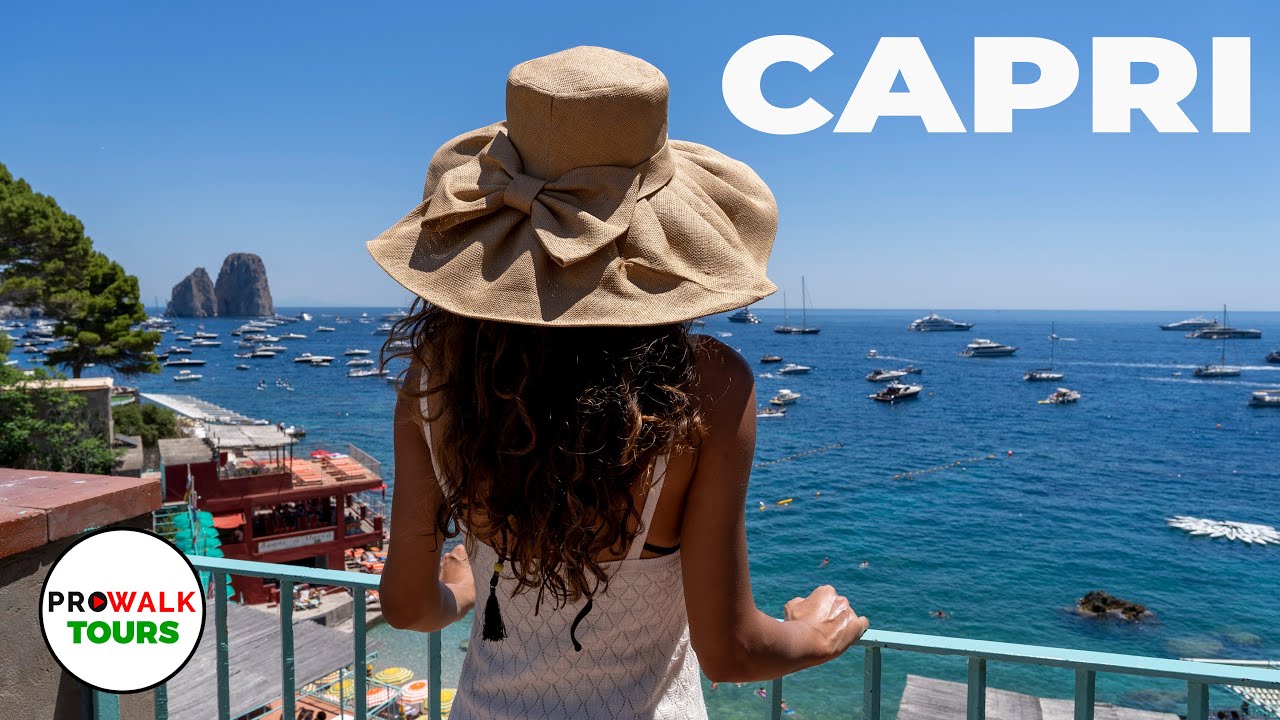
This walking tour of CAPRI, ITALY was filmed on Saturday June 18th and Sunday June 19th. The walk begins at 3pm at the Marina Grande.
🗺️Map of the Walk – https://www.google.com/maps/d/u/0/edit?mid=1aNBh6QPmjsiOmJSUeU6bTw0IXuszxsY&usp=sharing 🗺️
🔻𝗩𝗶𝗱𝗲𝗼 𝗧𝗶𝗺𝗲𝗹𝗶𝗻𝗲 𝗟𝗶𝗻𝗸𝘀🔻
0:00 Intro and Map
1:04 Marina Grande
25:45 Piazzetta of Capri
48:40 Via Vittorio Emanule
55:03 Quisisana Hotel
1:00:51 Carthusia Perfume Shop #1
1:03:26 Pergola of Flowers
1:10:18 Hotel Luna
1:18:32 Carthusia Perfume Shop #2
1:22:45 Gardens of Augustus
1:35:28 Walk back to Hotel Quisisana
1:42:32 Via Camerelle
1:51:52 Via Tragara
2:00:46 Belvedere Tragara
2:11:32 Scenic Lookout
2:17:55 Walk down to the beach club
2:25:11 Da Luigi Beach Club
2:35:00 Belvedere Tragara
2:49:32 Walk out to Arco Naturale
3:04:13 Arco Naturale
3:19:59 Via Croce
3:28:26 La Piazzetta
3:34:17 Church Santo Stefano
3:43:45 Old Nun’s Convent
3:54:21 Belvedere di Punta Cannone
4:06:30 Via Roma
4:15:31 Via Mulo
4:24:18 Marina Piccola
================================================================================
🌎Complete List of Walks: http://www.prowalks.com/videos 🌎
📢 𝗣𝗹𝗲𝗮𝘀𝗲 𝗦𝘂𝗯𝘀𝗰𝗿𝗶𝗯𝗲! 📢 – https://www.youtube.com/c/ProWalks?sub_confirmation=1
🔷 Help with a donation! – https://www.paypal.me/Prowalks 🔷
🔶 Support me on Patreon – https://www.patreon.com/Prowalks 🔶
🟥 Become a Member – https://www.youtube.com/channel/UCNzul4dnciIlDg8BAcn5-cQ/join 🟥
👕Merchandise – https://teespring.com/stores/prowalk-tours 👕
================================================================================
For the best experience, be sure to turn on closed captions [CC] and wear headphones 🎧 as you watch this tour. Visit www.prowalks.com to learn more!
🔷THE EQUIPMENT I USE🔷
Amazon Storefront: https://www.amazon.com/shop/prowalktours
🎥Camera1: Gopro Hero 10 https://amzn.to/3EwDveV
🎬Gimbal1: INKEE Falcon Plus https://amzn.to/3JWdgzF
🦯Camera Monopod: https://amzn.to/3rFzPCl
🎥Camera2: Sony a7siii:
🎬Gimbal2: DJI Ronin S2
🎤Microphone: https://amzn.to/3lYW5CI
🎧In-Ear Monitors: https://amzn.to/2DBdS1D
🎦Drone: https://amzn.to/3jYMiuR
✔️Let’s connect✔️
➤Facebook: https://www.facebook.com/Prowalks
➤Instagram: https://www.instagram.com/prowalktours
➤Twitter: https://twitter.com/ProwalkTours
➤E-mail: travel@prowalks.com
I would like to thank Michael Damico, Andrey Antsut and Katrin John for being a top level Patreon Supporter! Thanks Dino, Andrey and Katrin for your support!
No part of this video may be used for personal or private use without written permission from Prowalk Tours. I will not remove a copyright strike after one has been issued.
#ProwalkTours #Walkingtour #capri
Welcome to Capri, Italy! Here at the Marina Grande you can find boat tours that will take you around the island, including to the Blue Grotto. This is also where all the ferry boats arrive that are coming from Naples, Sorrento and the Amalfi Coast.
Capri is located in the Bay of Naples just off the Sorrento Peninsula in the Campania region of Italy. A ferry ride from Naples takes about an hour while a ferry from Sorrento takes about 25 minutes. Marina Grande is the main port of Capri and lies along the island’s northern coastline.
There is another smaller port on the opposite side of the island called Marina Piccola. As soon as you get off the ferry, you will most likely be looking for a way to leave the Marina Grande. You can take a taxi, like this one, for 20 euro.
If you don’t want to take a taxi, you can either walk, take the bus or the funicolare up to Capri. For those who want to take a bus or the funicolare, you will first need to purchase a ticket here on the right.
The line on the right is for bus tickets while the center line is for the funicolare. To the left is where you can purchase ferry tickets. There are only TWO beaches here on Capri. One is here at the Marina Grande and the other is at the Marina Piccola.
Most visitors who come to Capri to go swimming, do it by boat. The beach ends at the base to the tree line in the distance. Nearly the entire coastline, except at the two ports, is made up of high rocky cliffs.
There is one other popular swimming area on Capri located at the base of the Faraglioni rocks. There is no beach however. Swimmers sit in their beach chairs and jump off the rocks into the water. I really like the sound of the tumbling rocks when the water recedes.
Local or Tourist? Comment below. 🙂 Here on the right is the Capri bus station where you can get a bus to the main town of Capri, Anacapri or the Marina Piccola.
You can buy a bus ticket right on the bus so there is no need to stand in line at the ticket counter. Some hotels will provide staff who will pick up your luggage and bring it directly to the hotel.
The hotel I stayed at was able to pick me up at the port when I arrived, the Hotel Bougainville. The island is divided into two sections, Anacapri on the west, and Capri on East. Right now, we are directly below the main town of Capri. Piaggio Ape 50!
A boat ride around the island will cost around €20 per person plus an additional €14 per person to enter the Grotta Azzurra (Blue Grotto). You can also access the Blue Grotto by bus(€2), followed by a few flights of stairs down the cliff to the water.
The Blue Grotto is by far the most popular tourist attraction on the island. You can store your luggage here while you wait for your ferry.
Here is the entrance to the Funicolare, a cable car that runs from the Marina Grande up to the main piazza of Capri, the Piazzetta. The ride takes about 5 minutes. The island has several grottos to explore, including the white, green and blue.
During peak season, the waiting line to get into the Glue Grotto can be extremely long. Visitors typically spend less than 5 minutes in side.
Is the Blue Grotto worth it? I suppose it is worth seeing once. The long wait to get inside for a few short minutes takes away from the fun of it I think. Here is a small grocery store where you can get some food and drinks at normal prices.
Ferry boats also dock up on this side of the port as well. The port as it is today was built in 1928. Prior to that, large boats moored up in the bay and visitors took small boats into the port.
Monte Salaro can be seen in the background and its peak is Capri’s highest point at 589 meters.
Up ahead there is a set of stairs, called Via Truglio, which leads up to the main piazza of Capri. It only takes about 10 minutes to walk down and about 20 to walk up. I do not recommend trying to walk up with your luggage though.
Instead of waiting in line for the funicolare, I walked down to the port right before filming this intro. Here are the steps up to the Piazzetta. Another Piaggio Ape 50! I’ve always wanted to buy on these. This is the track for the Funicolare.
You can find handmade sandal shops all over Capri and other popular tourist sites along the Amalfi Coast. Beginning in the mid-19th century, the island became a popular tourist destination for European artists, writers and celebrities.
Two million tourists now visit each year and tourism has become the only industry on the island. For many of the 14,000 residents living on the island, tourism is their livelihood. Okay, let’s head up to Capri and see the Piazzetta. The original railway line was built in 1907.
The funicolare was rebuilt in 1958 and then again in 1991. It underwent a major renovation in 2018. The funicolare railway is 670 metres (2,200 ft) long and climbs a vertical distance of 139 metres (456 ft).
The steep rocky cliffs of Monte Salaro divide the island of Capri into its two towns, Capri and Anacapri. The town of Capri is the busier and more touristy part of the island. The quieter and more peaceful town of Anacapri is located high up on the western side of the island.
The Greek prefix ana- actually means “up” or “above.” It is currently 4:10 PM. The clock tower called the Torre del Orologio is the symbol of the piazza below and is also known as the “Campanile della Piazzetta.”
From this famous belvedere , known as “the loggetta,” we can admire the provincial road and the Phoenician staircase that climb towards Anacapri as well as enjoy the evocative views of the island and its sea.
I have a video on my channel where I hike down from the top of Monte Solaro and in to Capri. In the distance you can see the islands of Ischia and Procida (left) and Napoli (right).
The origins of the clock tower are unclear. Some believe it was originally a watch tower while others think it was the bell tower to a now destroyed church. Look up by the clock tower and to the left you can see part of an old Roman wall.
This is the entrance to the Funicolare going back down to the Marina Grande. From here you can see Mt. Vesuvius in the distance. The people living here 2000 years ago would have had a nice view of it erupting.
One important fact about the island of Capri is that it is a broken off section of the mainland. Ischia and Procida on the other hand, are volcanic islands formed by eruptions.
It is for this reason that the Roman Emperor Augustus traded the island of Ischia for Capri with the Neapolitans in 6 AD. Ischia has hot springs which the Romans loved, but the constant volcanic activity made it an unsafe place to live.
At that time, the island of Ischia was actually called “Enaria”, meaning “Land of Wine” due to its excellent vineyards. There is a different sculpture here each time I visit. This bronze sculpture by the artist Giacinto Bosco is called Swing with the Moon.
We are now at the Piazza Umberto I, more commonly known as La Piazzetta meaning “little square.” Here you can enjoy the most expensive coffee on the island. 🙂 For many years the piazza was the site of the local fish and produce market.
This piazza has been a gathering point since Roman times. In the 1930’s, the owner of a café decided to arrange his chairs and tables outside in the little square. From that moment on, the Piazzetta has been the place to see and be seen on the island.
The tourist season in Capri begins at Easter and ends in the first week of November. During the height of tourist season, up to 20,000 tourists arrive by ferry every day. About eighty percent of these tourists are day-trippers, many of which are part of large tour groups.
Only residents of the island are allowed to bring a car onto the island between Easter and November This path leads out to the Arco Naturale and the Villa Jovis. That guy looks like he is “totally goin’ to send it!” The prime seating is up above the piazza….when the sun goes down.
Is this the right way? Every door is closed… Oh…its automatic. I quickly realized there was a reason no one was up here. Here you can see the Church of Santo Stefano which we will visit a little later.
This is the path that leads down to the Marina Grande. If you hurry, it will take about 10-15 minutes to walk down. There are also some public restrooms right here on the left….a little tip for when you visit.
To the ancient Greeks, the island was known as Cauros or Kapros, meaning wild boar. The early Greeks left their mark on the island with 921 steps that join Capri with Anacapri, known as the Phoenician Steps.
The steps are carved into the rock face and are believed to have been built between the 7th and 6th Century BC. To the Romans, the island was known as Caprae, which is Latin for goats.
This path to the right leads back up around the church and to the piazza again. The line to get gelato here can get quite long at times! There is an ATM to the left…just in case you need to know. 🙂
On the left is the entrance to the popular nightclub Taverna Anema e Core. There is some shade here and some room for the kids to run around, but not much else is here at the moment. In the mid-1800s, British doctor George Sidney Clark arrived on the island to open a clinic.
Doctor Clark believed that the island’s mild Mediterranean climate had health giving properties. Doctor Clark opened his clinic in 1845 and called it Quisisana, which means, “here one heals.” By 1861, the island’s popularity among European high society had increased dramatically and the good doctor converted his sanatorium into a hotel.
This is the largest hotel on the island with 148 rooms. After Clark’s death, the hotel was sold and construction began on a new west wing. During construction, dinosaur bones were found which can now be seen in Capri’s Cerio Foundation Museum.
After several remodels and new additions, including a theater, the Quisisana Hotel is now one of the largest buildings on the island. The Restaurant Quisi indoors serves Italian cuisine for dinner, accompanied by romantic music. It has been cited as one of Italy’s finest hotel restaurants.
A park suite room at the hotel costs 3,100 per night. A deluxe suite costs $7,000 per night. A premiere deluxe suite costs $8,000 per night. It doesn’t look like I’ll ever be staying at the Hotel Quisisana.
We are now going to walk to the Garden of Augustus with a couple stops, first at the Hotel Luna and then at the famous perfume shop, Carthusia. Caesar Augustus first visited Capri in 29 BC and fell in love with the island’s beauty.
During the construction of one of his imperial villas, builders found the remains ancient animals as well as traces of the early occupants of the island. The story was documented by the historian Suetonius (75–140) who described the interest shown by the emperor Augustus in preserving these remains.
This shop was closed last time I filmed. Let’s go inside and check it out. This area is all part of the Hotel Luna grounds. The flower growing over the pergola is known as a Pink Bougainvillea.
The Hotel Luna is next to the old monastery of Carthusian monks, known as the Charterhouse of San Giacomo, built in 1371. All the day trippers are missing out! A room here at the Hotel Luna ranges between $350 and $850 per night.
The hotel includes a pool as well as gym with views of the sea and the Faraglioni rocks. The Faraglioni Rocks are Capri’s most iconic site. If you get a chance to visit, look into renting a boat and visiting the island that way.
In 1380, the Father Prior put together a bouquet of local flowers when he heard the news of Queen Joan of Anjou coming to Capri. The flowers remained in water for several days and after they were thrown out, the Prior noticed the water had gained a pleasing fragrance.
This water become Capri’s first perfume. Over 500 years later, in 1948, the old perfume formula was found by the Prior of the Charterhouse. A small laboratory was created to produce the perfume and the Prior called it “Carthusia” after the Carthusian monastery.
We will walk through the main Carthusia shop shortly, but I figured another stroll through here would be nice first. This is Via Matteotti which leads out to the Gardens of Augustus and Via Krupp, which is still closed.
In the early 20th century, German industrialist Friedrich Alfred Krupp intended to build large villa near this location. Krupp died in 1902 and his mansion was never built but he was able to complete a large garden and a new path from the gardens down to the Marina Piccola.
What! We have to pay? Last summer it was free! 🙂 The cost is 1 euro. The gardens were originally named Krupp Gardens but in 1918, the name was changed to the Gardens of Augustus after the famous Roman emperor.
From the gardens it is possible to see a panoramic view of the island which includes Mount Solaro, the bay of Marina Piccola, and the Faraglioni. This is selfie central. We are now looking out over the bay in front of the Marina Piccola.
Up in the trees is the Belvedere di Punta Cannone. We will be there later in the walk. The winding road below the gardens, called Via Krupp, is another one of Krupp’s legacies. The footpath, built between 1900 and 1902, joins the garden area with the Marina Piccola.
Via Krupp is currently closed due to the danger of falling rocks and has only been open a few times since 1976. Next to the Hotel Luna is the Saint James’ Charterhouse (Certosa San Giacomo). I usually include a visit to the charterhouse but I decided to skip it this time.
The English name for a Carthusian monastery is a charterhouse. In Italian, the name is a Certosa. The Carthusian order of monks date back to 1084 and come from the Chartreuse Mountains in southeastern France.
The charterhouse was built in 1371 by Count Giacomo Arcucci on land donated by the Queen of Naples, Joanna I. In 1373, the Queen sent the Fathers to the island to inhabit the Certosa. The Certosa suffered serious damage due to Saracen pirate raids and after 1563 it underwent a major restoration.
Inside the charterhouse, the monks devoted their lives to contemplation, silence and solitude. During the time of the plague in 1656, the monks locked themselves inside the charterhouse. The locals were upset with the monks for not helping the general public.
In an act of retribution, the locals took the corpses of the monks who had died, and threw them over the cliff. In 1808, the island was attacked by Joseph Bonaparte who banished the monks from the island forever and who confiscated the assets of the Certosa.
After the monks were forced to leave, the Certosa fell into decline and was used for a variety of purposes. The Certosa is now the location of the local high school as well as a museum and library.
This luxury shopping street dates back to Roman times when it was a stone path joining the center of the island with the imperial villa of Tragara. In Roman times, the road, originally name Via Anticaglia, was lined with over 40 tanks, believed to be cisterns used to collect fresh water.
The giant tanks were opened up on the side facing the road during the middle ages and were used to store livestock. Many of those ancient cisterns were eventually adapted into these luxurious boutiques.
The archway entrances to the shops on the left are part of the ancient cisterns. The Roman road was built above the cisterns. In 1879, a German named Adolf Kottgen built his villa on one of the ancient Tiberian cisterns. This road leads down to the charterhouse.
This large building to the left was Kottgen’s, the Villa Pompeiana. The Roman road was built to join the imperial villa of Tragara with the center of the island. Capri was a favorite island retreat for Emperor Tiberius Agusustus. He had a total of 12 massive villas on the island.
One of the villas was built on the site where the Garden of Augustus now stands. We are now heading out to the Belvedere Tragara which offers a beautiful view of the south side of the island. Emperor Tiberius’ twelve villas were each dedicated to one of the twelve god’s of Olympus.
The largest of the twelve villas was the Villa Jovis (Villa of Jupiter). Tiberius spent ten years living on Capri, ruling Rome from his Villa Jovis with a lingering fear of assassination.
I did not visit the Villa Jovis during this visit to Capri but I do have a walking tour video of the villa on my channel.
After Tiberius died, the island seems to have been little visited by the emperors, and we hear of it only as a place of banishment for the wife and sister of Commodus. Capri has a long history of being the ‘island of exiles.’
On March 17th, 180 AD, the Roman Emperor, Marcus Aurelius died and his son Commodus came into power. In 182, Commodus’ wife Crispina and his sister Lucilla became involved in a plot to have him assassinated.
The assassination attempt failed and Commodus had his wife, his sister and her daughters banished to Capri. A year after being exiled to Capri, Commodus sent a centurion to the island and had them all executed.
Over a thousand years later, in 1810, a Roman sarcophagus was found after the French army sacked the Church of San Costanzo at Marina Grande. Inside was a skeleton, believed to be Crispina, wrapped in robes and adorned with gold jewelry.
The sarcophagus is now kept on the terrace of the former Hotel Blue Grotto and viewing is available upon request. This lady really takes advantage of the fact there is no other place to get food and cold drinks while you are out here. She is always singing….except for right now.
Ruins of his Villa Tragara, where we are heading now, could still be seen in the 19th century. To the left is the Punta Tragara Hotel. This five-star hotel was originally a private villa built in 1920 by the Lombardy-born engineer Emilio Vismara.
The private home was used as an American command base during WWII and was eventually converted to a hotel in 1973. These steps lead down to the Pizzolungo Trail leading out to the Arco Naturale.
This is the start of the Pizzolungo Trail. It offers better views than the steps we just saw. The trail splits just up ahead. If you continue straight, you end up at the Arco Naturale. The trail to the right leads down to the Faraglioni beach clubs.
We are going to walk a short distance out to a scenic viewpoint and then come back and walk down to the beach clubs. This coastal path, called the Pizzolungo trail, traces the southern coastline and ends at the Arco Naturale.
There are a ton of steps though…and I didn’t want to walk up them again in this heat so we will get to the Arco Naturale an easier way.
It is easy to miss this trail to the right. In fact, it doesn’t look like anyone has been on it in a long time. This natural wonder is so incredible that it’s been dubbed one of the most captivating landscapes in the world.
The name of the rocks, “Faraglioni”, is thought to stem from the Greek word “Pharos” which basically translates as “lighthouse”. Centuries ago, these kinds of coastal rock formations were used as lighthouses with fires burning at their tops to signal safe navigation.
There are three separate rocks we are looking at here. The middle one has a tunnel through its base that the boats go through all day long. The three rock stacks are named Stella, which is connected to the island, Mezzo and Scopolo or Fuori, the furthest out.
The Scopolo faraglione is home to the endemic lucertola azzurra, a blue lizard that is said to bring good luck if you see it. Dolce & Gabbana filmed a famous perfume advert using the Faraglioni as a backdrop. The first beach club opened up in 1936 and quickly attracted film starts, models and politicians.
The beach clubs, like many other businesses in Capri, are open from the end of April to the 1st of October. As mentioned earlier, there are only a few beaches on Capri, but there are several swimming holes among the rocks.
Here below the Faraglioni rocks is where the women of Capri would come to soak their flax seeds used in making linen as well as the thread for fisherman’s nets. This area became known as “E font d’o lino,” meaning “the source of the linen.” Eventually E font d’o lino became Fontelina.
La Fontelina beach club opened here in 1949 with a small beach hut and restaurant. This trail leads out to La Fontelina. After the La Fontelina opened in 1949, Capri began to attract the rich and famous and by the 1960s, La Fontelina was one of the most popular sites on the island.
The restaurant has been destroyed several times over the decades due to violent storms but the owners continued to rebuild. Now we will head over to the second beach club here, Da Luigi ai Faraglioni.
It was here at the base of the rocks that the Roman ships would unload their cargo 2,000 years ago. Da Luigi ai Faraglioni first opened back in 1936 and has remained a popular resort on the island ever since.
Visitors can also access this bathing resort by boat from the Marina Piccola. I’m trying to keep my camera pointed at the rocks. People get a little…more sensitive to the camera when they are out sunbathing.
I decided not to film the walk back up. The walk resumes where the trail splits just below the Belvedere Tragara. This is now the second day of filming. I started day 2 right here at about 10 AM. New day…new boats!
We are now going to walk out to the Arco Naturale. In historical times the island was occupied by Greeks who from the eighth century BC onwards first settled on the island of Ischia and the mainland, at Cumae, and later came to Capri.
I’ve been to the Cumae archaeological site with my family but I have yet to film a walk there. The historian Strabo (63 BC – 23 AD) wrote that “in ancient times there were two towns in Capri, which were later reduced to one”
One of those two towns was the precursor to today’s Capri town. This is confirmed by the remains of fortification walls which were built with large limestone boulders.
Regarding the second city, many hypotheses have been advanced, but the most reliable is that even then it was Anacapri, based on the existence of the Phoenician Steps that connect to the port. Since its first settlement, the natural shape of the island led to the creation of two communities.
One in the East with hills sloping down to the sea, and one to the West on a large plateau, the steep slopes of Monte Solaro and with no access to the sea.
Capri subsequently fell into the hands of Neapolis (the former Greek colony called Naples today) and remained so until the time of Augustus. After the fall of the Western Roman Empire, Capri fell again under the rule of Naples, and suffered various attacks and ravages by pirates.
In 866 Emperor Louis II gave the island to the comune of Amalfi. The pirate Barbarossa Hayreddin Pasha, called Barbarossa, plundered and burned Capri seven times.
The worst raid occurred in 1535, when Barbarossa captured the island for the Ottoman Empire and had Anacapri castle burned down, the ruins of which are now called Castello Barbarossa. This castle is on the property of Villa San Michele today.
In 1553, a second invasion by Turgut Reis resulted in another capture and in the looting and destruction of Certosa di San Giacomo. The danger of such attacks led Charles V to allow the inhabitants to arm themselves, and new towers were built to defend the island.
Only the 1830 French defeat of the pirates ended this threat. A 17th-century visitor to the island was the French erudite libertine Jean-Jacques Bouchard, who may be considered Capri’s first modern tourist. His diary, found in 1850, is an important information source about Capri.
In January 1806, French troops under Bonaparte took control of the island. In May 1806, the island was seized from French control by an English fleet under Sir Sidney Smith. The English had the island strongly fortified, but in 1808 it was retaken by the French under Lamarque.
Under British rule, Capri became an important naval base and several forts were constructed around the coast, sadly causing severe damage to surviving Roman ruins. By a simulated attack on the two docks of Marina Grande and Marina Piccola, British attention was diverted from the west coast.
The French were able to scale the cliffs and forced the enemy to surrender. In 1813 Capri, was restored to Ferdinand I of the Two Sicilies. In the latter half of the 19th century, Capri became a popular resort for European artists, writers and other celebrities.
In 1826, German author and painter August Kopisch, visited the island for an extended period of time. During his stay on the island he heard of a little known grotto that the superstitious locals had refused to enter for centuries.
Joined by his friend Ernst Fries, the pair entered the grotto to discover the brightly illuminated waters within. The two friends also discovered several ancient Roman artifacts inside. Together they named the grotto La Grotta Azzurra, The Blue Grotto.
This is where the Pizzolungo Trail ends…after climbing up a long stretch of steps. Never again! 🙂 In his 1838 book, Discovery of the Blue Grotto on the Isle of Capri, August detailed his rediscovery of the Blue Grotto with the rest of the world.
The book, along with his paintings of the Blue Grotto, sparked a wave of fascination with Capri that continues today. he Arco Naturale is a natural limestone arch that is 12 meters wide and 18 meters tall. From the water, the arch has the appearance of an elephant.
In the distance you can see the point of the Sorrentine Penisola. We are looking doing the coastline of the Amalfi Coast. The Grotta Bianca is just around the corner from here. The tour will resume at the top of the steps near the restaurant we saw earlier.
From here, we are going to walk out to the Belvedere di Punta Cannone for a scenice view from up above the Gardens of Augustus. After the belvedere, we will walk down to the Marina Piccola, the main swimming area on the island.
The natural scientist Ignazio Cerio catalogued Capri’s flora and fauna during the 19th century. His work was continued by his son, author and engineer Edwin Cerio, who wrote several books on life in Capri in the 20th century.
If you are enjoying the video, please click the LIKE button and/or share the video with a friend. Grazie. Be sure to click the subscribe button and the bell icon so you will be notified when a new video is posted.
The easiest way to subscribe to the channel is probably on your phone, but it can be done here on your smart TV as well. Only 12% of viewers are actually subscribed to the channel. Have you ever been to Capri? What did you enjoy most about your visit?
What information would you have liked to know before visiting the island? Leave a comment below to help out people planning their trip. Frank Sinatra recorded a song about the island “Isle of Capri” on October 1, 1957, for his album ‘Come Fly with Me.’
Did you know that the Caprese salad got its name from the island. It translates ‘the salad of Capri’. An authentic Caprese Salad is made from sliced tomatoes, buffalo mozzarella, fresh basil and olive oil. The island of Capri also gave its name to Capri pants, which are three-quarter length slim pants.
They were named after the island because they were popularly worn here in the 1950s and 60s. Jackie O was known to buy several pairs of custom made white Capri pants while on the island since she never wanted to carry any luggage.
Sophia Loren, Audrey Hepburn and Elizabeth Taylor all wore Capris, but Jackie O made them famous. Capri hosts various festivals and events throughout the year, including the Capri Art Film Festival in April, the Capri Tango Festival in June and the Capri Hollywood International Film Festival in late December/early January.
The Capri Hollywood International Film Festival was first held in 1995 and was dubbed “the last major film festival of the year” by The Hollywood Reporter. We will now take a tour of the former cathedral of Capri, the Church of Santo Stefano.
This church was built in 1685 on the site of a Benedectine monastery which dated back to 580 AD. The clock tower in the piazza is believed to be the only remaining trace of the original 6th century monastery.
Part of the floor was made with the marble taken from the Villa Jovis on the east side of the island. It is here that the tombs of the Arcucci family are preserved, which were moved from the Carthusian monastery after 1810, and also the tomb of God’s servant Mother Serafina.
Capri has twelve churches in total and seven museums. This church was built 1661 and 1685 at the wish of Mother Serafina who ran the convent next door. Next door we find the Convent of the Teresian nuns.
Although many of the houses of the old nuns are now private homes, we can still walk around the portico and breathe in the history. There are only closed doors at the top of the steps. We are now going to walk out to the Belvedere di Punta Cannone.
The point was named for the defensive cannon placed there by French troops in 1808, It will take us 6 minutes to walk out there.
Some locals still refer to this scenic spot as the “Piazzetta degli Artisti” after the German painters who would set up their easels here in the beginning of the 19th century to capture the view on canvass. We are going to end this tour by walking down to the Marina Piccola.
We will be back at the Convent of the Teresian nuns in about 6 minutes. If you have been watching the channel for a while, you may notice that I using a different camera. I usually film my walks with a Gopro Hero 10. This walk was filmed with a Sony a7siii.
Do you prefer one camera over another? This street is Via Roma. I don’t know what she was saying to me. 🙂 This trail leads straight down to the Marina Piccola. It will take 9 minutes to walk down.
What a view! I stopped and asked her if I could take her picture for the thumbnail of this video It’s moments like this that I wish I were not filming but instead just enjoying the beach with everyone else. Looks like fun. 🙂
I was going to end the walk with the last view, but I walked out here to the end of the rocks and decided to start up the camera one more time. Thanks for watching this tour. I hope you enjoyed it.
40 Comments
Увезите меня и иставьте там😢😢😢
more than just a tour, this is a valuable documentary. Appreciate all the efforts.
I am sick and in bed and can also be in Capre, thanks a lot
2:04:00 какая примерно в среднем глубина в том месте где яхты? Если относительно скал земля уходит в низ то должно быть там глубоко
Спасибо Вам, за Ваш труд!!! Прекрасная работа!!!!
Sizde lütfen çekim yaparken ve Tarihi anlatırken Tarih okuyarak yazın
Barbaros Hayrettın Paşa gibi büyük bir denizciye korsan dıyemezsınız.
Sizi protesto ediyor ve beğenimi geri alıyorum.
CAPRI LOOKS "CHANANA"-=CAPRI SE FINI
The beach scene at 4:30:00, difficulty viewing such an over populated beach…….
Capri island is beautiful ❤❤❤
Great video! Answering your question about which camera is preferred… So, I like this one but it might have the minor drawbacks of 1) possibly hurting your back lugging it around and 2) not sure if it's just me but it seems like the GoPro might handle what to focus on better?? Not a big deal either way. Enjoy your vids! Take care. Ciao.
Thanks a lot for let us know this wonderful place
I love it so much amazing ❤❤❤❤❤💗😍🤩😍🤩😍😍😍😍🤩🤩😍😍🤩🤩😍
❤❤❤ i love italia ❤❤❤❤
LINDO LUGAR
На Капри не был никогда поэтому смотрю с огромным удовольствием!
hello walking tour fans.. I`m a small walking youtube channel hopefully some of you will find time to watch my channel. thank you.
The quality of your videos is incredible!! It makes me feel like I am right there! My favorite Chanel!
2:01:40 😮 lot of boats…
This is the only place I want to live
ОБАЛДЕТЬ РАЙСКОЕ МЕСТО КАК БЫ Я ХОТЕЛ ТАМ ЖИТЬ !!!!!!!!!!!!!!!!!!!!!!!!!!!!
А ЗАЧЕМ ВОЗЛЕ ОТЕЛЯ "СКАЛИНОТЕЛЛА" УБРАЛИ СКУЛЬПТУРУ ДЕВУШКИ И ПЕРЕТАЩИЛИ К БУТИКУ ПАРФУМА???
МЕНЯ БОЛЬШЕ ИНТЕРЕСУЕТ КТО ЗАСТРАИВАЛ И ОБУСТРАИВАЛ СОВРЕМЕННЫЙ КАПРИ А НИ ГОЛУБОЙ ГРОТ, ЧТО ТО КОГДА ТО БЫЛО ЭТО ИСТОРИЯ, ЛУЧШЕ БЫ РАССКАЗАЛИ КАК ЕГО ОСВАИВАЮТ СОВРЕМЕННЫЕ ЖИЛЬЦЫ КАКИЕ РЕШАЮТ ПРОБЛЕМЫ КАК РЕШАЕТСЯ ВОДОСНАБЖЕНИЕ, КАНАЛИЗОВАНИЕ УБОРКА МУСОРА КУДА ЕГО УВОЗЯТ СНАБЖЕНИЕ ПРОДУКТАМИ ВОТ ВОПРОСЫ ТУРИЗМА, А НИ ТО КТО КОГО ЗАВОЕВАЛ !!!
МЕНЯ КАК АРХИТЕКТОРА И ЛАНДШАФТНОГО ДИЗАЙНЕРА ЭТО БОЛЬШЕ ИНТЕРЕСУЕТ!!!
КАКОЕ НАСЕЛЕНИЕ ОСТРОВА НА СЕГОДНЯШНИЙ ДЕНЬ, КАКОЙ% ОТ НАСЕЛЕНИЯ ЗАНИМАЕТСЯ ОБСЛУЖИВАНИЕМ ТУРИСТОВ, КТО ПО ЭТНИЧЕСКОМУ СОСТАВУ НАСЕЛЯЕТ ОСТРОВ И КАКОГО ВОЗРАСТА, КАКИЕ СОЦИАЛЬНЫЕ ЗАВЕДЕНИЯ ЕСТЬ НА ОСТРОВЕ, ДАЮТ ЛИ ВНЖ НА ОСТРОВЕ?
ПОЧЕМУ У ВАС В КАДРЕ ПОСТОЯННО ЧЬИ ТО СПИНЫ ЧТО НЕЛЬЗЯ ПОДОЖДАТЬ ЧТОБ ЛЮДИ НЕ МИЛЬТИШИЛИ ПЕРЕД ГЛАЗАМИ, ЭТО МЕШАЕТ ВОСПРИНИМАТЬ ЦЕЛОСТ НОСТЬ КАРТИНКИ. И ГЛАВНОЕ В САМЫХ КРАСИВЫХ МЕСТАХ….
ЧТО ТЫ ПРИКЛЕИЛСЯ В 2-М МОЛОДЫМ ЛЮДЯМ ЧТО ОТПУСТИТЬ ВПЕРЁД НА 10 М НЕЛЬЗЯ? КАК КРАСИВОЕ МЕСТО У ТЕБЯ ЧЕТВЕРТЬ КАДРА ЗАНИМАЕТ ЗАНИМАЮТ ЧУЖИЕ ГОЛОВЫ И СПИНЫ, А НАМ ХОТЕЛОСЬ БЫ ПОСМОТРЕТЬ КРАСОТУ ОСТРОВА,А НИ ЧЬЮ ТО ПРИЧЁСКУ!!!
ПОЧЕМУ НЕ СООБЩАЕШЬ КАК ЖИВЁТ РЯДОВОЙ КАПРИОТ КАКУЮ ПОЛУЧАЕТ З/ПЛАТУ И В КАКОЙ ВАЛЮТЕ:
КАКУЮ
НИБУДЬ ДЕВКУ КАПРИОТКУ НА КОТОРУЮ ПРИЯТНО СМОТРЕТЬ ТЫ СНЯТЬ НЕ МОЖЕШЬ ЗАТО КАКОЙ-ТО ДЕД В СВЕТЛЫХ ШОРТАХ У ТЕБЯ ПОСТОЯННО МЕЛЬТИШИТ В КАДРЕ КАК БУДТО ТЫ ЕГО ПАСЁШЬ!!!ЧТО ВЫ ЗАЧЕРКНУЛИ КРИТИКУ Я ЧТО НЕ ПРАВ САМ ОПЕРАТОР -ПРОФИ!!!
ЦЕРКОВЬ ПРОСТО ВЕЛИКОЛЕПНА Я КАК АРХИТЕКТОР ПОРАЖЕН МАСТЕРСТВОМ И УМЕНИЕМ ТЕХ МАСТЕРОВ КАКАЯ ТЩАТЕЛЬНАЯ ПРОРАБОТКА И ФИЛИГРАННОЕ ИСКУССТВО!!! А КАК СТРОИЛИ В ТАКОЙ ТЕСНОТЕ ДОВОЛЬНО КРУПНЫЕ ЗДАНИЯ БЕЗ КРАНОВ И ПОДЪЁМНОГО ОБОРУДОВАНИЯ ДА ЕЩЁ С ТАКИМ КАЧЕСТВОМ ПРИМИТИВНЫМИ ИНСТРУМЕНТАМИ???
МЕНЯ ЦЕРКОВЬ ПОРАЗИЛА СВОИМ И КАЧЕСТВОМ И НАПОЛНЕНИЕМ ЧТО СОБОР АНДРЕЯ ПЕРВОЗВАННОГО В АМАЛЬФИ ПРОСТО УСТУПАЕТ ЕЙ…КТО ЭТИ МАСТЕРА КОТОРЫЕ ТВОРИЛИ ЭТО ВЕЛИКОЛЕПИЕ ???!!!!!!!!!!!!!!
А ЦЕРКОВЬ МАТУШКИ СЕРАФИМЫ В УДРУЧАЮЩЕМ СОСТОЯНИИ И ТРЕБУЕТ РЕСТАВРАЦИИ…
МЕНЯ БОЛЬШЕ ПОРАЖАЮТ ЦВЕТУЩИЕ БУГИНВИЛИИ И ПРОЧИЕ РАСТЕНИЯ, А НИ ПУШКИ…У НАС В СИБИРИ ТАКОГО ВЕЛИКОЛЕПИЯ И ПАЛИТРЫ РАСТЕНИЙ НЕ УВИДИШЬ И ЭТО ВСЁ ПРОСТО ПОРАЖАЕТ !!!!!!!!!!!!!!!!!!!!!!!!!!!!!!!
КОЛИЧЕСТВО ЯХТ И ЛОДОК ПРОСТО ПОРАЖАЕТ ЭТО ЖЕ СКОЛЬКО СОСТОЯТЕЛЬНЫХ ЛЮДЕЙ И ЧТО У НАС В НАШЕЙ ОБОДРАННОЙ РОССИИ…..
СОНЬКА АЛЬФА 7 С 3 КАК РАЗ ЗАТОЧЕНА ПОД ВИДЕО С ШИРОКИМ БИТРЕЙДОМ !!!!! И НЕТ ИСКАЖЕНИЯ ОТ ЭТИХ ШИРИКОВ КОТОРЫЕ Я НЕ ПЕРЕВАРИВАЮ…
В ЦЕЛОМ ВЕЛИКОЛЕПНОЕ ВПЕЧАТЛЕНИЕ ОТ УВИДЕННОГО, ХОТЯ КАК АРХИТЕКТОР И СТРОИТЕЛЬ УВИДЕЛ МНОГО АГРЕХОВ…
НА ТВОЕЙ МИНИАТЮРЕ Я БЫ НИ ТОЛЬКО СПРОСИЛ МОГУ ЛИ ТЕБЯ СФОТОГРАФИРОВАТЬ, НО И ПОПРОСИЛ БЫ ЕЁ КРАСИВО ПОПОЗИРОВАТЬ!!!
НА ПЛЯЖЕ КОНЕЧНО ЛУЧШЕ СНИМАТЬ СКРЫТОЙ КАМЕРОЙ ПОТОМУ ЧТО НАРОД НЕ ПОНИМАЕТ, ЧТО ОПЕРАТОРУ ВАЖНА ОБЩАЯ АТМОСФЕРА, А НИ КОНКРЕТНО КАКАЯ ТО ЛИЧНОСТЬ
ОГРОМНОЕ ТЕБЕ СПАСИБО БЫЛО ОЧЕНЬ ЗДОРОВО, ВОЗЬМИ МЕНЯ В ПОМОЩНИКИ !!!
Красиво.Но очень много людей.Отдыха никакого.