
Thanks to Trade Coffee for sponsoring! Get a free bag of fresh
coffee with any Trade subscription: https://drinktrade.com/maxmiller
Support the Channel with Patreon ► https://www.patreon.com/tastinghistory
Recipe at https://www.tastinghistory.com/recipes
Order the TASTING HISTORY COOKBOOK: https://amzn.to/42O10Lx
Merch ► https://crowdmade.com/collections/tastinghistory
Instagram ► https://www.instagram.com/tastinghistorywithmaxmiller/
Twitter ► https://twitter.com/TastingHistory1
Tiktok ► TastingHistory
Reddit ► https://www.reddit.com/r/TastingHistory/
Discord ► https://discord.gg/d7nbEpy
Amazon Wish List ► https://amzn.to/3i0mwGt
Send mail to:
Tasting History
22647 Ventura Blvd, Suite 323
Los Angeles, CA 91364
LINKS TO INGREDIENTS & EQUIPMENT**
Baldo Rice: https://amzn.to/3S6yP6K
Pistachios: https://amzn.to/3vOzPoz
Currants: https://amzn.to/48MeJ8T
SOURCES**
Bountiful Empire by Priscilla Mary Isin: https://amzn.to/3SduMW9
The Gulper and the Slurper by Helen Pfeifer: https://brill.com/view/journals/jemh/24/1/article-p41_3.xml?language=en
Melceü’t Tabbâhîn
A Voyage Into the Levant by Sir Henry Blount
Kutadgu Bilig
Everyday Life in Turkey by Mrs. W. M. Ramsay
Alexis Soyer, A Culinary Campaign
On Horseback through Asia Minor by Frederick Burnaby
Tableau Genéral by Mouradja d’Ohsson
The Itinerary of Fynes Moryson
A Relation of A Journey to Constantinople by Nicholas Rolam
Ogier Ghiselin de Busbecq
Journals of Edward Lear
**Some of the links are from companies from which Tasting History will earn an affiliate commission. These help to support the channel at no cost to you.
Subtitles: Jose Mendoza | IG @worldagainstjose
PHOTO CREDITS
Court of Slejuk ruler Tughril III: By Author: Benjamin Banayan (rugrabbit.com), photographed at the Metropolitan Museum of Art exhibit "COURT AND COSMOS: The Great Age of the Seljuqs", 2016 – This file has been extracted from another file, CC BY-SA 4.0, https://commons.wikimedia.org/w/index.php?curid=143668161
#tastinghistory #ottoman #foodhistory
Dining during the Ottoman Empire was a rather regimented affair. There were certain protocols that had to be followed table manners if you will, and I’ll tell you what those table manners were as I make this Ottoman recipe for acem pilawi. So thank you to Trade coffee for sponsoring this video as we make pilaf from the Ottoman empire
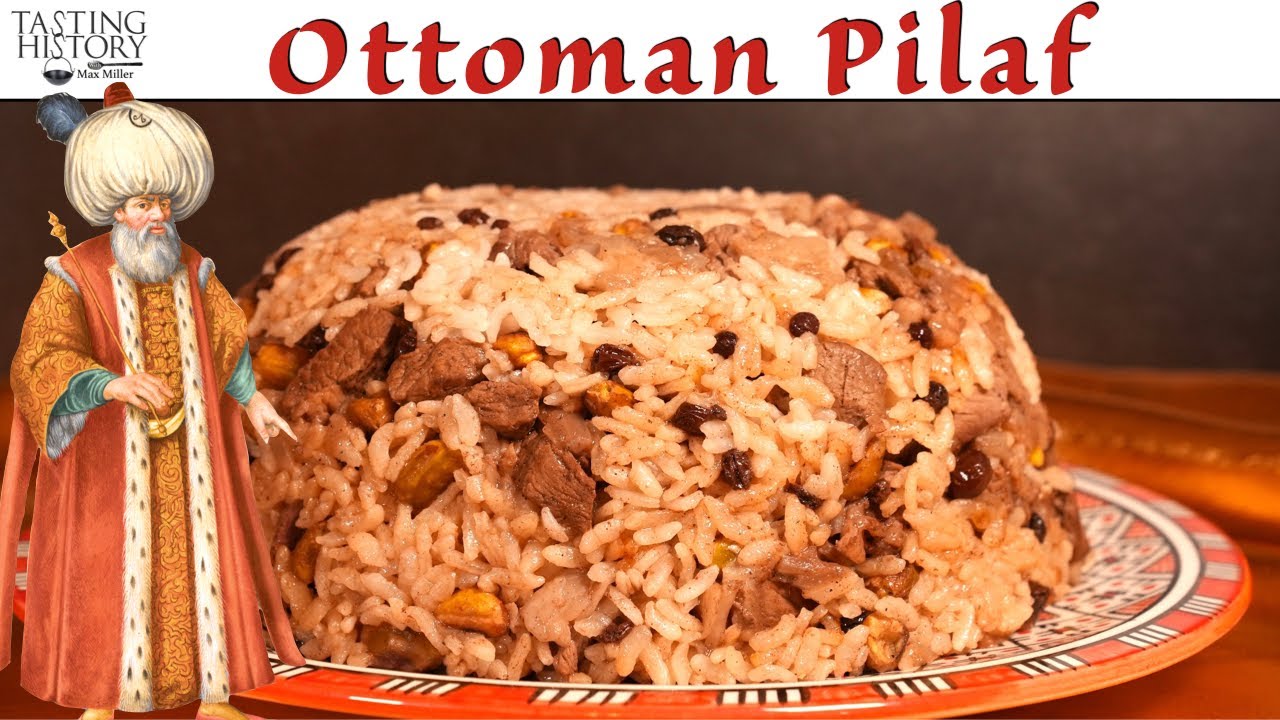
This time on Tasting History. So today’s dish acem pilawi actually translates to Persian rice but it was one of the most popular dishes during the Ottoman empire and actually has become more associated, I think, with Turkey than with Persia. The recipe comes from the first Ottoman cookbook written in 1844 and it says
“Chop a piece of good mutton into small pieces, place them in a pot… add one or two spoonfuls of fresh butter and after frying take the cooked meat from the pot with a hand strainer. Finely chop three or four onions and fry them, then put the roasted meat on top.
Then add plenty of pistachios, currants, cinnamon, cloves, and cardamom on top. After that according to the old method one measure of washed Egyptian rice. Add two measures of cold water without disturbing the rice, add sufficient salt, then close the lid of the pot and cover it thoroughly with dough.
Boil it slowly on coals and when the water is absorbed, take the cover off, and turn the contents out of the pan onto a dish so it comes out intact. This makes a Pilaw that is very pleasing to the sight, and exceedingly pleasant to the taste.”
So what’s interesting about this dish is that while today we would think of this as an entree or a main dish during the Ottoman empire it was more like dessert, not that it was sweet but that it was the last dish of the meal.
A traveler back in the 19th century after sitting through a 3-hour feast said “And with a thrill of joy came the recollection that pilaf is always the last dish at a Turkish dinner!” After that was usually just coffee, you would also get coffee when you arrived at someone’s home
Along with some other things to welcome you into the house. It was customary to have some sort of sweet often flavored with rose or orange blossom, and then some sherbet or a bit of perfume or incense. In 1634 when Sir Henry Blount visited an Ottoman home he was offered
“sweet water, and besprinkled me: after that one brought a porcelain dish of coffee.” And this would have been a thick Turkish coffee which you could make using beans from today’s sponsor Trade. Now for Turkish coffee you need a very fine grind almost like a powder but
Personally I prefer a coarser grind so I can make a lighter drip coffee but that’s the great thing about Trade, you tell them all about your coffee preferences, how often you drink it, how you like to take it, and your taste preferences. Then they work with over 55 local roasters to curate a coffee feed
Just for you that gets delivered to your doorstep within just a couple of days of being roasted. And with Trade’s subscription service you can give them feedback so they are always able to provide you with the best coffee for you. Recently I received this organic Toketee medium roast from Sight Glass.
It’s definitely on the darker side but it also has some bright vanilla notes and it’s not acidic at all which is perfect for me because I like to put creamer in my coffee and you don’t want acidic coffee for that. But since Trade knows my coffee drinking preferences they always send me exactly what I want.
And right now Trade is offering a free bag of coffee with select subscriptions when you use my link to sign up. That’s drink trade.com/maxmiller I’ll put the link in the description and then you can have some coffee while you prepare your pilaf for which which you will need:
1 1/2 pounds or 680 grams of lamb or mutton cut into very small piecesl, three onions finely chopped, 4 tablespoons or 55 grams of butter, 1/2 cup or 70 grams of pistachios, 1/2 cup or 60 grams of currants,
1 and 1/2 teaspoon of cinnamon, 1/2 teaspoon of cloves, 1 and 1/2 teaspoons of cardamom and 2 cups or 370 grams of Baldo rice. Now Baldo rice is the type of rice that they use in Turkey typically for this dish but you can use any kind of rice, it’ll work just fine.
So to start melt the butter in a deep pan over medium high heat and then add the meat. Let the meat sear and cook for about 7 or 8 minutes or until it’s shrunk up and left most of its juices, and then using tongs or a strainer remove the meat and put it into a bowl.
Then add the onions into the same fat and sprinkle with a pinch of salt, and then fry them for 10 minutes or until they’re nice and soft. Then reduce the heat to medium low and gently add the meat back in.
What you’re trying to do here is create layers, so you’ll have the onions on the bottom then the meat, then the pistachios and currants, and then the rice on the top, and so then when you invert the dish at the end you’ve still got those layers,
And you’ll see at the end of the video that maybe that’s a lot harder than one might expect but you just have to wait to see. Regardless once the meat is in a nice even layer add about a cup of warm water trying not to disturb any of the meat,
And then reduce the heat to low and let it cook for about an hour or until the meat is nice and tender. If all the water evaporates add just a little bit more.
While the meat and the onions cook through you can prepare your rice by salting a bowl of water and then adding your rice to soak for 30 minutes. After 30 minutes drain the rice and rinse it several times or until the water runs clear.
Also add some cool water to your currants and let them plump up for about 30 minutes. Then drain them and mix them with the pistachios and then add in the spices, and toss everything together until it’s all well-coated.
Now once the meat is cooked you can add in the pistachios and the currants and again you want a nice even layer so try not to disturb the meat underneath. Finally add in the rice in the same manner and sprinkle a generous pinch of salt on top,
And then add 3 cups or 700 milliliters of cool water. Then set the lid on a pan and cook at a medium heat for 10 minutes then reduce the heat to low, and cook for another 10 minutes and after that full 20 minutes
Lift the lid of the pan just to make sure that the rice has absorbed all the water. If it needs more time then it needs more time if not then turn off the heat and put a cloth or a double layer of paper towel over the meat and securely put that lid on,
And you want it nice and tight. The original recipe says that you are supposed to take dough, and put it around the edge of the pot but that’s when pot lids didn’t entirely fit perfectly so if you have a modern pot, you really don’t need to do this.
So skip the dough and instead make sure you are subscribed to Tasting History as I tell you about the table manners of the Ottoman empire. The first book on etiquette written in Turkish was called ‘Kutadgu Bilig’ and it was written around 1070 by a court official in Central Asia
Long before the Ottomans had moved West and become a thing. What it was was a book of wise proverbs written for a prince, things like “Humans are not rare, but humanity is rare.” And “Wisdom is a type of wealth that cannot turn to poverty and cannot fall prey to theft or fraud.”
But along with these little nuggets of wisdom it also included practical tips on how the prince should behave when eating with others things like not stuffing his mouth full of food, and not reaching way across the table to grab something and when he does eat to
“eat with pleasure and desire that the mistress of the house may see you and be pleased.” And even though these were written over 200 years before the Ottoman empire even existed they still held true in any Ottoman household. There’s a wonderful 16th century Ottoman manual on dining etiquette by Badr al-Dīn al-Ghazzī
And it lays out different rules for civilized dining and he does so through introducing a colorful cast of characters who do exactly what you’re not supposed to do it’s like the Goofus of ‘Goofus and Gallant’.
There’s the Shoveler who “if he puts a bite of food in his mouth, the tips of his fingers go with it, as if he were pushing it in with them.” Now of course this was very bad manners but you could go a step further with a character called the Vomiter
Who stuck his fingers so far in his mouth when eating that it looked like he was trying to induce vomiting. Then there was the Disgusting one who “smears his chin with grease because he has no control over his mouth or hand
When he puts [food] into his mouth, so that everyone has to watch the grease dribbling down from his moustache.” Then the Annihilator who would scrounge around in a dish of meat choosing the best pieces and leaving only gristle and bones for everyone else.
The Reacher “who eats from a little bowl that is far away from him reaching out his arms toward it or moving closer to it.” And then of course there was the Double Dipper, he calls him the compulsive cutter.
This was someone who would take a piece of bread or meat, take a bite out of it, and then take what was left, and dip it again in the sauce on the table. “That’s like putting your whole mouth right in the dip!”
Personally those that would offend me the most would be the Slurper who slurped his soup very audibly, and the Smacker who “doesn’t close his mouth while chewing, so that the sound of his eating can be heard from the front door.” You know who you are. >:/
I hate the sound of chewing I even have to have have the TV or music playing when I’m eating myself, and I often mute the sound of my chewing in my videos just because I can’t stand to hear it while I’m editing. Anyway I think all of these would be considered a faux pas
Even at a modern table or at a Western European table during the Ottoman empire but there were some other manners that might seem a little bit more foreign if you were traveling there. Namely you would not find a fork on the table instead you used your fingers.
Traditionally it was the right hand and “Turkish ladies eat daintily, using only the tips of two fingers and a thumb.” In many ways it was actually the same way that most Europeans had eaten until the fork became popular during the Renaissance but even without a fork most Europeans would always bring a knife to the table,
But in the Ottoman empire you did not bring a knife to the table. In fact it was considered a serious breach of etiquette. This is why it was up to the cooks to make sure that everything was prepared in a way that wouldn’t necessitate the use of a knife.
The only utensils you would have would be your fingers and a spoon that you would use for soup and sometimes pilaf. And many Europeans who traveled to the Ottoman empire found this very inconvenient. Though Alexis Soyer, the great Victorian chef, wrote that “After several trials, I must admit that it has some peculiar advantages;
Their sauces being of a thinnish nature, require to be absorbed with a piece of bread in order to partake of of them, which could not be performed equally well with a knife or fork.” Though by the time Soyer wrote that in 1856 many of the elite of the Ottoman empire had adopted the use of forks
At least when dining with their Western guests though this was not always the case. When a British officer Frederick Burnaby was dining with an Ottoman official he offered him the use of a knife and fork, and the Ottoman turned him down and when Burnaby said why do you prefer your fingers?
He answered “With my fingers… it is is so much cleaner. I first wash my hands, and then put them into the dish; but I do not clean my own fork- that is the duty of the servant, who, perhaps, is an idle fellow.
Besides this, who knows how many dirty mouths this fork has been stuck into before I put it in mine?” And as someone who worked as a server in restaurants for a very long time I kind of agree with him because I have seen the many, many mouths that restaurant utensils have gone into…
And you know what it’s just better not to think about it. But it’s because of all of this finger eating that people made sure to wash their hands before dining. “No one ever sits down at table without washing the hands, nor leaves without cleaning his beard and moustache with soap lather…
Before as after the dinner, the servants of the guest cause the master and all the guests to wash their hands.” Now once your hands were nice and washed you would go into the dining room and and sit down at the table which was very low to the ground and you would sit on a cushion.
Then you would wait until your host and the guests of honor came in and sat down, and they would say grace. This was always done in Arabic and translated to “In the name of God the Compassionate the Merciful”. Then once they began eating then you too could say grace and begin eating yourself,
And you wouldn’t talk. There would be no dinner discussion and if there was any need to speak you needed to keep it at such low volume that only your neighbors could barely hear you. But typically you wanted to follow the old Turkish proverb ‘food first then words’. The 17th century English traveler Fynes Moryson recalled that
“taking meat, they all together say a short prayer or grace, and talk not while they eat but silently fall hard to their work”. And the Swedish Ambassador Nicholas Rolamb in 1656 recalled a palace banquet where “There was such a silence during dinner, that not one one word was spoke, nor the least noise perceived”.
Though I bet you could hear people chewing, I know I could hear people chewing. Anyway I say that you had to wait for your host and guests of honor to start eating because they really set the whole tone for the meal even where everyone sat.
“The Pasha himself sits in the chief place at the table, and about him those of higher rank, and then in a long row the guests who belong to inferior families till no more room remains for anyone, and many are left standing for the table cannot hold all at once.
However, as they eat with great moderation and do not talk, it is not long before the first party have appeased their hunger, they then conclude their meal with a draft of water sweetened with honey or sugar, and, after bidding the master of the feast farewell make room for others who have not yet sat down.”
That was Ogier Ghiselin de Busbecq whose writings are filled with wonderful stories about his experiences as a diplomat from the Austrian Court during the 16th century. And in one of his stories he talks about eating at a big meal at one of the big palace banquets and he sees an older gentleman
Who is taking food from the table kind of as leftovers to give to his wife back at home, and that was not rude. In fact it was it was done by most people, you would bring like a napkin or some little piece piece of cloth and and take some food and wrap it up
And bring it back to whoever is at home. But he forgot his napkin and so instead he like an old grandma at an all you can eat buffet is taking food and surreptitiously stuffing it into his bag behind him without looking.
“This he crammed as full as he could, finishing with a good slice of bread by way of a stopper to prevent anything slipping out.” Then he got up, bid farewell to everyone and started to walk away but he looked in his bag and it was completely empty
Because he had not been taking food and putting it in his bag… he had actually been putting it in the bag of the person sitting next to him. Well when this guy is done eating he gets up to go “in happy ignorance of the load that was hanging behind him… with every step he took, something fell out,
And his progress was marked by a long line of leftovers. Everyone began to laugh; he then looked back, and his face grew crimson, when he saw his bag disgorging pieces of food.” Definitely funny but the Pasha was a very good host and didn’t want to embarrass anyone
Because that would be bad manners so he calls the old man back and says I’m surprised you didn’t want to take any leftovers for your wife and children back at home so take some food and so the old man takes some food and he lets him go and-
Nobody made fun of the guy who was leaving leftovers trailing behind him, I guess. And that’s good because one of the worst breaches of etiquette that you could do at an Ottoman feast is come across as greedy, eating too much from any one one platter or eating too much in general
Usually there were many, many dishes and you just took one or two bites of each. “It is not considered necessary, by the rules of Turkish etiquette, to do more than taste each dish; and although the Pasha twice or thrice helped me himself it is sufficient to eat the smallest atom…”
But even a few bites of all the dishes at a banquet could be quite filling because there could be dozens and dozens of dishes paraded out during the feast and that would be usual even for Western diners at the time, something they would be used to. What they weren’t used to is the order in which the dishes came.
“There was no order in the course according to European notions; the richest pastry came out immediately after the dressed fish and was succeeded by beef, honey, and cakes; pears and peaches; crabs, ham, boiled mutton, chocolate cakes, garlic and fowl… it was the very chaos of a dinner!” I would very much like to be part of that chaos.
A Mrs. W.M. Ramsey who was the wife of a British archaeologist was especially vexed though by this odd unconventional ordering of the meal and frankly she sounds like a horrible traveling companion, she’s kind of always complaining about things. This was the 19th century always complaining about how how they were doing it in other places.
It wasn’t like she knew back at home but she does some good writing. At one of these big meals she is expecting it to be laid out like she would have a meal back in England
And it starts off that way. First comes the soup and she has a bit of that and then they bring out the fatted calf and she thinks this is the main course, and so she she likes it and “with a recklessness born of ignorance I made a meal of it.”
And then she says a cream tart comes out and she assumes that that is dessert and that is the end of the meal, it is not. After that came came dolma, cherries and honey, roast kid with pistachio, more sweets “and that again was succeeded by fowls, vegetables, meats and fruits –
Always a dish of meat and one of sweets alternating in hideous succession, till I lost count of them at last. Daylight died out, lamps were lit, and still the dreadful feast went on.” Like I said, terrible traveling companion.
Anyway, she sits at this feast for 3 hours as it goes on until finally a pilaf is set on the table “And with a thrill of joy came the recollection that pilaf is always the last dish at a Turkish dinner.” And our pilaf which will be my only course today should be about ready.
So after it’s rested for 20 or 30 minutes take the lid off, remove the towel, and then comes the moment of truth. It takes some skill. Skill… that it turns out I do not have. What you’re supposed to do is set a serving plate on top of the pan and then quickly but carefully flip the pan over.
Now that I did with some aplomb but it didn’t come out the way that it should. It should be nicely layered and and well molded and I could hear as soon as I turned it they were like two plops and I knew it did not go well.
It wasn’t a complete mess but it definitely wasn’t the pretty picture that it should be, and Ottoman dishes were meant to be beautiful, even more than flavorful, it was about a presentation of the eyes, which I did not achieve there.
So I decided to serve it the way that it is often done today in households and that is after it’s all cooked take everything out and put it into another bowl or another thing that you can use as a mold. Then gently press it down into the mold and flip that onto a plate.
And here we are acem pilawi from the Ottoman empire. Now this could be eaten with your fingers but they also did often use spoons for pilaf so I’m going to use a spoon. Here we go. Hmm. This has everything. First off the scents in my house right now, the the aromas, it’s just wonderful,
Just that spice, it’s just warming and the flavors you’re getting those spices. They’re not overwhelming but those spices mixed with the lamb, you know cardamom is perhaps my favorite spice. That cardamom and the lamb they just- they’re not something that you typically would get together in Western cuisine so it’s it’s really, really interesting but what’s fun
Are all the textures. You get the chewiness of the lamb but then you get a little bite from the pistachios, they kind of crunch. They’re softened because they’ve been cooking but they’re still firm, and then the rice, it’s crossed between the softness of a rice pudding and just basically
Having plain rice. It’s kind of a middle ground. This is really, really good. Definitely add enough salt, you know kind of throughout you kind of have to taste especially the meat earlier on but fantastic. So yes I failed in my desire to flip it over but I guess my career as an Ottoman chef
Is you know just- it’s just not ever going to materialize but that’s okay because I think it looks good in the end and it definitely tastes fantastic so give it a try, make sure you’re subscribed to Tasting History, and I’ll see you next time on Tasting History.
46 Comments
Thanks to Trade Coffee for sponsoring! Get a free bag of fresh
coffee with any Trade subscription: https://drinktrade.com/maxmiller
I don't understand why Westerners get queasy when it comes to eating with your hands. First of all, it's expected to wash your hands with soap, and when there are guests around there's even a person who handles a giant bowl and a bar of soap so that you can wash your hands, while another person pours water over your hands. Second many Middle Eastern cuisine are stews that are too thin to be eaten with a spoon, so you are supposed to dip bread into the sauce. That is the correct way of eating Tajines for example, not with a fork and knife.
Ah Misophonia, my dear enemy. I also have issues with chewing, but even more with other sounds that just aggravate my other sensory issues. I understand your pain XD
I thank you for making this video. There are much more other stories about pilav as well. But I laughed the Ogier Ghiselin de Busbecq's memory. He made me laugh after centuries he lived and you bring the story to the platform. Thank you again.
İt's look delicious! Love from Turkiye 🇹🇷
Romanian here, but as a person from the former ottoman empire with gastronomic influence, to help it get off the pan, when it is turned face down to fall from the pan to the plate, you are supposed to hit the bottom of the pan with a wooden spoon (to avoid dents)
I’m Lebanese on my mom’s side via my grandfather. My mom learned to always press the pilaf prior to the flip (much as you did in your second mold). I think you just needed to press it while hot and then let it cool before flipping, running a thin spatula around the edge helps too.
Made the pilaf yesterday. Had the same issue with the dish not coming all from the pan (the onions become a paste). But it's soooooooo good. I had an urge to add more currants and nuts, thankfully my wife stopped me. It was sweet enough. Thank you for a fantastic recipe. You never disappoint.
In Greece my mom made pilafi but it was a totally different recipe. She used rice, fide (kind of very thin pasta), milk and sugar and then she sprinkled cinnamon on top. It was awesome.
Sounds like you needed that dough
Finally, I found someone else who has to forcibly drown out chewing sounds. I totally get it.
I just made this mere minutes ago, and by golly, its real good!
I also made some of those Turkish Warrior Halva's because it was the next video up and I had some time while waiting for the Pilav to cool.
Also, regarding the flipping, I actually didnt have a lot of trouble, and im wondering if it was because i used Japanese rice. That, or maybe i just let it cool longer.
Don't be so hard on yourself. I'm sure your career as an Ottoman chef will materialize with a little practice. Hehe. I said "hard on"
Thanks to this video, i have found that the only place i am able to buy currants is the internet.
don't forget to click me up top!
Egyptian rice? Rice originates from Asia and Asians had ot before Egyptians
Im wondering if there were Egyptians harvesting it and maybe they imported it from there.
Turks have been eating this type of rice for thousands of years way before Ottoman Empire just different spices but definitely meat rice onion were staples in it
a different way of biriyani 😅
As a Turk I like Uzbek pilav the most 🇹🇷🤝🇺🇿
Great video as always. Though I have one little correction to make. Ottomans used their hands while eating but it was usually done with a really thin bread called "yufka". It is still the primary way to eat some dishes to this day. You take a small piece of the mainly flavourless thin bread and essentially use it to keep your fingers from getting greasy.
Палау дисің
Love Persian rice dishes. I think I’ll be making one for dinner tomorrow now! Was really hoping you’d make the dough lid though Max – I know you don’t need to now with good pot lids and the dough was usually discarded, but I think it’s still a tasty addition if you just add a little salt. Even without, it’s fun to crack the little dough lid to get at the biryani/rice.
I think the writer meant pine nuts , not pistachio ,but it looks yummy.
I made this dish for todays lunch. Very good! My daughter said it tasted like Christmas pastries, at least the ones we have here in Germany. It's the same spices too.
As a 32 year old Turkish guy who traces his ancestry to Turks of Chepni tribes, I can say my father who was raised in a provintial, very rural community in a mountain village still doesn't like the course system we use at household when together.
My father still dislikes the orderly serving of food when family is all together. He insists that it's restraining and the food should be kinda free for all and he should eat whatever he likes from the buffetlike table
Which rest of the family gets irked and accuses him with being stuck in 1955 Anatolia..
"I often mute the sound of me chewing in my videos"
Bless this man. 🙏
.
I wish that all cooking video channels hadn't decided to go all ASMR – the sound of people eating is going to be what finally breaks my sanity someday.
thank you for this wonderful video,
at home in Türkiye we still cook a similar recipe on holidays and family gatherings
I have to say, this is exactly the etiquette I still follow. Being an Indian, we are taught all of these to this day.😄
These table manners are still part of the balkan dinning culture
Great piece! The details you are giving are perfect. Really appreciate these Ottoman series! 👏🏻
fantastic production work here. You have a quality others should aspire to
The rule of waiting for your host to say grace and formally start the meal reminds me a lot of my very proper southern grandmother’s advice to me for formal dining: always wait for your host to lift their fork before starting your own meal. To this day even in casual settings I still feel weird eating before anyone else 😂
As a Turk, your pilav looked delicious. The pilav as it is known today in Turkey usually accompanies another dish such as beans or dried chickpeas, or it is eaten with meat (red or white, many different recipes). Yours is a less known or made variant in modern Turkey but it is among one of the best in my opinion.
i think the ottomans would have benefited greatly from the use of chop sticks, its like using your fingers but better in my opinion
Mrs W.M Ramsay sounds like the typical Brit tourist or expat. Always complaining about how things are not like the way they are back home.
We would be great neighbors. You have the coffee and I’ll bring the creamer 🥴❤️
The worst manner everrrrr is ppl chewing with their mouth open and or talking with food in their mouth. Sooo gross. This looked delicious no matter how you served it lol. I could almost smell it 😋
Interesting how the Turks called it Ajem Polo, while the Iranians(Persians) have a recipe called the Estamboli Polo, which my brother in law once cooked for me, when I was visiting my aunt's place three years ago.
There are never TV bites for Max. He goes full gusto with a soup spoon. By that time there is no chance to frown always a smile!
Onions ruin it
It is fascinating to see these mannerisms are engrained in our daily Turkish family life still to this day😊
개인적으로 이 레시피를 시도해 보았는데 정말 마음에 듭니다. khal 웹사이트에 업로드해주세요.💜🤞*-––*********************************
The recipe is very similar nowadays in Egypt
man looking at the thumbnail
i immediately recognize it as this they look cooked very similar but with different ingredient.
uhm looks like in the chinese version of the Tube rice pudding has been around since the 11th century.
https://en.wikipedia.org/wiki/Tube_rice_pudding
Hey Max Not everyone is perfect in how they eat how they cook and how they live life get used to it.
Max, sorry but you blew it. Maybe start over and get it right, try using pottery instead? Disliked for the first time.