
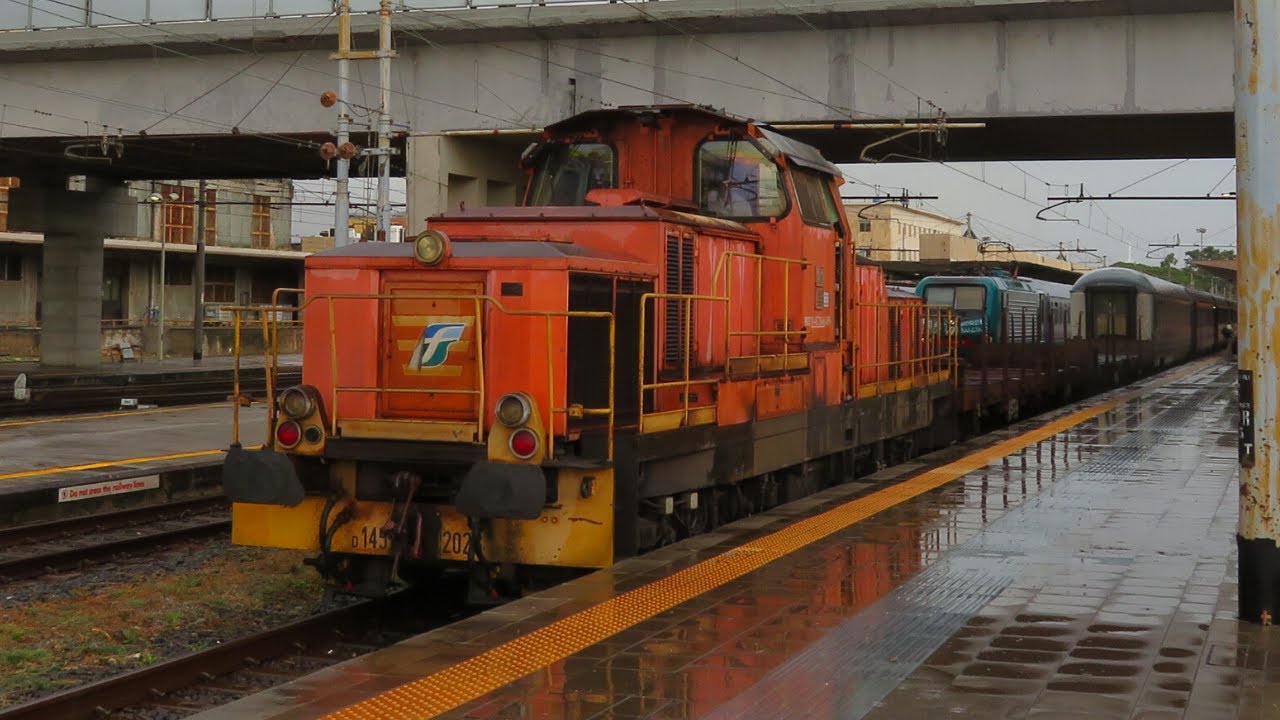
Italy/Sicily, D145 shunting locomotives seen in action at Messina Centrale station.
D145 2026 is seen leaving the stock of train IC35979, the 0726 Roma Termini to Palermo Centrale/Siracusa having shunted it off the ferry from Reggio Calabria on the Italian mainland, an unidentified classmate is also seen.
Clip recorded 3rd October 2019.
Le D.145 sono locomotive Diesel a trasmissione elettrica di costruzione italiana per servizio di manovra pesante e per treni merci.
Si tratta del primo progetto di locomotiva di nuova generazione per il rinnovamento del parco di rotabili ferroviari delle Ferrovie dello Stato. Il progetto venne sviluppato dalla Fiat Ferroviaria Savigliano alla fine degli anni settanta. La sua costruzione venne ordinata il 26 luglio del 1979 e le prime consegne iniziarono nel 1982.
La difficoltà di realizzare, sia in versione elettrica che Diesel, locomotive con buoni rendimenti adatte a questa vasta gamma di servizi fu finalmente superata negli anni ottanta del XX secolo con lo sviluppo dell’elettronica di potenza, che permise la realizzazione delle locomotive D.145 da parte della FIAT Ferroviaria Savigliano e della sua consociata Elettromeccanica Parizzi.
-+-+-+-+-+-+-+-+-+-+-+-+-+-+-+-+-+-+-+-+
Ferrovie dello Stato Italiane S.p.A. (previously Ferrovie dello Stato), (English: Italian State Railways) is a state-owned holding company that manages infrastructure and services on the Italian rail network.
One of the subsidiaries of the company, Trenitalia, is the main rail operator in Italy.
Trenitalia is the most important subsidiary of the company, as it manages all the trains of the company group. Trenitalia is the primary train operator in Italy. It was established in 2000 following a European Union directive on the deregulation of rail transport.
-+-+-+-+-+-+-+-+-+-+-+-+-+-+-+-+-+-+-+-+
Trenitalia is the primary train operator in Italy. A subsidiary of Ferrovie dello Stato Italiane, itself owned by the Italian government, it was established in 2000 following a European Union directive on the deregulation of rail transport.
Trenitalia offers national rail transport in Italy and international connections to Austria, France, Germany, and Switzerland. The company operates both regional and long-distance trains.
Regional trains travel within an Italian region or between neighboring Italian regions, and are subsidized by local government at the regional level by “Contratto di servizio”. Regional trains stop at more stations than other long-distance trains, and some stop at all stations. Regionale veloce (fast regional train) are trains stopping at about half of stations.
Long-distance trains are of mainly of two types: the Frecce (arrows) and Intercity trains.
Intercity trains also serve medium-sized cities besides the big cities, thus are generally slower but are cheaper than the Frecce.
Night trains (Intercity night) operate mainly between north and south of Italy and between Italy and its neighbouring countries and are comparable to Intercity level.
-+-+-+-+-+-+-+-+-+-+-+-+-+-+-+-+-+-+-+-+
Messina Sicilian: Missina; Latin: Messana; is the capital of the Italian Metropolitan City of Messina. It is the third largest city on the island of Sicily, and the 13th largest city in Italy, with a population of more than 231,000[7] inhabitants in the city proper and about 650,000 in the Metropolitan City. It is located near the northeast corner of Sicily, at the Strait of Messina, opposite Villa San Giovanni on the mainland, and has close ties with Reggio Calabria.
The city’s main resources are its seaports (commercial and military shipyards), cruise tourism, commerce, and agriculture (wine production and cultivating lemons, oranges, mandarin oranges, and olives).
Messina has a light rail system, Tranvia di Messina, opened on 3 April 2003. This line is 7.7 kilometres (4.8 mi) and links the city’s central railway station with the city centre and harbour.
-+-+-+-+-+-+-+-+-+-+-+-+-+-+-+-+-+-+-+-+
Messina Centrale is the main railway station of the Italian city of Messina, in Sicily. As Palermo Centrale, Catania Centrale and Syracuse it is one of the most important stations of its region.
The station, originally named simply as Messina, was inaugurated on 12 December 1866, as the terminal of the railway to Taormina, the first section of the Messina-Catania-Siracusa line. Heavily damaged after the 1908 earthquake, it was repaired a few years later. In 1939 it was finally renewed and replaced by the modern Messina Centrale, with the station building projected by the architect Angiolo Mazzoni.
The new station building was projected following the modern criteria of the futurist architect Angiolo Mazzoni, and is extended through the stations square.
-+-+-+-+-+-+-+-+-+-+-+-+-+-+-+-+-+-+-+-+
@FrontCompVids – Follow us on Twitter!
More FrontCompVids clips are regularly added to so don’t forget to Like and Subscribe!
Click for more details 🙂