
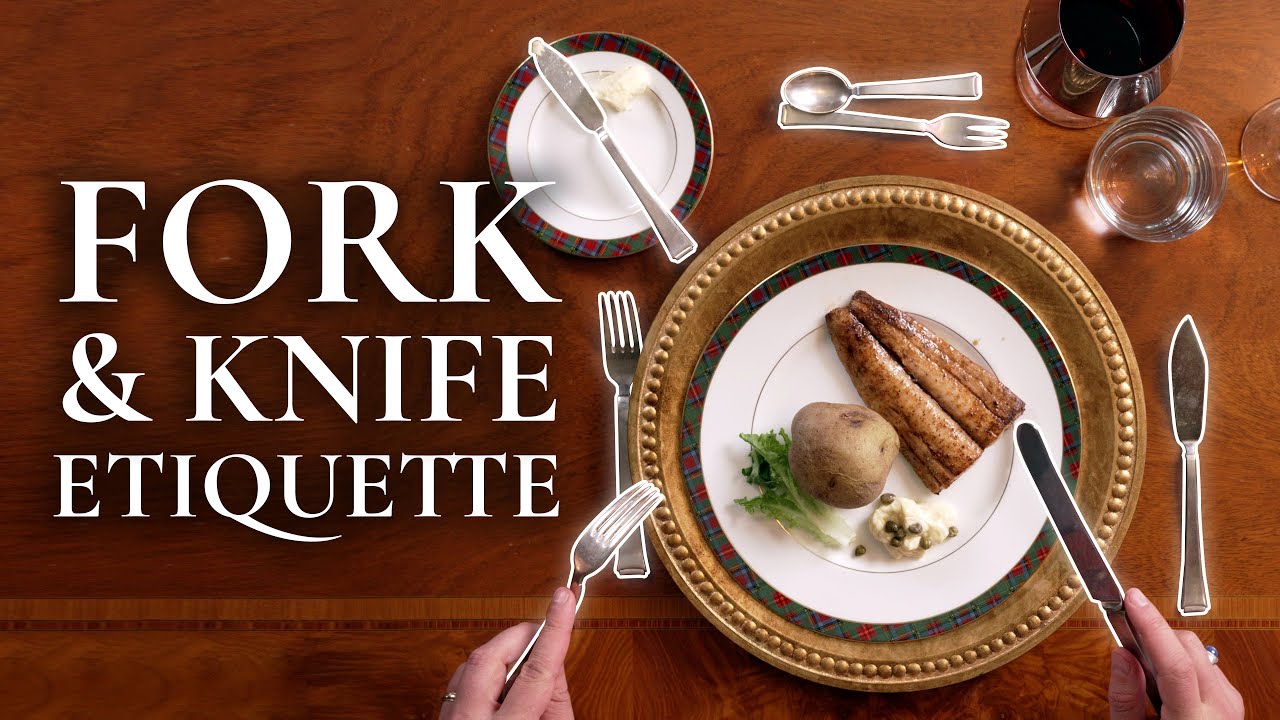
Learn the methods of eating with a knife and fork properly, the basic rules, and the dos & don’ts: https://gentl.mn/eat-fork-knife-etiquette
#etiquette #tablemanners #notsponsored
SHOP THE VIDEO:
→ Madder Print Silk Tie in Red with Buff Micropattern: https://gentl.mn/red–buff-micropattern-tie
→ Silver Eagle Claw Cufflinks with Lapis Lazuli Balls: https://gentl.mn/lapis-lazuli-silver-eagle-claw
→ Copper Red Pocket Square Art Deco Egyptian Scarab Pattern: https://gentl.mn/copper-red-pocket-square-art-deco
→ Navy and Khaki Shadow Stripe Socks: https://gentl.mn/navy-khaki-shadow-stripe-socks
GUIDES YOU DON’T WANT TO MISS:
→ Ultimate Table Manners Guide: https://gentl.mn/table-etiquette-guide
→ Restaurant Etiquette: https://gentl.mn/restaurant-etiquette-guide
VIDEO CREDITS:
→ Scriptwriter: E.J. Daniels
→ Camera & Editing: Chris Dummer
→ Visual Supervisor: Preston Schlueter
Sven Raphael Schneider
→ Paramount Pictures
→ Universal Pictures
→ Disney
→ ABC
Want to see more videos? Subscribe to our channel!
→ https://gentl.mn/youtube
Become a part of the Gentleman’s Gazette community – support us on Patreon!
https://gentl.mn/patron
Want to join our team? Take a look at our open positions!
https://gentl.mn/work-with-us
________________________________________________________________________
Gentleman’s Gazette
https://gentl.mn/homepage-gentlemansgazette-03
https://gentl.mn/FB-accessories-02
Facebook: https://www.facebook.com/gentlemansgazette
Gentleman Quiz: https://gentl.mn/3mins-gentlemansgazette-quiz-01
00:00 Eating with Fork & Knife Introduction
When dining, you’re going to want to enjoy yourself, and the people you’re with, but with etiquette varying across continents, it’s easy to get confused. We talk about how to eat with a fork and knife properly so you don’t embarrass yourself and can focus on the company you have tableside.
01:35 American (Zig-Zag) Style
At the core, it means that you eat the majority of your food with your dominant hand and your fork only. While you eat with your dominant hand, your other hand rests on your lap or underneath the table. In Europe, that wouldn’t be considered proper at all.
07:02 Continental (European) Style
It’s used in most parts of the world, except, of course, the US. The important difference is that both the fork and the knife are held in both hands throughout the meal.
10:56 Which Style Is Better?
Ultimately, the choice of which style you choose is entirely yours; however, if you’re switching styles or if you’re planning to up your table manner game, we suggest you practice at home, so you become really comfortable, and it’s all second nature.
13:52 Pausing & Resting Your Fork & Knife
Table manners are not something that is universally adhered to. So, your staff may not have the proper training, and they may not recognize that this is what you’re trying to communicate. Again, it’s important for you to understand what surroundings you’re in. At a high-end hotel, they will certainly take that clue. At a low-brow establishment, maybe not.
15:32 How to Show You’re Finished Eating
So, why are there really different styles to begin with? The Continental Style is older. The use of fork and knife to eat became standardized in the Western World in the 17th century. Ironically, the American Style was developed in France during the 18th century. At the time, it was thought it appeared more elegantly when one hand would rest while the other would do the eating. The cultural exchange between France and the US brought the style over to the US.
17:35 Cultural Differences in Fork and Knife Usage
Also keep in mind that etiquette can vary, not just based on the establishment you’re in, but also based on the type of food you eat.
21:47 Specialty Pieces: Salad Fork
22:37 Steak Knife
23:16 Bread Knife & Plate
24:55 A Word on Potatoes
26:01 Fish Cutlery
26:45 Dessert Fork
28:36 22 Fork & Knife Do’s & Don’ts:
1. Understand Your Surroundings
2. Don’t Eat With Your Knife
3. Give People A Chance To Eat
4. Use Quality Silverware
5. Don’t Use Plastic Utensils
6. Use A Firm Grip
7. Hold Your Fork & Knife Properly
8. Take Small To Moderate Bites
9. Don’t Use Your Fork Like A Shovel
10. Bring Your Fork To Your Mouth
11. No Elbows Or Arms On The Table
12. Don’t Slice Yur Food All AT Once
13. Use The Right Utensils For The Job
14. Request New Silverware When Needed
15. Don’t Make Excessive Noise With Silverware
16. Use Communal Flatware When Available
17. Rest Used Utensils On the Plate
18. Don’t Leave Half-Eaten Food On Fork
19. Don’t Gesture With Your Silverware
20. Allow Your Silverware To Be Taken Away
21. Don’t Hang Onto Your Silverware
22. Keep Leftover Sauce On Your Plate
If you’re interested in more etiquette guides, or other things in that vein, please share with us in the comments.
37:30 Outfit Rundown
40 Comments
Information like this just not widely enough taught / available. I learned so many things I do (or should do 🤦♂) unconsciously on this video. Thanks for posting!
American style or European style? I use both, according to the situation. My overriding consideration is how to get the food from the plate to my mouth with as little mess and spillage as possible. The US style can be simpler and more comfortable in some situations, but is limited in ensuring that food does not fall off the fork; the Euro style gives more control over the food by using the knife to shepherd some kinds of food onto the fork and keep it there.
While I was watching this I wasn't even sure what I do. I had to go eat something to find out.
1:33 I don't know about that. People in Europe were forced to use their right hand for everything regardless if it was the dominant one. This didn't happen as much in say East Asia. Today there are way more lefties in Europe. Probably the lefties got an advantage – likely their brains developed more. Just like the idea that people who speak foreign languages might have bigger protection against brain diseases. So use your non-dominant hand whenever possible.
Stabbing and eating peas one-by-one is psychotic. Don't do it. 😮
22:34 yes, I'd love a video where you explain all the different utensils. i am a student in the food and beverage service industry so it would help out a lot thank you:)
12:23 I'm used to seeing movie scenes but a meme is the last thing I can expect from GG's video! It was a really pleasant surprise.
Table topics like a fun video. I would enjoy that.
do europeans eat unpeeled boiled potatoes?
it seems like americans always make things more dumber. using two hands to eat with cutlery takes good amount of time. using only one hand will make it eternally slow. how long does lunch time take there, 50 mins?
i am an indian, so eating with your hands is the custom here. But, I have also been to quite some nice restaurants where they give you cutlery. Never have I ever got a sharp knife which can cut the cooked meat in a single motion. My home knives are much sharper than those restaurant knives.
The US style is awful
One important thing: never ever leave a messy plate that looks like a battlefield! With paper napkins, never throw them all crumpled up onto your plate. Fold them (stains inside, not to be seen) and place neatly under knife and fork when done eating.
Never put a fabric napkin after eating on the plate, it’s just gross. I’ve seen that once at a wedding reception in the US, and the guy who did that also used his left index finger to shove food onto his fork.
Also, never stuff a napkin in your collar…
I grew up in Austria and Germany with the continental way of using knife and fork. Taught it to my kids too. If kids see their parents eat this way, it is amazing how quickly it becomes natural to them too.
Love your videos about manners. They are universal
in the old days you did not cut potatos bechause silver knives turn black on potatos.
Any other Brits die inside a little every time he said "fork and knife"?
These etiquette videos are great. A specialist video on the different knives and forks would be good.
The 'fork in the off-hand' technique was.supposed to slow down the eating.
The theory was that with those few extra moments were the differemce between satisfied and gluttony.
The swapping of the hands 'zig-zag' would be an attempt to replicate that.
"… makes you look like a 4-year old, or at worse, a peasant." 😂
In Australia, the knife and fork placed together withbtines up and knife resting on tge fork and between the tines (usually anywhere from the 8 o'clock to 4 o'clock positions) is a sign of the person finishing their food.
Aside from that, formally, it's the continental way.
The American style is how I children eat 😂
Even the wording is different in the UK…
'Fork and knife' just sounds weird. It would always be said as knife and fork.
I prefer a hybrid approach. Meat, or anything requiring consistent cutting, O use the continental approach. All else is American style.
Shared. Be surprised on how many people don't have a clue. Your daughter is a cutie.
Excellent video Raphael!
What do you do if you are eating the salad after the main course and before dessert as is commonly done by the French, as they believe it aids the digestion process?
Thank you so much!
Lisa
This advice will come in handy on my next visit to Applebee's!
0:12 im sorry But shouldn’t your jacket be open when sitting down? Or is that only with single breasted jackets? Looks like that one is double breasted but I could be wrong
It is impolite to eat in "reverse continental"? (Fork on the right and knife on the left) i don't know why but y grew up doing that way
I really like that you learned to incorporate more memes & jokes into your videos
This explains why my husband eats differently than I do. I was taught by my Mom in Canada the American style and my husband's Mom was from England and taught him the European style.
Thank you for the review of table etiquette. I learned quite a few things I didn't know.
When I stayed at a hotel in a small Japanese city, the hotel restaurant only had chopsticks to use.
Luckily, I brought my own fork and knife with me and used it everyday to eat at the hotel breakfast buffet.
The other guests and hotel staff pretended not to notice. LOL 😅
Debretts say the tines must always point down.. Otherwise the tines may poke the roof of your mouth
LOL my like pushed it to 1,000. You're welcome.
Yes to table conversation topics please?
I was amazed to see our use of the zigzag method wasn't just something we used in our family. Sorry to say it didn't really stick with our kids, but at least we tried.
Much needed refresher. Is it acceptable to switch between european and american styles while eating a meal?
Would love to see more videos like this. Also a video on all the different silverware pieces and how to use them would be great. I love all the videos you produce. They are informative as well as entertaining. Have been watching for over a year now.
American born, but learnt the Continental European Style from my family. Was mocked once for using Continental, but I perfer Continental because its much mannerable for me. Great video😊 😊😊
Funny. Are you going to have a video how to tie your shoes?
This video is absurd. No American eats like that. Grown up in America my whole life and I have never seen anyone eat like that.
How to basic