
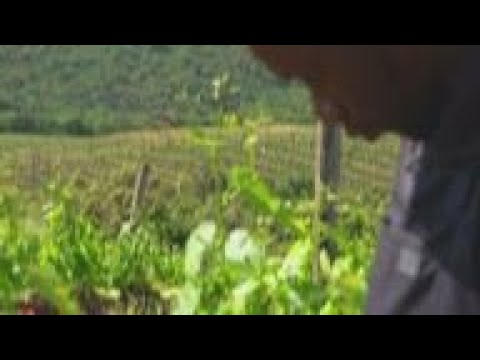
(3 Jun 2021) Summer season is arriving in wine country in Italy’s Tuscany region and the leaves on the vines shimmer in gold and green.
Yahya Adams moves his gloves through the foliage, removing excess buds and shoots to make the vines stronger.
He’s among 24 asylum-seekers from Africa and Asia who are working in the Tenute Silvio Nardi vineyard on this year’s crop of Brunello di Montalcino, one of Italy’s most famous wines.
They come from Ghana, Togo, Sierra Leone, Guinea Bissau, Pakistan and other countries, with no prior experience in wine-making, but have found work here through a local non-profit group that helps asylum-seekers find legal employment in vineyards or olive groves while their claims are being processed.
“I like this job,” said Adams, a 21-year-old from Ghana.
He left Ghana when he was just 14 years old to search for work abroad.
After spending two years in Libya, where he said he was temporarily held in captivity by one of his employers, he crossed the Mediterranean Sea to Italy on a ship with 118 other migrants.
He said he lived in various centres for unaccompanied minors, then tried to find work in Belgium, where he had friends, but returned to Italy where he is now enrolled in the work program of the Cooperativa Agricola San Francesco.
The NGO aims to bring asylum-seekers into the labor market under the same pay and conditions as Italians, rather than getting sucked into the off-the-books system known in Italian as “caporalato.”
The phenomenon is widespread in the agricultural industry, where workers are hired temporarily for seasonal work, with more than 400,000 people at risk of being exploited as cheap labor without proper contracts, according to the Placido Rizzotto Observatory, a union group monitoring the infiltration of organised crime in agriculture.
Some of them, they will say, work in the black market for three or four years, with no contract, nothing,” said Salis Godje, who co-ordinates the agriculture program for Cooperativa Agricola San Francesco.
Godje said the migrants selected for the program are given a training course to learn the basics of vineyard work.
After that they do three seasonal stints in the vineyard, pruning in the winter and summer and harvesting in the fall.
Nicola Peirce, the president of NGO, said the workers are paid around 7 euros an hour and work eight hours a day.
Migrant workers who work in agriculture irregularly often earn half as much while working longer hours.
Established in 1954, the family-owned Tenute Silvio Nardi every year produces 210,000 bottles of wine made with Sangiovese grapes, including 160,000 bottles of Brunello di Montalcino, which is aged for five years before release.
The asylum-seekers work in teams of eight in about 15 hectares (40 acres) of the vineyard in the hills of Casale del Bosco under the supervision of agronomist Vittorio Stringari.
Adams said he considers himself lucky to have a job that he likes and from which he earns enough to send and a little money to his family in Ghana.
“If I was having this work in my country, I would not go anywhere,” he said.
Finding Italians willing to work in the field is becoming more and more difficult, as Emilia Nardi, owner of the vineyard, believes.
“Everything changed recently, nowadays there are services teams, and we all know the phenomenon of the “caporalato,” she said.
“Well it’s not a nice thing, my family has an ethical principle, maybe it’s a Christian one, but everybody has the right to get their social security contributions paid, and we have respect for the work,” she added.
Find out more about AP Archive: http://www.aparchive.com/HowWeWork
Twitter: https://twitter.com/AP_Archive
Facebook: https://www.facebook.com/APArchives
Instagram: https://www.instagram.com/APNews/
You can license this story through AP Archive: http://www.aparchive.com/metadata/youtube/093fb0d71d2d4fcbaf06481476d05691
1 Comment
This man is a warrior of God.