
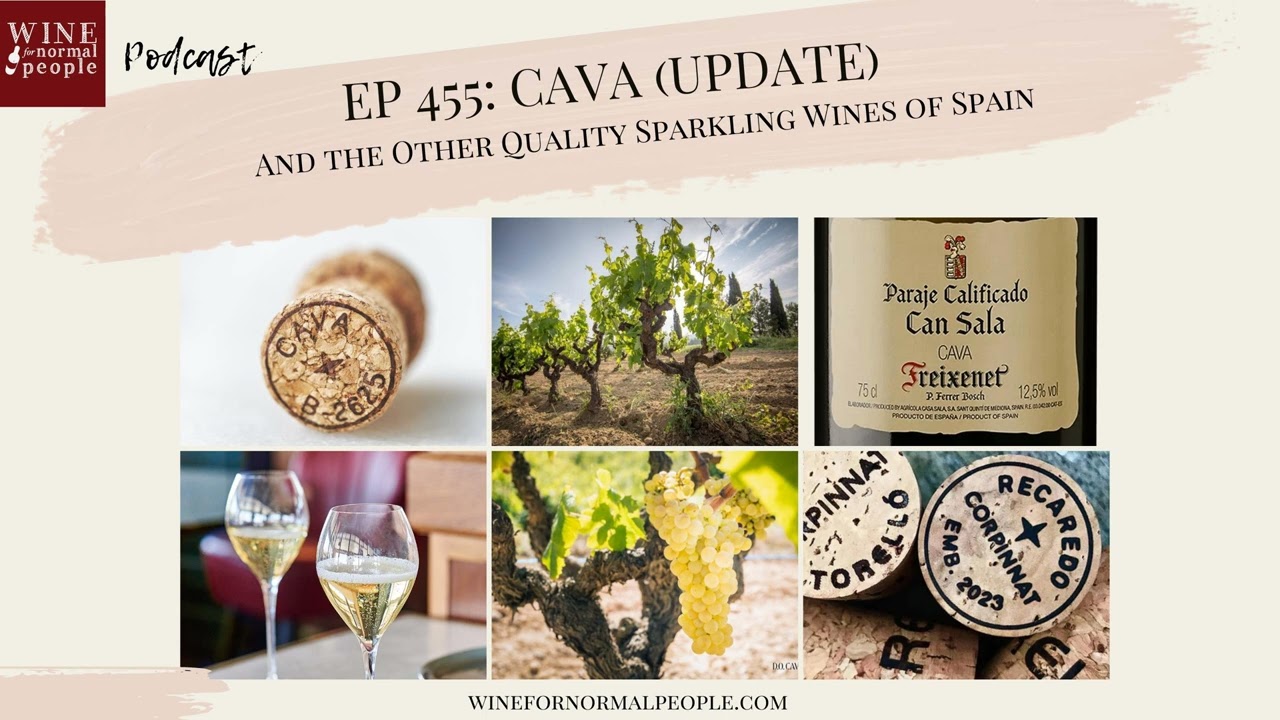
Much has changed since our original 2017 episode (199) on Cava and Spanish sparkling wine. It’s time for a refresh and an update!
Photo: Cava cork. Credit: cava.wine
In this episode we fill you in on the roller coaster the DO has been on since 2017 and where it stands today. The story shows how Spain has moved from just being ON the radar of international wine buyers to moving to a level of sophistication that demands its regions have the kind of terroir focus of the other great wine nations of the Old World – France, Italy, Germany, and Austria, to name a few.
We review the regulations, changes, and the strife in the region and discuss what to seek out to get the best of these highly accessible, delicious, and decidedly Spanish wines.
Here are the show notes…
The Basics
We start with the statistics on Cava — it encompasses 38,133 ha/94,229 acres and made 253 MM bottles in 2021 91% of Cava is white, 9% is rosado (rosé) Various zones produce the wine, but Penedés is the heart of Cava production, with more than 95% of total output We discuss the early history of the area, beginning with the first sparkling production in 1872 with Josep Raventós to the point where the DO is formed in 1991 – we leave the modern history until later, as complex and muddled as it is!
Map: The overly spread out regions of Cava. Credit: Cava DO
We then get into the grapes and winemaking:
Whites: Since most Cava is white, the white grapes dominate. Most important are the indigenous grapes, Macabeo (Viura, the white of Rioja), Xarel-lo, and Parellada. Chardonnay is also authorized, as well as Subirat Parent (Malvasia) for semi-sweet and sweet Cava. Photo: Macabeo. Credit: D.O. Cava
Reds: Used for rosado (rosé), native grapes are Garnacha (Grenache), Trepat, and Monastrell (Mourvèdre). The Cava DO authorized Pinot Noir for use in rosado in 1998 Winemaking: We discuss the vineyard requirements for the making of quality Cava, including the importance of gentle picking and transport to the winery to prevent oxidation We briefly review the Traditional Method (Champagne Method) of winemaking, which is how all Cava is made Photo: Riddled Cava, ready for disgorgement.. Credit: D.O. Cava
We discuss the aging qualifications for Cava, Cava Reserva, Cava Gran Reserva, and Cava Paraje Calificada that range from a minimum nine months to several years, and what each style yields We review the various dosage levels so you know what to look for: “Brut Nature” – no added sugar Cava Extra Brut – very little sugar Cava Brut: Slightly more added sugar in the dosage, sugar is barely noticeable Cava Extra Seco: heavier mouthfeel, noticeable sugar Cava Seco: Dessert level, very sweet Semi Seco: Even sweeter Dulce – Super sweet
We discuss why Cava is such a big mess, with much infighting in its modern history, and why not all sparkling Spanish wine is created the same:
We talk about the first fissures in Cava, with the 2012 break off of Cava OG producer Raventós i Blanc leaving the Cava DO because the quality standards were too low -Vino de la tierra Conca de l’Anoia (their own site) Photo: Raventós i Blanc Rosado, Vino de la Tierra
We discuss the 2015 formation of The Association of Wine Producers and Growers Corpinnat (AVEC) or Corpinnat. We define the group and talk about its requirements for the small member producers: Mission: Create a distinguished, excellent quality, terroir-driven sparkling wine based solely on Penedès, rather than far flung regions that make lesser wine. To raise the profile of Cava from cheap shit to good stuff Photo: Corpinnat corks. Credit: Corpinnat Website
Corpinnat Requirements At least 75% of the grapes must be from vineyards owned by the winery, wine must be made on the premises of the winery Minimum price paid for livable wages to the growers Certified organic and hand harvested grapes 90% of the grapes must be indigenous varieties: Macabeo, Xarel-lo, Parellada for whites, Garnacha, Trepat, Monastrell, for reds. 18 months minimum aging **By design: Cava’s three biggest producers can’t meet the requirements: Cordoniu, Freixenet and García Carrión – which is why Corpinnat started in the first place, to raise the quality standard and allow smaller producers a voice Corpinnat members (2022): Gramona, Llopart, Recaredo, Sabaté i Coca, Nadal, Torelló, Can Feixas, Júlia Bernet, Mas Candi, Can Descregut, Pardas We discuss the qualifications of the Cava Paraje Calificado classification, created by the Cava DO in 2017 for single-estate sparkling wines with a vineyard designation, lower yield, and a longer aging period Cava de Paraje Calificado requirements include specifications for: lower yield, manual harvest, minimum fermentation time in the bottle at 36 months. Vines must be at least 10 years old and the wine must be produced locally in the same winery that…
1 Comment
Wow. I thought I knew Cava. I obviously did not. Will seek out the Corpinnat producers.