
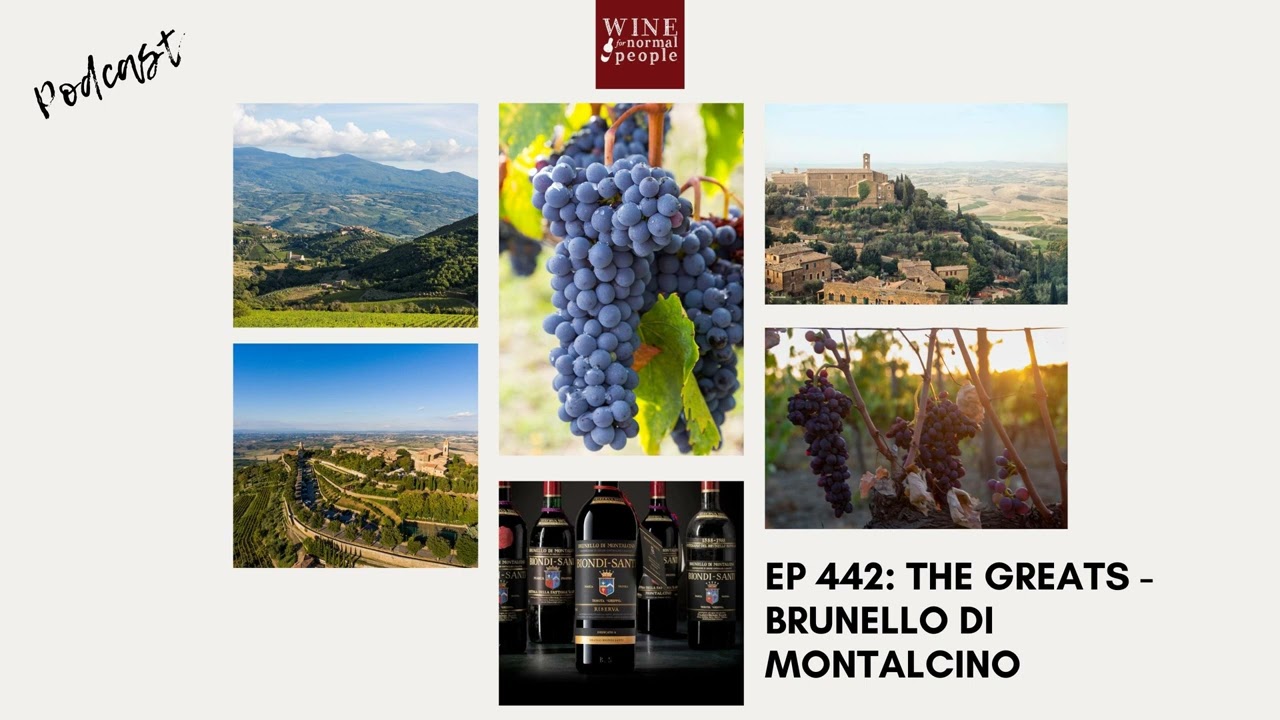
In Italy’s arsenal of great wines of the world, Brunello di Montalcino may be the most coveted of all. Its small production and terroir-driven style represents the pinnacle of Sangiovese, widely considered Italy’s most famed grape. Made in the small and historic Tuscan hilltop village of Montalcino, just south of Siena, the grapes thrive in the climate and soils of this rugged area. Although the youngest of all the Italian greats, Brunello, with its rich flavors, elegant balance of acidity and tannin, and incredible ability to improve with age, is a wine that everyone should experience even if just once in their wine lives. In this show we delve into the nuances of Brunello and talk about just what makes it so special.
Photo: Montalcino town & Vineyards, from Conzorzio di Brunello di Montalcino
Here are the show notes:
Location:
The small production zone of Montalcino is centered to the northeast of the namesake village in a wooded, hilly area with the most notable feature being Monte Amiata, the highest peak in Southern Tuscany. The village is Iabout 25 miles/40 km south of Siena, about 40 miles 77 km from the sea, and 62 miles/100 km from the Apennine Mountains, which affects the climate
History
I won’t give all the detail we do in the show, but the summary is that Montalcino has had a reputation for special wines for about 600 years but the wine as we know it today wasn’t created until the late 1800s. This is when first Clemente Santi, and then his grandson Ferruccio Biondi-Santi isolated the clones of Brunello/Sangiovese Grosso at their Il Greppo estate and made a wine of a quality the world had rarely seen from Italy. They began better vineyard work, meticulous cellar work, and extended aging that built the reputation of the area. Despite the accolades, the wine was such small production and Montalcino so obscure, that it wasn’t until the 1970s, when others started to recognize the potential in the area and by 1980 the supply of Brunello was adequate for wine lovers to be able to access this wine, created by one passionate family (who sadly no longer owns Biondi-Santi but whose legacy remains!). Photo from Biondi-Santi
Climate
Montalcino is marked by a Mediterranean climate: it is dry with some continental conditions. The area gets influences from both the coast and the mountains. Generally speaking it experiences mild summers, that permits gradual ripening of fruit. Although Central Tuscany can experience bad weather,Montalcino is protected by Mount Amiata to South, which blocks from storms and hail from destroying crops
Although everything in the above bullet is kind of true, it’s important to recognize that it’s a generalization: Microclimates really determine the specific wine’s flavor, as does producer sourcing and style. PLACE is so important…
Land
Montalcino is unique in that it’s elevations and various soil types produce a range of wines that can stand alone or be blended together to create a harmonious wine. The hilly, rugged area is at elevations between 490-1640 ft/150 – 500 m and the slopes have different exposures – south and north facing slopes are used in this area for different styles of wine The soils of Montalcino vary and each impart something different – limestone for elegance, calcareous rock for minerality, galestro soils in the north for aromatic, nuanced wines, clay in the south for heavier, denser Brunello. The general rule of thumb is Northern slopes: fruit ripen more slowly, the wines are more acidic Southern and western slopes: have intense sunlight that can be tempered by cool breezes, to make complex, yet often very fruity wines Top Brunello producers own vineyards on all of the finest terroirs and blend Photo: Montalcino town & Vineyards, from Conzorzio di Brunello di Montalcino
We discuss the eight sub-zones that have been proposed (but that will be a long time in coming, since it is a political hot potato): Montalcino North, Montalcino South, Castelnuovo dell’Abate, Camigliano, Tavernelle, Bosco, Torrenieri, Sant’Angelo (To see a Subzone Map Click Here) Montalcino (north and south): Known for ageable wines with complexity. These areas have the most famed producers (Biondi-Santi, Barbi, Costanti) Castelnuovo dell’Abate: Powerful wines with a balance of elegance and fruit Bosco: In the northwest is cooler with less tannic, more acidic wines Torrenieri: Clay soils make dense, tannic wines but producers are working on clones and rootstock to tame that Tavernelle: In the southwest is quite warm but has very even ripening and that means the wines are extremely consistent Camigliano: In the south this is the land of fruit bombs – it is hot, dry and wines can have a raisined note if not picked in time Sant’Angelo: The hottest driest part of Montalcino’s zones. These are very tannic, very fruity and have much lower acidity. They can have high…