
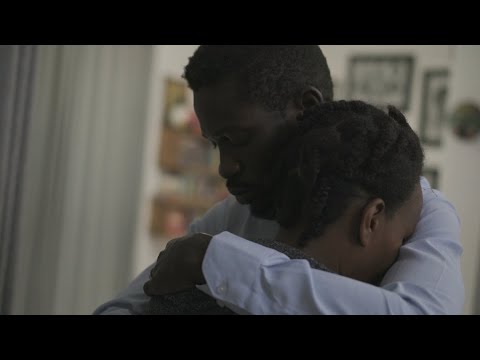
Documentary “Bobi Wine: Ghetto President,” which world premieres Out of Competition at the Venice Film Festival on Sept. 1, centers on a man’s pursuit of freedom and justice for his country, but at the film’s heart is a love story. Variety speaks to the filmmakers, and unveils the trailer, the first time any footage has been released.
The film, directed by Christopher Sharp and Moses Bwayo, and produced by Sharp and Oscar-winner John Battsek, follows the attempt by musician Bobi Wine to topple the repressive regime of Ugandan president, Yoweri Museveni.
Sharp has a personal connection to Uganda: both his father and he were born there, and he spent a large part of his childhood in the country. He met Wine, whose real name is Robert Kyagulanyi, in 2017, just after the musician had become a Member of Parliament.
“I was just bowled over by him: his optimism, his determination, his bravery. And then, his amazing wife, Barbie… I just felt like I’d never met anyone like them before,” he says. “I spent time with him and Barbie, and said: ‘We’ve just got to make a film about you guys.’”
Sharp started the project with a British cameraman, Sam Benstead, who decided to quit after a short period of time, and Benstead was replaced by an Italian cameraman, Michele Sibiloni, who also stood down. Finally, Sharp was introduced to Bwayo, who stuck with the task to the end, at great personal cost to himself. Bwayo says of his predecessors: “Because of the regime and how far they go with the torture and intimidation, because of some of these issues, those guys couldn’t carry on with the project.”
“Bobi and Barbie just gave us complete access,” Sharp says. “There was literally nothing they didn’t let us film. We shot thousands of hours of footage, and then spent two years in the cutting room trying to work out what film we were going to make.”
The film follows Wine as he steps up his campaigning against Museveni, culminating in his bid for the presidency itself in the election held in January 2021. Along the way, he and his supporters in his National Unity Platform party, part of what Wine dubbed the “People Power” movement, were subjected to repeated detentions and assaults. A crackdown by the police and army on anti-government protests resulted in scores of deaths.
Central to the film’s story is Wine’s relationship with his wife Barbie, and their children. “We obviously wanted to give Barbie and the children as much space as possible. We didn’t want it just to be a sort of political drama about another despot. We wanted it to be much more personal,” Sharp says.
“From the start, of course, it was a very conscious decision not to become an activist myself, or become a story myself,” he says. “But that said, actually, the stuff has happened to me myself. I mean, I’m in Los Angeles right now. I can’t live in Uganda anymore because of this film. Not in a bad way. I appreciate the fact I am part of this film, and it’s a sacrifice, and a very conscious decision that I made. Because change doesn’t come easy. There have to be sacrifices and to be honest, if you want to be a vehicle [for change], if you want to be involved in change… of course, you cannot be reckless, but you have to put your life at stake or [put yourself] in these situations to effect change in places like Africa and Uganda.”
“When Bobi saw the film, he said: ‘You made it not look that bad. There’s so little violence in it,’ ” Sharp says. “We filmed people who’d had their fingers chopped off, tongues chopped off, eyes gouged out, beaten. And in the end, we took a decision to really tell the story through Bobi and Barbie and those people around them. We thought that’d be more impactful, but it doesn’t do anything to show just how brutal [the regime is] and how so many bad things happen to a lot of people around [Bobi and Barbie].”
However, he considers himself lucky because no footage has been released, until now. “Luckily, when we were making this film, we hadn’t put out anything [online or on television]. So, this really kept me safe, because the regime didn’t see anything really out.”
However, “safe” in Uganda is a relative term. He adds: “Journalists, and anyone in Uganda who works to expose the regime, you’re a threat directly to the establishment.” As such, they are subject to intimidation and attacks. “I mean, I myself was shot in the face. If it wasn’t for the camera I was holding in front of me, I probably would have lost my eye. Just right here [he points to a scar]. My jaw would be shattered, or … I don’t know.” He was shot on Nov. 6, 2020, and was arrested around the end of February, beginning of March 2020, he adds. “Moses and Bobi and all those guys are just off the scale brave,” Sharp says.