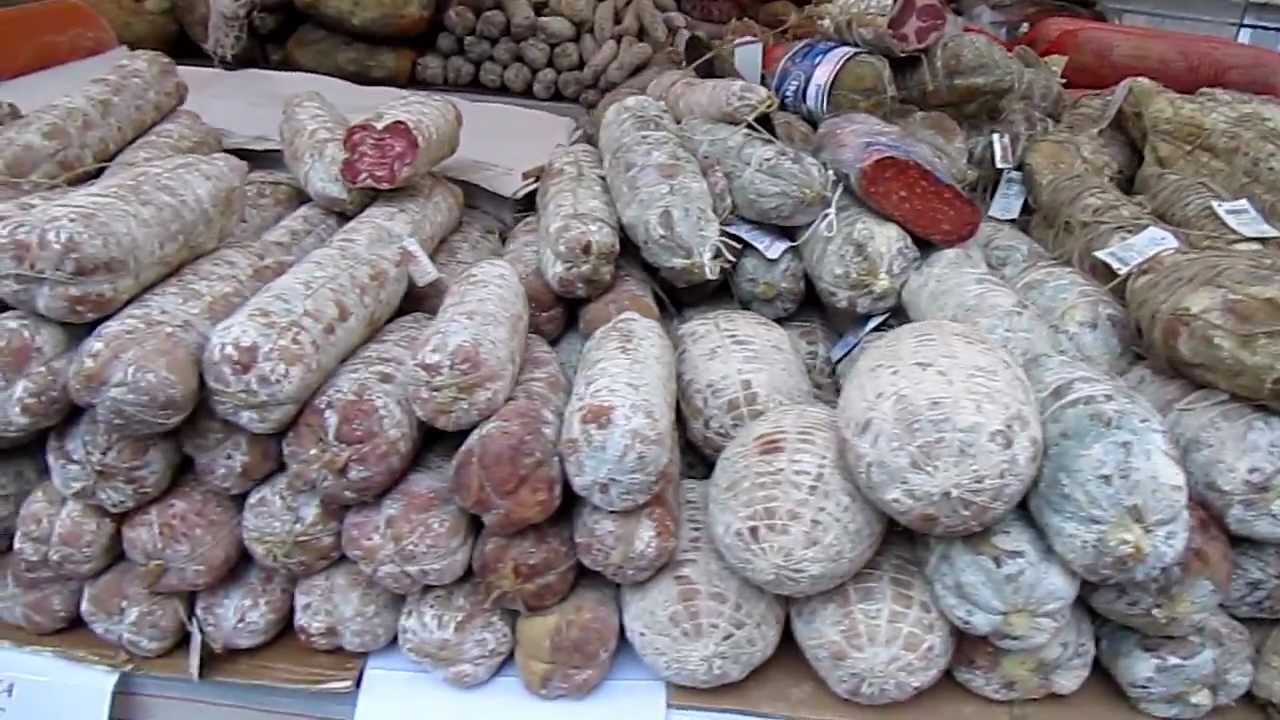
The main historical documents attest clearly and precisely the origin of the product and the link with the territory, dating back to 1231, kept at the State Archives of Cremona, and confirm a trade between the territory of Cremona and neighboring states of pigs and in meat products. From Renaissance documents existing in “Litterarum» and «Fragmentorum” irrefutably proves the presence, but above all the importance of the product “salami” in the production area identified in the specification. In reports made during the visit of the Bishop Cesare Speciano (1599-1606) to the female monasteries of the area shows that the “way of life cotidianamente,” “panels days you eat fat” was also distributed a certain amount of salami. The area where Salame Cremona includes the territory of the following regions: Lombardy, Emilia Romagna, Piedmont and Veneto. The weather is around the production area autumns and winters are fairly harsh, and very wet and foggy, springs are mild and rainy, while summers are characterized by quite high temperatures, rains rarely frequent, short-lived and very often, of intensive. The pig has always demonstrated in the Po Valley and in the valleys adjacent to it, the best animal to take advantage of the availability of corn and scraps of milk. Italian salami is a term to define a food-based raw or cooked meat, almost always with the addition of salt, sometimes of animal fat, herbs and spices and possibly other ingredients and preservatives. In other languages the term is used to identify meats, sausages and hams typical Italian. If locked in a container called bagged (traditionally used are the intestines of the animal, although today are also used synthetic materials). Is preserved in several ways, depending on whether raw, cooked, cured or smoked. Although meats can come from meat of different farm animals (cattle, goose, goat, donkey, sheep) and game (wild boar, deer, roe deer), the pig is certainly the most suitable for this purpose: they can use parts whole (thighs, shoulders, cups), or chopped meat and sausages, both raw (salami and sausage) and cooked (mortadella, pig’s feet, pork sausage). We should also mention the meats of fish present locally in Italy, as the ficazza Sicilian tuna, salami and the musciame trout Trentino and Piemonte. The ham is obtained from pork leg, which is dry salted, by immersion in brine or injection of saline into the femoral artery. The dry salting process is traditional and the most suitable for a quality standard. The piece is then sprinkled with salt once a day, for the duration of one month, in a refrigerated environment; eventually washes ham with warm water and allowed to mature in the open air for at least three months (for the best products even a year). The sausages are obtained from various muscle tissues, which are chopped and mixed with fragments of fat, salt and pepper; the mixture is then stuffed into casings animals, who are tied with string at regular intervals. Follows a curing period (from 1 to 6 months) in a well ventilated and cool (10 to 13 ° C). The production process is summarized as follows: the raw material for the production of the PGI must come from pigs born, raised and slaughtered in the following regions: Friuli Venezia Giulia, Veneto, Lombardy, Piedmont, Emilia Romagna, Umbria, Tuscany, Marche, Abruzzo, Lazio and Molise. They can be used: traditional pig breeds Large White and Landrace Italian Italian, as improved by the Italian herd book, or offspring of boars of these breeds; progeny of sows of the Duroc Italian breed, as improved by the Italian Herd Book; progeny of sows of other breeds or hybrid boars provided they come from selection or crossing schemes implemented for purposes not inconsistent with those of the Italian Herd Book for the production of heavy pigs. The pigs are sent for slaughter before the end of the 9th month and not after the 15th month from birth. The average weight of the individual sent for slaughter must be embodied in the current range between 144 kg and 176 kg. The pork used to the dough is that muscle tissue from carcases and pieces of striated muscle and fat. Ingredients: salt, spices, peppercorns or coarse pieces, garlic crushed and worked into the mixture. Any other ingredients: white or red wine stationary, sugar and / or dextrose and / or fructose and / or lactose, starter cultures for the fermentation, sodium nitrite and / or potassium, ascorbic acid and its sodium salt. Are prohibited MSM. Preparation: the pieces of muscle and fat are carefully trimmed, removing the larger pieces of connective and adipose tissue springs, lymph nodes and nerves. The meat is ground in mincers using blades with 6 mm holes. The temperature of the meat to the shredding must be greater than 0 ° C; the meat is salted during slaughter; gained ground combine the other ingredients and flavors.