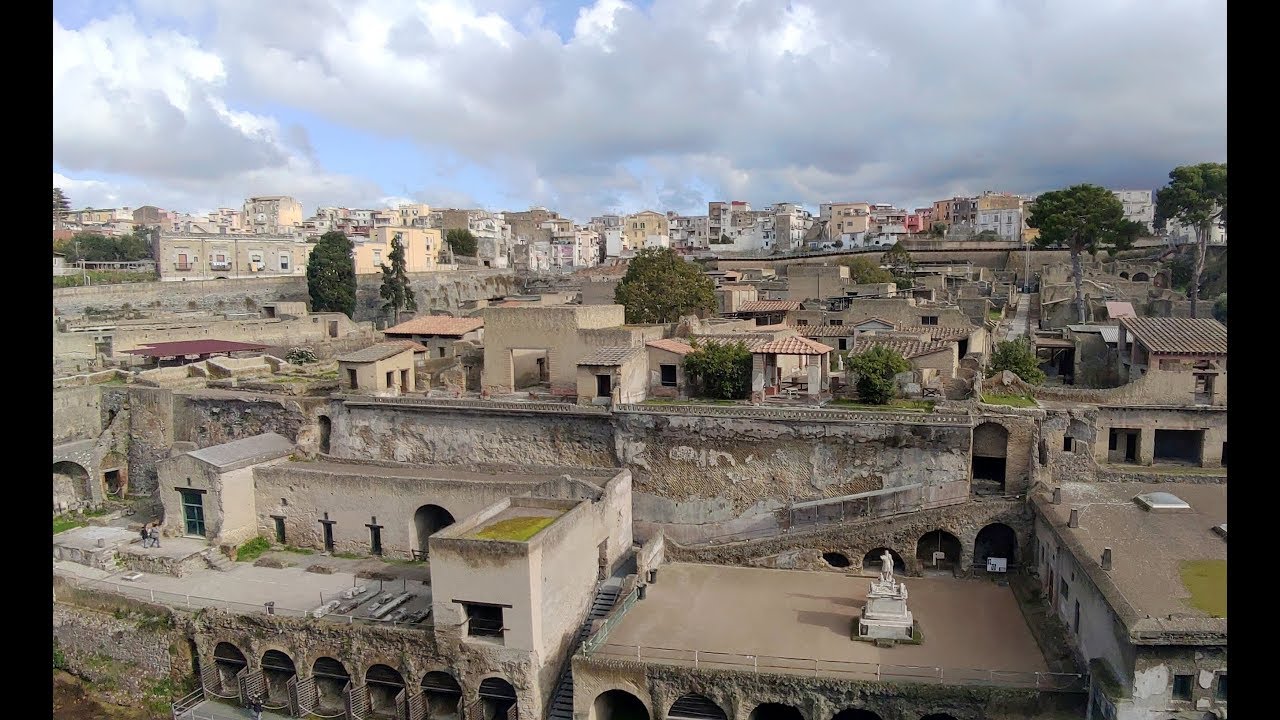
Ercolano is a town and comune in the Metropolitan City of Naples, Campania of Southern Italy. It lies at the western foot of Mount Vesuvius, on the Bay of Naples, just southeast of the city of Naples. The medieval town of Resina – read Resìna – was built on the volcanic material left by the eruption of Vesuvius (79 CE) that destroyed the ancient city of Herculaneum, from which the present name is derived. Ercolano is a resort and the starting point for excursions to the excavations of Herculaneum and for the ascent of Vesuvius by bus. The town also manufactures leather goods, buttons, glass, and the wine known as Lacryma Christi (Tears of Christ). Since the time of Roman Herculaneum, the area has attracted famous artists, poets, writers and philosophers. The Villa dei Pisoni, for instance, was an international centre of Epicurean philosophy. In the middle of the 15th century, Antonio Beccadelli, known as Il Panormita, built a villa on the seafront of Resina that was named Plinianum where the fellows of the Porticus Antonianum (also called Accademia Pontaniana after Antonio Pontano) used to gather. Following the discovery of the buried town of Herculaneum and the start of the excavations, artists, scholars and authors from all around Europe begun to converge to Resina and the ruins of Herculaneum were one of main destinations of the Grand Tour. Some of the most famous architects, painters, and sculptors of that time worked in the town to design and build the villas of the Miglio d’Oro (The Golden Mile) and many villas became important literary salons. In 1863 the local painter Marco De Gregorio started the Scuola di Resina (School of Resina), an art movement that broke with the academic tradition in favour of a more realistic and intimate vision of the world around. It had some connection with the Macchiaioli movement, and had as main interpreters, together with De Gregorio: Adriano Cecioni, Giuseppe De Nittis, Federico Rossano, Eduardo Dalbono, Nicola Palizzi and Antonino Leto. Between 1892 and 1893 Gabriele D’Annunzio was guest in Villa D’Amelio in Resina where he found inspiration for his work during those years. After the establishment of the Ente per le Ville Vesuviane and the restoration of Villa Campolieto, the town of Ercolano hosted international events such as the international exhibition of contemporary art Terrae Motus, conceived by Lucio Amelio after the earthquake of 1980. Villa Campolieto is the location of the Festival delle Ville Vesuviane and hosts the School of Management Stoà. The town is also home to the MAV, Virtual Archeological Museum, which gives an original multimedia presentation of the history of Herculaneum and the eruption of Mt. Vesuvius in AD 79. In addition there is the Creator Vesevo, alongside the street leading to Mt.Vesuvius, an open air permanent exhibition of stone sculptures created by famous international artists in 2005.