Santa Maria Novella is a church in Florence, Italy, situated just across from the main railway station which shares its name. Chronologically, it is the first great basilica in Florence, and is the city’s principal Dominican church. The church, the adjoining cloister, and chapterhouse contain a store of art treasures and funerary monuments. Especially famous are frescoes by masters of Gothic and early Renaissance. They were financed through the generosity of the most important Florentine families, who ensured themselves of funerary chapels on consecrated ground. The vast interior is based on a basilica plan, designed as a Latin cross and is divided into a nave, two aisles with stained-glass windows and a short transept. The large nave is 100 metres long and gives an impression of austerity. There is a trompe l’oeil-effect by which this nave towards the apse seems longer than its actual length. The slender compound piers between the nave and the aisles are ever closer when you go deeper into the nave. The ceiling in the vault consists of pointed arches with the four diagonal buttresses in black and white. The interior also contains corinthian columns that were inspired by the Classical era of Greek and Roman times.
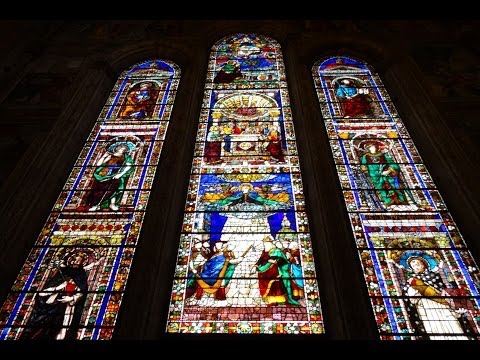
The stained-glass windows date from the 14th and 15th century, such as 15th century Madonna and Child and St. John and St. Philip (designed by Filippino Lippi), both in the Filippo Strozzi Chapel. Some stained glass windows have been damaged in the course of centuries and have been replaced. The one on the facade, a depiction of the Coronation of Mary dates from the 14th century, based on a design of Andrea di Bonaiuto da Firenze.
The pulpit, commissioned by the Rucellai family in 1443, was designed by Filippo Brunelleschi and executed by his adopted child Andrea Calvalcanti. This pulpit has a particular historical significance, because from this pulpit the first attack came on Galileo Galilei, leading eventually to his indictment. The Holy Trinity, situated almost halfway in the left aisle, is a pioneering early renaissance work of Masaccio, showing his new ideas about perspective and mathematical proportions. Its meaning for the art of painting can easily be compared by the importance of Brunelleschi for architecture and Donatello for sculpture. The patrons are the kneeling figures of the judge and his wife, members of the Lenzi family. The cadaver tomb below carries the epigram: “I was once what you are, and what I am you will become”.
Of particular note in the right aisle is the Tomba della Beata Villana, a monument by Bernardo Rossellino in 1451. In the same aisle, you can find the tombs of the Bishop of Fiesole by Tino di Camaino and another one by Nino Pisano. Giorgio Vasari was the architect, commissioned in 1567 by Grand Duke Cosimo I, for the first remodeling of the church, which included removing its original rood screen and loft, and adding six chapels between the columns. An armillary sphere (on the left) and a gnomon (on the right) were added to the end blind arches of the lower façade by Ignazio Danti, astronomer of Cosimo I, in 1572. The second remodeling was designed by Enrico Romoli, and was carried out between 1858 and 1860. The square in front the church was used by Cosimo I for the yearly chariot race (Palio dei Cocchi). This custom existed between 1563 and late in the 19th century. The two obelisks marked the start and the finish of the race. They were set up to imitate an antique Roman circus. The obelisks rest on bronze tortoises, made in 1608 by the sculptor Giambologna. This church was called Novella (New) because it was built on the site of the 9th-century oratory of Santa Maria delle Vigne. When the site was assigned to Dominican Order in 1221, they decided to build a new church and an adjoining cloister. The church was designed by two Dominican friars, Fra Sisto Fiorentino and Fra Ristoro da Campi. Building began in the mid-13th century (about 1246), and was finished about 1360 under the supervision of Friar Iacopo Talenti with the completion of the Romanesque-Gothic bell tower and sacristy. At that time, only the lower part of the Tuscan gothic facade was finished. The three portals are spanned by round arches, while the rest of the lower part of the facade is spanned by blind arches, separated by pilasters, with below Gothic pointed arches, striped in green and white, capping noblemen’s tombs. This same design continues in the adjoining wall around the old churchyard. The church was consecrated in 1420.