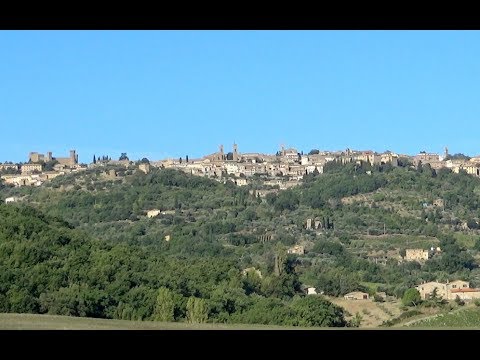
Montalcino is an Italian town of 5920 inhabitants in the province of Siena in Tuscany. It is a place known for the production of Brunello wine. It is located in the territory north-west of Monte Amiata, at the end of the Val d’Orcia, on the administrative border with the province of Grosseto. The hill on which Montalcino is located was probably inhabited already in the Etruscan era. Montalcino is mentioned for the first time in a document dated December 29, 814, when Emperor Louis the Pious granted the sub Mount Lucini territory to the abbot of the nearby abbey of Sant’Antimo. On the origin of the name of Montalcino there are at least two hypotheses. Some believe it derives from the Mons Lucinus mentioned in the 814 document, a name in honor of the goddess Lucina or reference to the Latin word lucus, which means “sacred wood”, or more generally “small forest”. Others, instead, derive the toponym from Mons Ilcinus, from the Latin mons (mount) and ilex (leccio), that is “monte dei lecci”, a plant widespread in the area represented also in the city coat of arms. With the passing of the centuries the name, however, would have been transformed by Mons Lucinus or Mons Ilcinus into Mons Elcinus and later into the current Montalcino. The first settlement is believed to date back to the 10th century. In this period the population had a notable demographic increase when the inhabitants of Roselle moved to the city. The original inhabited nucleus would have extended over the centuries to reach its current dimensions in the 14th century. Thanks to the position of the city, overlooking the top of a hill, from its avenues the view can range over the Ombrone and Asso valleys. In medieval times the prevailing economic activity was the tannery and Montalcino had numerous leather processing factories, factories that were famous for the quality of their products. Subsequently, as happened to many inhabited centers of the province of Siena, Montalcino also experienced a very serious economic and demographic crisis. Like many of the medieval villages of Tuscany, Montalcino experienced long periods of peace that allowed the inhabitants a certain prosperity. This peace and relative well-being, however, have been interrupted by a series of extremely violent episodes. During the late Middle Ages Montalcino was still an independent town of considerable importance due to its position on the old Via Francigena, the main road between France and Rome, but over time it entered the orbit of the powerful Siena. Like a satellite of Siena, at the time of the Battle of Montaperti 1260, Montalcino was deeply involved in the conflicts in which Siena was also involved, particularly in those with the city of Florence during the 14th and 15th centuries. Like many other cities in central Europe and northern Italy, the city was also affected by the infighting between the Ghibellines and the Guelphs (supporters of the Holy Roman Empire, the Ghibellines and supporters of the Papacy, the Guelphs respectively). Factions of the two camps controlled the city at different times at the end of the medieval period. After the fall of Siena 1555 the Sienese nobles perched in the city for 4 years with the hope of one day returning to Siena, giving life to the Republic of Siena repaired in Montalcino. But in the end even Montalcino became part of the Grand Duchy of Tuscany until the unification of Italy in 1861. The situation changed radically in the second half of the 20th century. In the case of Montalcino, his fortune was to be in the center of one of the most important grape growing areas. The territory, in fact, is celebrated for the presence of Sangiovese vineyards from which the famous Brunello di Montalcino is obtained and which are also used for the production of two other DOC wines: Rosso di Montalcino and Sant’Antimo. On 1st January 2017, the municipality of Montalcino merged that of San Giovanni d’Asso. With this merger the municipality has increased its land area so as to become the 35th largest municipality in Italy by extension, as well as the 5th in Tuscany and the 1st in the province of Siena.