
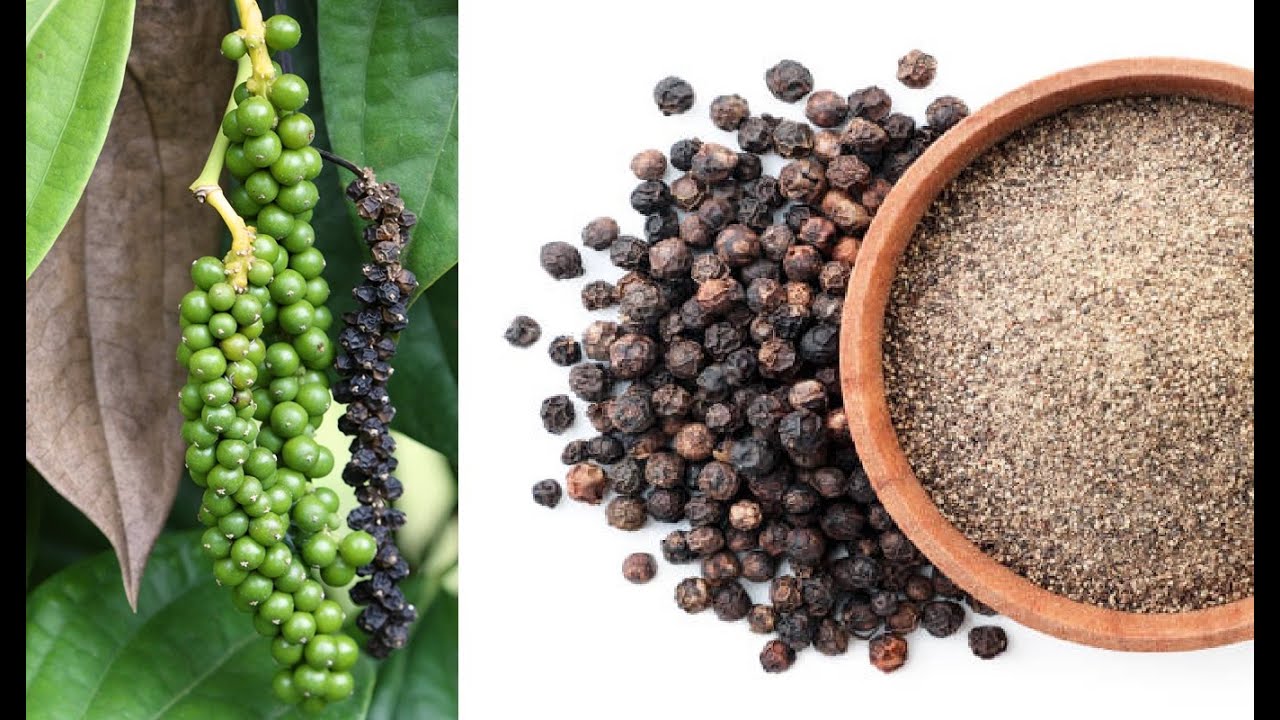
Black pepper (Piper nigrum) is a flowering vine in the family Piperaceae, cultivated for its fruit, known as a peppercorn, which is usually dried and used as a spice and seasoning. The fruit is a drupe (stonefruit) which is about 5 mm (0.20 in) in diameter (fresh and fully mature), dark red, and contains a stone which encloses a single pepper seed. Peppercorns and the ground pepper derived from them may be described simply as pepper, or more precisely as black pepper (cooked and dried unripe fruit), green pepper (dried unripe fruit), or white pepper (ripe fruit seeds).
Black pepper is native to the Malabar Coast of India, and the Malabar pepper is extensively cultivated there and in other tropical regions.
Ground, dried, and cooked peppercorns have been used since antiquity, both for flavour and as a traditional medicine. Black pepper is the world’s most traded spice, and is one of the most common spices added to cuisines around the world. Its spiciness is due to the chemical compound piperine, which is a different kind of spicy from the capsaicin characteristic of chili peppers. It is ubiquitous in the Western world as a seasoning, and is often paired with salt and available on dining tables in shakers or mills.
Black peppercorns were found stuffed in the nostrils of Ramesses II, placed there as part of the mummification rituals shortly after his death in 1213 BCE.Little else is known about the use of pepper in ancient Egypt and how it reached the Nile from the Malabar Coast of South Asia.
Pepper (both long and black) was known in Greece at least as early as the fourth century BCE, though it was probably an uncommon and expensive item that only the very rich could afford.
A Roman-era trade route from India to Italy
By the time of the early Roman Empire, especially after Rome’s conquest of Egypt in 30 BCE, open-ocean crossing of the Arabian Sea direct to Chera dynasty southern India’s Malabar Coast was near routine. Details of this trading across the Indian Ocean have been passed down in the Periplus of the Erythraean Sea. According to the Greek geographer Strabo, the early empire sent a fleet of around 120 ships on an annual trip to India and back.[25] The fleet timed its travel across the Arabian Sea to take advantage of the predictable monsoon winds. Returning from India, the ships travelled up the Red Sea, from where the cargo was carried overland or via the Nile-Red Sea canal to the Nile River, barged to Alexandria, and shipped from there to Italy and Rome. The rough geographical outlines of this same trade route would dominate the pepper trade into Europe for a millennium and a half to come.