
Hey everyone, Welcome to Mythology Explained. In today’s video, we’re going to discuss Dionysus.
Let’s get into it.
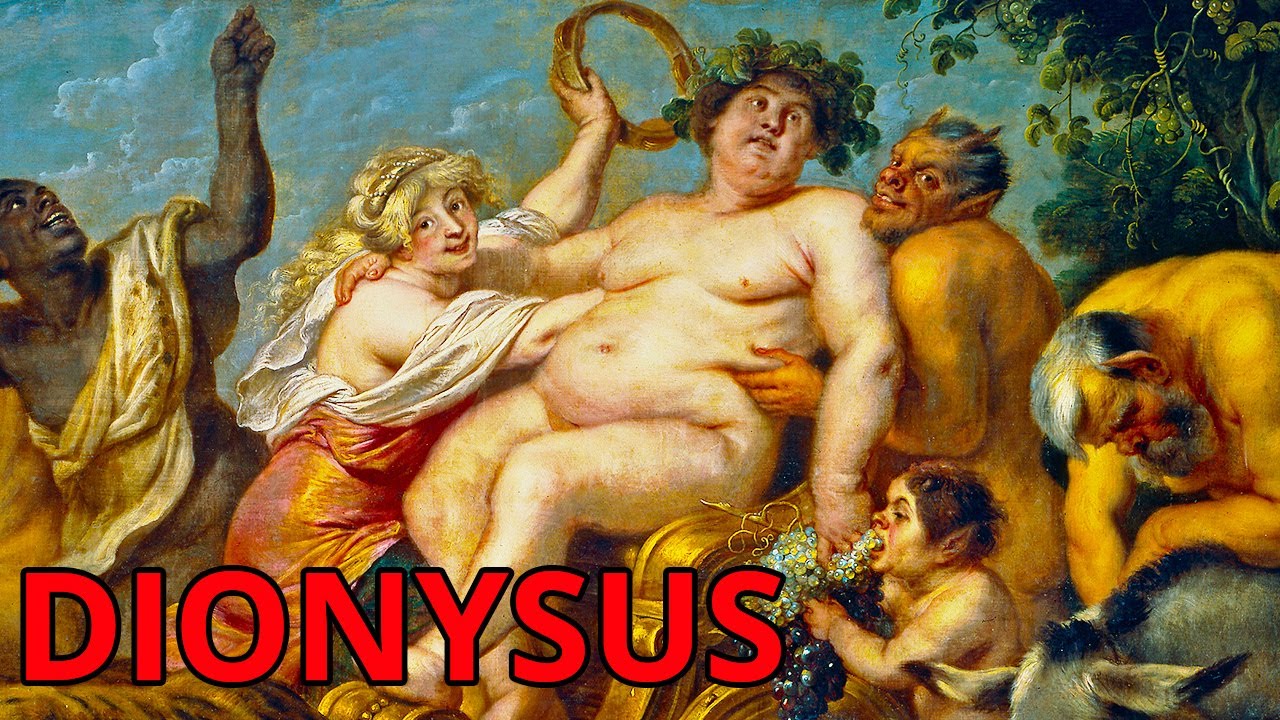
Known as Bacchus to the Romans, Dionysus was the god of wine. Both the Ivy, a plant symbol of eternal life, and the grapevine were sacred to him. He kept a raucous and motley entourage that included Satyrs, Silens, and Maenads. In art, he most commonly featured on alcohol paraphernalia, such as wine cups and pitchers. Dressed in fawn skin, wine cup in hand, he was depicted with long hair, a beard, and with ivy wreathed about him.
Dionysus was closely tied to Demeter, the goddess of grain, the harvest, and agriculture, and he was also viewed as a god that brought earth’s bounty to bloom, providing sustenance for humanity. He was the god of wine, but originally and more fundamentally, he was the god of liquid life, especially the sort in plant life that allowed nature to flourish. Plant growth was his province, which is why he was called Anthios (“Bloom-Producing”), Karpios (“Bringer of Fruit”), and Dendrites (“Tree God”). That the liquids made from plants – such as honey and wine – became subsumed into his sphere of influence was a natural progression.
Dionysus became such a popular god, in part, because his favour was bestowed in egalitarian fashion. The classifications that culminated into the hierarchy that structured society were irrelevant to him. Free, slave, young, old, common, royal, man, woman, human, beast: all were equal in his eyes.
In particular, women, who were stifled in many ways men weren’t, were drawn to the cult of Dionysus. They were often confined to the home and didn’t enjoy the same freedom men did, so worshiping Dionysus was a respite from the tedium and drudgery that mounted day after day. Connection to Dionysus was achieved through ecstatic dancing and the drinking of wine. In this rapturous state, people went into the wilderness where they let the wild abandon of their rituals overcome them. Small animals were often captured and consumed raw, their blood symbolic of Dionysus. The practice of these rituals continued longer in rural areas, but in urban areas, such as the metropolis of Athens, the worship of Dionysus was subsumed into the purview of the theatre, which staged performances in his honour. In this way, Dionysus also became the patron god of the theatrical arts.
Watch the video for the rest!