
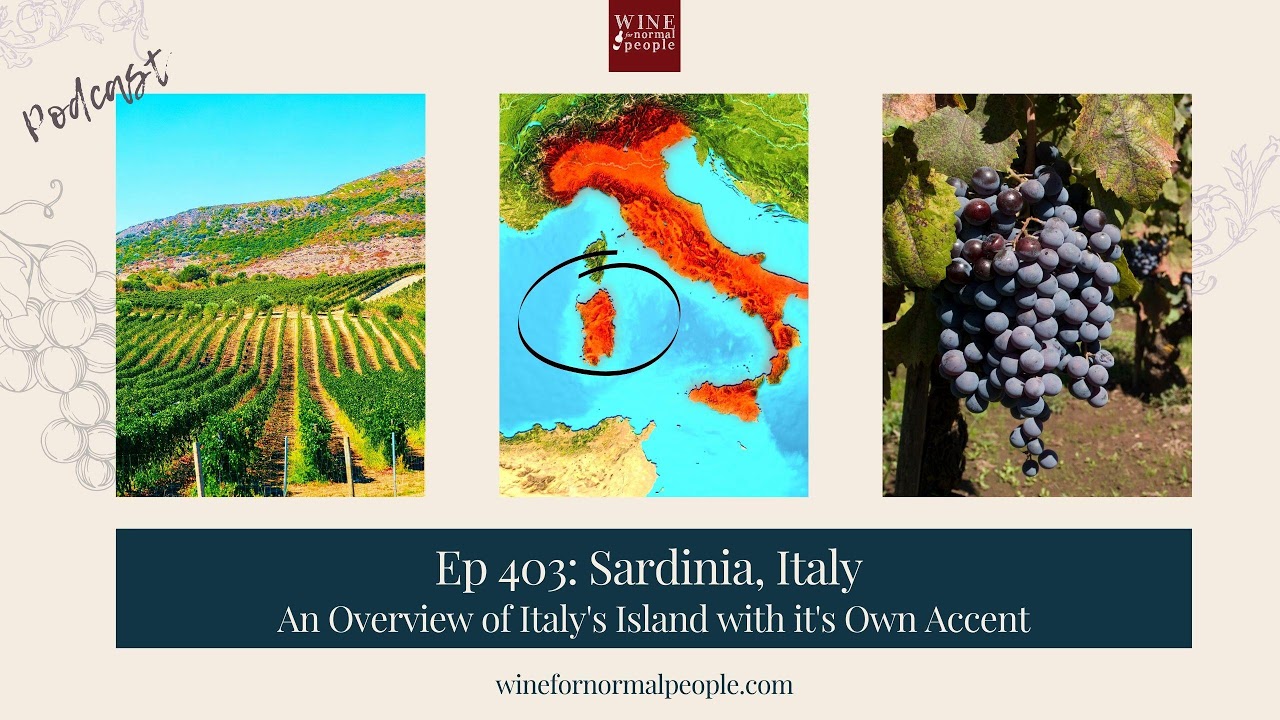
Sardinia is the second-largest island in the Mediterranean, and lies off the west coast of mainland Italy. Much larger than Corsica, the wines here have a distinctly Spanish influence, with some Italian and French to boot. The wines are unlike any other you’ll encounter (although many you can only encounter them if you visit!). In this show we try try to sort through the grapes and regions of this island to get to the heart of what’s here (Grenache, Vermentino) and what to look for in the future.
Sardinia is 150 miles (240km) off the west coast of mainland Italy. Across the Tyrrhenian Sea from Lazio (the province where Rome is located), Sardegna is sandwiched between French Corsica in the north and Sicily in the south at 38˚N and 41˚N latitude. The island is almost three times the size of Corsica with a population of 1.64 million people, with the largest city of Cagliari in the south. Known by the jet setters for the fancy Costa Smeralda in northeast tip, this big island is making more and better wines every year.
Photo: Getty Images/Canva
Here are the show notes:
After some facts and history, I get the hardest part of Sardegna out of the way: the fact that it feels like there are a million appellations: 1 DOCG, 17 DOCs, 15 IGPs and two-thirds is DOP level. It seems nonsensical – too many “line extensions” of the Sardinia brand!! There are more DOC and IGT titles than Basilicata and Calabria combined but has lowest production per hectare. This is especially confusing when you consider that there are just 25,000 ha/61,776 acres under vine, and 31,000 growers, who own tiny plots (and often form co-ops to economics work). To try to clear up the DOC confusion, I break it down into the three big buckets:
“di Sardegna” Appellations:
Cannonau di Sardegna Monica di Sardegna Moscato di Sardegna Vermentino di Sardegna Sardegna Semidano
Cagliari Appellations
Malvasia di Cagliari Monica di Cagliari Moscato di Cagliari Nasco di Cagliari Nuragus di Cagliari
Other important DOC/Gs:
Carignano del Sulcis Vermentino di Gallura DOCG Vernaccia di Oristano For Bovale: Mandrolisai, Campidano di Terralba
Then we discuss the basics on this large island…
The climate of Sardinia is dry and hot with some maritime influences to cool down the vineyards. The rolling hills and different elevations mean there are many mesoclimates, so growers have to pay attention to their particular area.
Sardinia is made up of hills, plains, coast, and inland areas with varied soils – granite (Gallura), limestone (Cagliari), sandstone, marl, mineral rich clay, sands, gravel. The land tends to be undulating but there are also very high altitudes at which grapes can be planted.
Grapes… The top five varietals are nearly 70% of land under vine, and the area is home to 120 native grape varieties. Old vines (70+ years) are common in Sardinia
The top 5 grapes are:
Cannonau/Grenache Vermentino Carignano Monica Nuragus The reds…
Cannonau is about 20% of the output of Sardinia. Although it is identical to Grenache, some natives think the grape originated here, and are trying to prove that. These best wines come from a triangle that covers the eastern interior areas within the Cannonau di Sardegna DOC (these names will be on the label):
Oliena (Nepente di Oliena) Capo Ferrato Jerzu
Cannonau is known to have thin skin, medium acidity, a medium body with soft tannins, and high alcohol. It often tastes and smells like peppery spice, red berry, red flowers, and earth and generally has low or no oak aging. Cannonau di Sardegna is required to be 90-100% Cannonau, with other non aromatic, local red grapes permitted. There are a few styles of this wine:
Rossoor classico (a little higher alcohol, more yield restrictions), which are often in one of two styles… Strong and tannic with lower acidity and higher alcohol – a steakhouse wine, as MC Ice called it Dry, fewer tannins and slightly fruity, with red berry, cherry, floral, spicy anise/herbal notes, earth, and strong acidity. This is a wine that improves with age Riserva is generally made with riper fruit, and is required to age at least two years with time in a barrel and a minimum alcoholic strength of 12.5% Rosato is a light to full rosé The fortified liquorosowines are made as dolce with a high residual sugar content, or secco, dry with a higher alcohol content. Passito styles are made, where grapes are dried on straw mats and then pressed. The resulting wines have similar sweetness toliquoroso dolce. *Many of the other red grapes are made in all of these styles as well
Photo: Getty Images/Canva
Other reds…
Carignano del Sulcis DOC is for red and rosato wines made from Carignano in the southwest corner of the island. These vines are quite old, and the flavors are like sweet spice, smoke, and dark fruit. The wines tend to be full…