
00:00 – Introduction
00:27 – The History (Why a Black Rooster?)
02:49 – Flavor Profile
03:48 – Serving Suggestions
04:43 – Food Pairings
05:58 – The Chianti Classification Conundrum
09:34 – The Super Tuscan
11:22 – Final Thoughts
Thank you for watching! Want to help us make more videos like this? Consider supporting our team by subscribing or liking the video. It really helps us grow our channel! www.patreon.com/quincestudios
Thanks in advance for any support you can offer us 🙂
—-
The story of Chianti — a much beloved, red-fruit-driven wine — begins as so many of the best stories do — with a fierce territorial dispute between two Italian city-states, settled — ultimately — by a rooster
In this video we’re talking about Chianti — exploring what it is, what it tastes like, complex Italian classification structures, history, and more!
Let’s dive in:
Italy — somewhere between Florence and Siena — Middle Ages.
Both the Florentine and Sienese republics wanted control of the Chianti region.
To settle things once and for all, they agreed to a bloodless duel (of sorts). Here’s how it worked:
Each city-state elected a knight to represent their interests.
At dawn, on the day of the challenge, the knights would be awakened by the crowing of a rooster, and would immediately ride toward the opposing city.
The border between the two states would then be drawn wherever the two knights met on their journey — and the battle for control would be decided firmly, finally, fairly, and for all time.
Easy.
For the job of alarm clock (or alarm cockerel, as it were), the Sienese selected a white rooster. He was well fed and well looked-after in the days leading up to the challenge
While the Florentines chose a black rooster, and more or less left him to go hungry.
As a result of not having had enough food, the black rooster crowed much earlier than his Sienese counterpart, and sent the Florentine rider off well before dawn.
Legend has it that the knights met less than 15 kilometers outside of Siena, to the lingering displeasure of the Sienese.
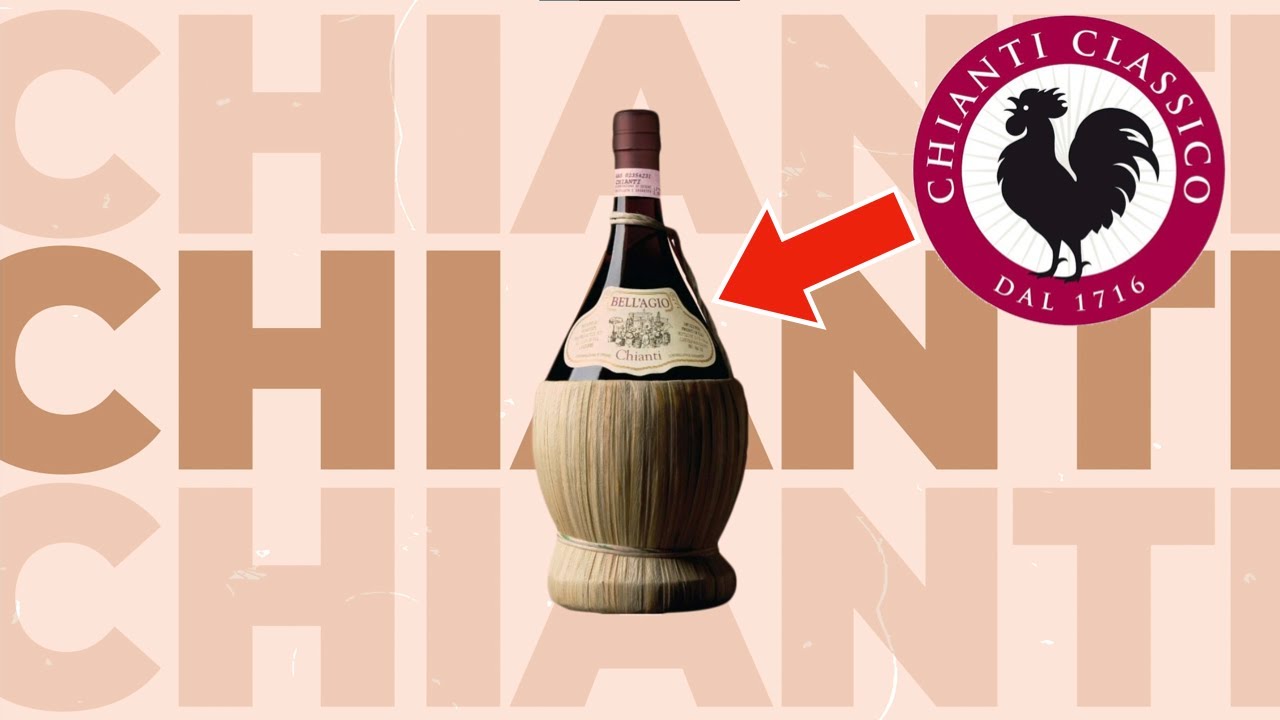
And with that, Florence won control of Chianti, and the black rooster attained lasting fame as a symbol of the region (and of outstanding Chianti wine — as, today, you can find a black rooster in a red circle embossed on all bottles of Chianti Classico).
That’s all very nice…But what is Chianti? Well…
At the most basic level, Chianti is a dry, medium-bodied red wine named for the Chianti region in Tuscany (where it’s from).
Chianti is also a Sangiovese-based wine and, while some Chianti is 100 percent Sangiovese, other Chiantis are blends. In a Chianti blend, Sangiovese is mixed with other Italian grapes, like Canaiolo, Cilliegiolo, and Colorino, or “International” grapes like Cabernet, Merlot, or Syrah — which round out the initial Sangiovese punch. All Chianti contains Sangiovese grapes. But not all Sangiovese grapes are Chianti. More on that later.
[Continued in video…]
Works Cited
“A Twist on Classic Wine & Cheese Pairings.” Wine Enthusiast.
Belfrage, Nick. “Clarifying Chianti Classico.” The Wine Society. 3 July 2019.
Capurso, Antonio. “The Chianti Series — Part 2: geography of the Chianti region, its grapes and appellations.” Wine and Other Stories. 23 August 2019.
“Chianti Colline Pisane Wine.” Wine-Searcher.
“Chianti — Learn About The Classic Italian Wine.” VinePair.
Fernando. “The Legend of the Black Rooster, the Symbol of the Chianti Classico.” Montefioralle.
Keeling, Phil. “12 Classic Wine and Cheese Pairings You Must Try.” Wine Folly. 2 April 2020.
Mowery, Lauren. “A Beginner’s Guide to Chianti and Chianti Classico.” Wine Enthusiast.
Schiessl, Courtney. “The Definitive Guide to the Regions of Chianti (With Map).” VinePair.
Stevenson, Tom. “A wine lover’s guide to vineyard soils.” Tim Atkin.
“What is DOC and DOCG Wine? Differences Between DOC, DOCG, IGT, and VdT on Italian Wine Labels.” MasterClass. 8 Nov 2020.