
Robots Take Over Italy’s Vineyards as Wineries Struggle With Covid-19 Worker Shortages l ION International
✅ IF YOU LIKE AND LOVE THIS VIDEO PLEASE SUBSCRIBE OUR CHANNEL.
🌐subscribe here :———————————–
✅ fb page:
✅ website:
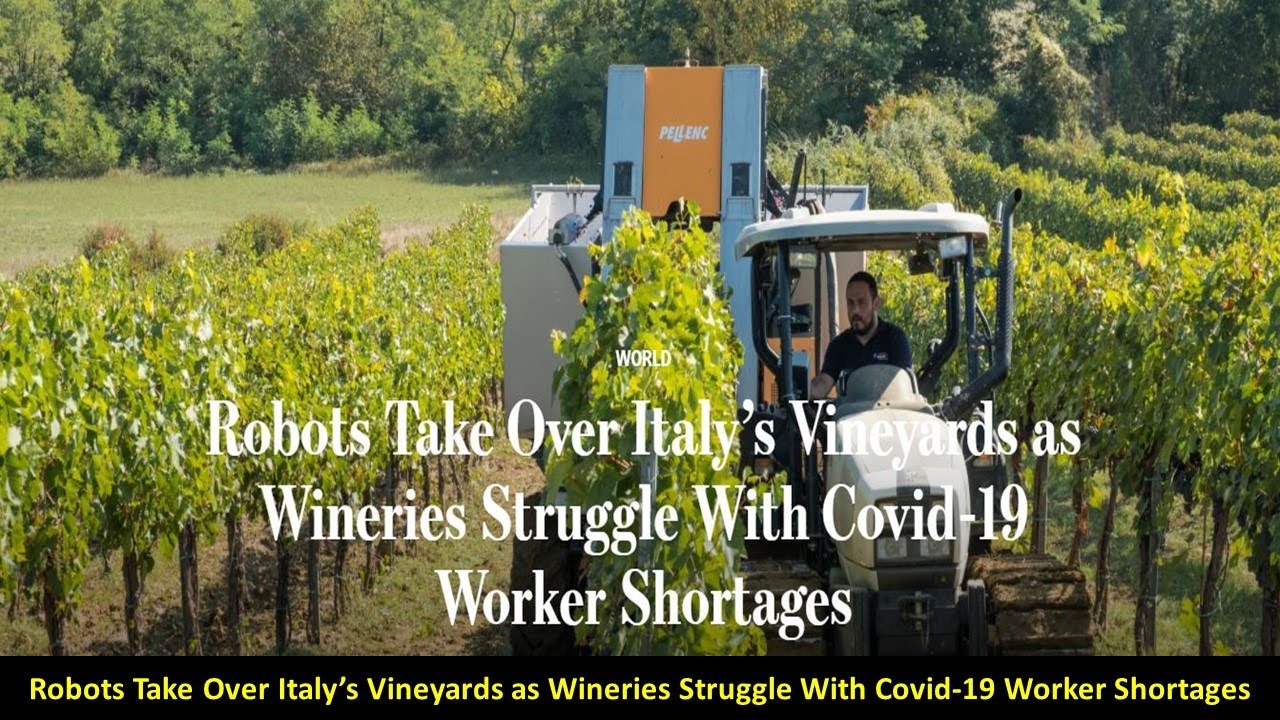
Robots Take Over Italy’s Vineyards as Wineries Struggle With Covid-19 Worker Shortages
Italian winemakers have increasingly relied on migrant workers for the autumn harvest, but travel restrictions and soaring wage costs are pushing many to turn to machines
VALDELSA, Italy—Last year’s grape harvest was a harrowing scramble at Mirko Cappelli’s Tuscan vineyard. With the Italian border closed because of the pandemic, the Eastern European workers he had come to rely on couldn’t get into the country. The company he had contracted to supply grape pickers had no one to offer him. He ultimately found just enough workers to bring the grapes in on time.
So, this year Mr. Cappelli made sure he wouldn’t face the same problem: He spent €85,000, equivalent to $98,000, on a grape-harvesting machine.
The coronavirus pandemic is pushing the wine industry toward automation.
Covid-related travel restrictions left severe shortages of agricultural workers last year, as Eastern Europeans and North Africans were unable to reach fields in Western Europe. Though the shortages have eased this year, the difficulty of finding workers has accelerated the shift, which was already under way across the agricultural sector.
While harvests of some crops, like soybeans and corn, are already heavily automated, winemakers have been slower to make the switch. Vintners debate whether automated harvesting is more likely to damage grapes, which can affect the quality of the wine. The cost is a deterrent for many small farmers. Some European regions even ban machine harvesting.
For many vintners in Europe and the U.S., however, the difficulty of finding workers—a problem they say had grown steadily for years but became acute during the pandemic—has pushed them to take the robot plunge. It is a change that will outlast the pandemic and could shift longstanding migration patterns that bring tens of thousands of foreign workers to Italy, France and Spain for agricultural harvests each year.
Ritano Baragli, president of Cantina Sociale colli Fiorentini Valvirgilio, a winemaker’s group in Tuscany, said it has been getting harder to find pickers for several years, as locals increasingly shun the physically demanding, low-paid, short-term work while the demand for pickers has increased.
But last year was the worst labor shortage of his half-century career in wine. Use of harvesting machines among the group’s members increased 20% this year in response, he said.
“Even smaller producers started looking at buying machines,” Mr. Baragli said.
Mr. Cappelli was one of those who made the switch.
“It was a very hard decision for a small farm like ours—it will take a long time to make the investment back,” Mr. Cappelli, a fourth-generation winemaker, said of buying the machine to harvest his 13 hectares of grapes. “But now when the grapes are ready, I can go pick them. We don’t have to worry about finding workers.”
He was lucky to be able to get the machine, made by French manufacturer Pellenc. Philippe Astoin, director of the company’s agricultural division, said demand for automated grape harvesters had been going up 5% to 10% a year, but shot up around 20% this year.
A shortage of parts—which has also plagued car makers during the pandemic—left the company unable to fill all the orders. Mr. Astoin expects demand to keep growing, as rising labor costs make automation comparatively more affordable. In Britain, for example, the minimum wage for agricultural workers increased 34% between 2014 and 2020, according to Andersons, a farm business consultant group.
“What we hear from our customers in [Western] Europe and North America…is they’re not sure they can gather the people they need for the harvest,” said Mr. Astoin.
Still, some wine-growing regions remain devoted to traditional hand harvest. In some cases, the machines are unsuited to steep terrain, or to certain grape-growing styles. In France, where the farming sector is less reliant on foreign workers than in Italy or Spain, the labor shortage—and the push toward mechanization—has been less urgent.
And in regions that produce high-end, high-price wine, growers doubt that a machine can do the job as well as a human.
In Burgundy, France, automated harvesters haven’t caught on, according to Thiébault Huber, president of the Confédération des Appellations et des Vignerons de Bourgogne, a winemakers trade group, in part because of farmers’ skepticism about the quality of the grapes they pick.