
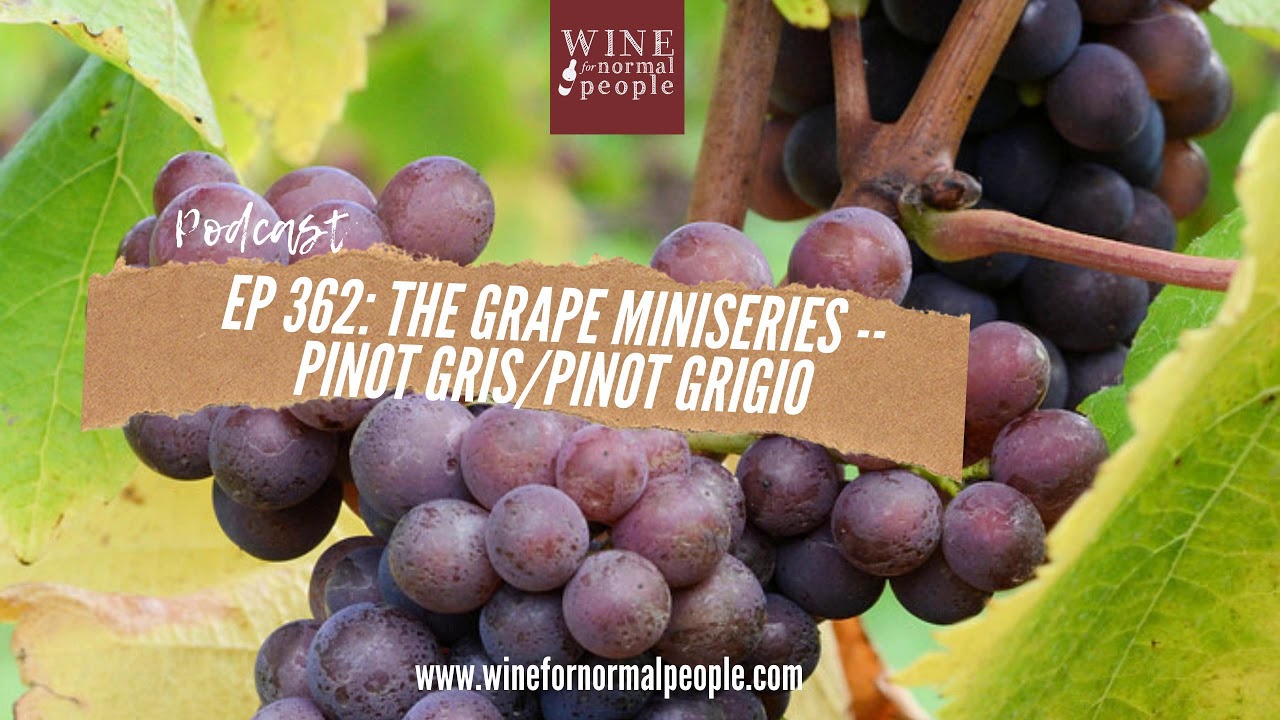
Of the many grapes that we have covered in this series, possibly the hardest to define is the one in this show — Pinot Gris. It’s so complex in part because it goes by many names and can taste neutral and boring to oily, powerful, and bold with notes of smoke, ginger, and spice. It can be bone dry to amazingly sweet and can be powderpuff or very serious in quality.
Whatever the incarnation, wine drinkers lap it up! In the U.S., Pinot Grigio (the Italian style) is the second most-consumed wine behind Chardonnay, according to Impact Databank (the sister publication to Wine Spectator). But it’s not just the US that loves this wine, it’s growing like mad in Australia too.
In this show, we discuss the many sides of Pinot Gris, or Pinot Grigio, or Grauburgunder or whatever you want to call it! Here are the show notes:
We first discuss the grape itself:
Pinot Gris, Pinot Grigio, Grauburgunder, or Rulander are all the same grape and all are mutations of Pinot Noir, so similar to their parent that the only thing that is different is the color of the grape after veraision Pinot Gris is one of the darkest skinned grapes that makes white. It’s fruit is gray-blue fruit but can be brown- pink, white or deep purple. As a result, the finished wine can have a copper tinge or be light pink The adjective gris is French for “gray” and the grape is named so because it has a grayish look to it. The gray name is used everywhere and has been adapted to local culture: Italian (grigio), German (grauer), Slovenian (sivi) and Czech (sede) Pinot Gris is thin skinned and does well in cool to moderate climates with very long growing seasons. Picking decision is essential to the wine’s character for every wine but with Pinot Gris, it will determine whether it is insipid and neutral (picked early) or rich with higher alcohol, lower acidity and rich, full flavors like pears, apples, apricot, tropical fruit, ginger, spices, smoke, and mineral “Pinot Grigio prior to harvest, vintage 2012” by stefano lubiana wines is licensed under CC BY 2.0
We discuss some general ideas about winemaking
There is a sharp distinction between early picked Pinot Grigio (the Italian style) and full bodied, rich and flavorful Pinot Gris (the Alsace, France style) Most cheap Pinot Grigio, in particular, is picked, fermented and brought to market quickly — it is a cash cow Pinot Grigio styles rarely use oak, but Pinot Gris (French style) often use older, neutral barrels for fermentation to give the wines texture. These styles also go through sur lie aging to give more texture to the wine The Growing regions and their styles:
Pinot Gris/Grigio is grown in: France, Italy, New Zealand, Australia, Austria, Germany, Romania, Canada, the U.S., Hungary, Switzerland, Russia, Moldova, China
_____________________________________________
Pinot Gris/Pinot Grigio Around the world
Alsace, France
Pinot Gris is 16 % of production in Alsace The grape thrives in the dry, sunny climate, with its long autumns. Yields are kept quite low and the best sites are the Grand Cru sites designated for Pinot Gris Alsace Pinot Gris is layered and bold with honey, ginger, spice, and bold apricot and sometimes tropical fruit notes. It can be picked late harvest (Vendanges Tardive) or allowed to develop botrytis (noble rot) that changes the wines into unctuous, full dessert wines. Occasionally these wines are oak-aged for texture, some are more medium bodied, many have residual sugar, so you must check the producer’s style and web site to see how sweet the wine is These wines, in the past, were substitutes for red wines and accordingly, go with fuller food Top producers in Alsace: Albrecht, Blanck, Marcel Deiss, Dopff & Irion, Kuentz-Bas, Albert Mann, René Muré, Schlumberger, Trimbach
Italy
Growing in Veneto, Friuli-Venezia-Giulia, and Trentino Alto Adige, along with a few other northern areas (Valle d’Aosta) the Italian style is always picked a bit early and has an emphasis on dry, mineral flavors Unlike Alsace, where grapes develop over a long season, in Italy the goal is to harvest grapes early, and to have high yields. The result of this overcropping is dilution of flavor and a high acid wine that doesn’t reflect the true character of the grape. Many experts charge that much of the Pinot Grigio planted in large vineyards is actually Pinot Bianco or even Trebbiano Toscano In the winery, stainless steel tanks are used and the wine is fermented and bottled quickly but the better wines can have light oak-ageing or skin contact Cheap Pinot Grigio has very little flavor or character. It is cheap and cheerful and nothing else. In Alto Adige -world-class Pinot Grigios from estate bottling are expensive but lead to nuttier, fruitier flavors that are recognizable as related to Pinot Gris. Producers include: Elena Walch, Franz Haas, Tiefenbruner, San Michele Appiano, Sanct Valentin Pinot Grigio, Alois…