
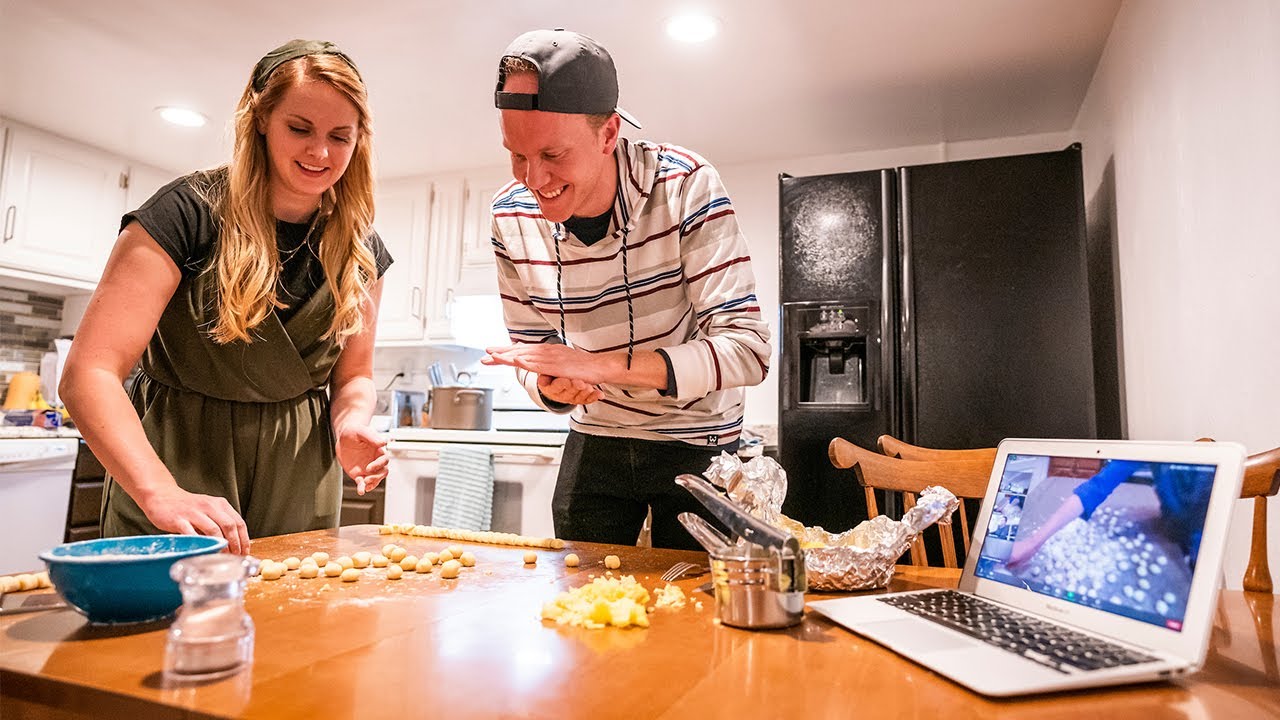
Missing the connection with her students during the pandemic, BYU Italian professor Marie Orton hosted a series of cooking classes over Zoom. The cooking sessions in Orton’s Italian 361 class represent her passion for helping students to connect—with each other, with her, with the subject matter. Orton said her teaching methods are inspired partly by the examples of many colleagues in the unique language programs at BYU, which offers its students immersive course experiences in 63 languages and which ranks third in the nation for the most bachelor degrees in a foreign language.
Orton’s fall class investigated what makes Italians “Italian”: how history, politics, sports, fashion, music, literature and (of course) food create a common identity among a people who unified from a loose group of nation-states less than two hundred years ago.
“In Italy, food and group identity are inseparable,” she explained. “Everybody who goes there realizes very fast, food is about anticipating and preparing, cooking with other people. It’s all about what we’re doing together.”
In-person cooking classes were a trademark of Orton’s Italian culture courses even before she joined the BYU faculty in 2016. But as happened for many instructors on campus, the pandemic-induced constraints of 2020 disrupted her favorite teaching routines. She found her way forward after a visit to Richard Swan, a consultant in the Center for Teaching and Learning.
“He said, ‘The things that make classes meaningful go beyond the delivery mechanism. If you like cooking food with your students, you can cook with them by Zoom,’” Orton recalled.
For Orton, the clear highlight was making gnocchi with the class. An inexpensive potato dumpling dish traditionally made by Italian migrants short on money, gnocchi has come to be a kind of “bar for showing a cook’s ability,” said Orton. It’s a common tradition for Italians to learn the art of making gnocchi from their grandmothers.
“One thing that I’ve loved about Professor Orton’s class is that she is really good at bringing us close to the things that we’re learning about,” said BYU senior Emma Stucki. “Technology can be a barrier sometimes, but it was lovely to share Italian food culture as a class.”
“By the time the end of the semester rolled around, I was a little worn out with all my Zoom classes,” added Ethan Bentley, another student in Orton’s class. “I valued Professor Orton’s unique approach.”
“In the time of YouTube, where the students could go online and learn how to cook all these things individually, they didn’t want to. They wanted to cook together,” said Orton. “That made me really happy.”
(Written by Christie Allen, BYU News)
READ THE WHOLE STORY on BYU News: bit.ly/2XV6LHN
Professor Orton’s gnocchi recipe
Makes about 90 gnocchi
Ingredients
4 medium-sized Yukon Gold potatoes (2 lbs.)
About 1 ½ cups of flour, plus a little more for dusting the counter
1 egg
½ teaspoon salt, plus a little more for salting water
Directions
Heat oven to 350F and lightly butter a cookie sheet.
Microwave the potatoes until they are soft, then wrap them in foil and let them sit for about five minutes. Fill a large pot with about 4 quarts of water, add a little salt and then heat to a rolling boil.
Spread ½ cup of flour on a clean counter. Peel the potatoes and squeeze them through a ricer onto the flour. Gently toss the flour onto the potato and sprinkle with the ½ teaspoon of salt. Gently draw the potato mixture into a mound and crack the egg into the top of it. With a fork, gently mix the egg into the potato and flour. With your hands, gently work the mixture to a soft smooth dough. If the dough is sticky, sprinkle with flour as needed (up to ¼ cup).
Break the dough into four pieces and roll each piece into a rope about ¾ inch in diameter. Cut off pieces of the rope in about ¾ inch-long chunks (pecan sized). Roll each chunk into a smooth ball to make one gnocco.
To shape each gnocco, place the gnocco ball on the flat of the tines of a fork. Let the tines make an indentation in the ball as you slide it down the fork with your thumb and let the gnocco drop on the counter. The gnocco should show lines from the fork across its front and an indentation in the back. Repeat with all the remaining dough.
With the water at a rolling boil, drop the gnocchi into the pot, 15 to 20 at a time. When the gnocchi rise to the surface (usually in about one minute), remove them with a strainer, place them on the buttered cookie sheet and bake in the oven for 3 to 5 minutes.
Serve with pesto, butter that has been melted with fresh rosemary or a red sauce.