
#oratino #molise #discovermolise #travelwithsergio #withsergioitsbetter
Ciao Belli!
How are you?
Today I’m very happy to introduce you to one of the secret jewels of Italy.
I’m talking about the beautiful Molise region!
Are you ready?
Andiamo!
Many Italians make jokes about Molise because it’s pretty unknown, quite small and not very well advertised.
In fact, on internet it’s plenty of “memes” like:
“Does Molise really exist?” or “Is there anything to do in Molise?” and so on.
Honestly, I do not find it very funny and if I was from Molise I would be annoyed about it!
So, I decided to go there and see with my own eyes and my opinion is that…
IT’S BEAUTIFUL!
Molise got a bit of everything: a coastline by the Adriatic sea with the lovely city of Termoli, hills, mountains, forests, lakes, valleys, a very peaceful countryside, a National Park (Parco Nazionale d’Abruzzo, Lazio e Molise), archeological areas (such as Altilia-Sepino) and beautiful villages perched on top of the hills like a Nativity at Christmas!
Despite an ancient history, until 1963 it was part of the region of Abruzzi e Molise alongside the region of Abruzzo. The split, which did not become effective until 1970, made Molise the youngest region in Italy. Covering 4,438 square kilometers (1,714 sq mi), it is the second smallest region in the country after the Aosta Valley, and has a population of around 300,000 inhabitants.
Campobasso the capital counts only 49,000 inhabitants.
It has a picturesque historical center dominated by the Monforte Castle located on a high rocky spur surmounting the town.
It was built in the 15th and 16th centuries after the original Norman castle was damaged by the earthquake of 1456.
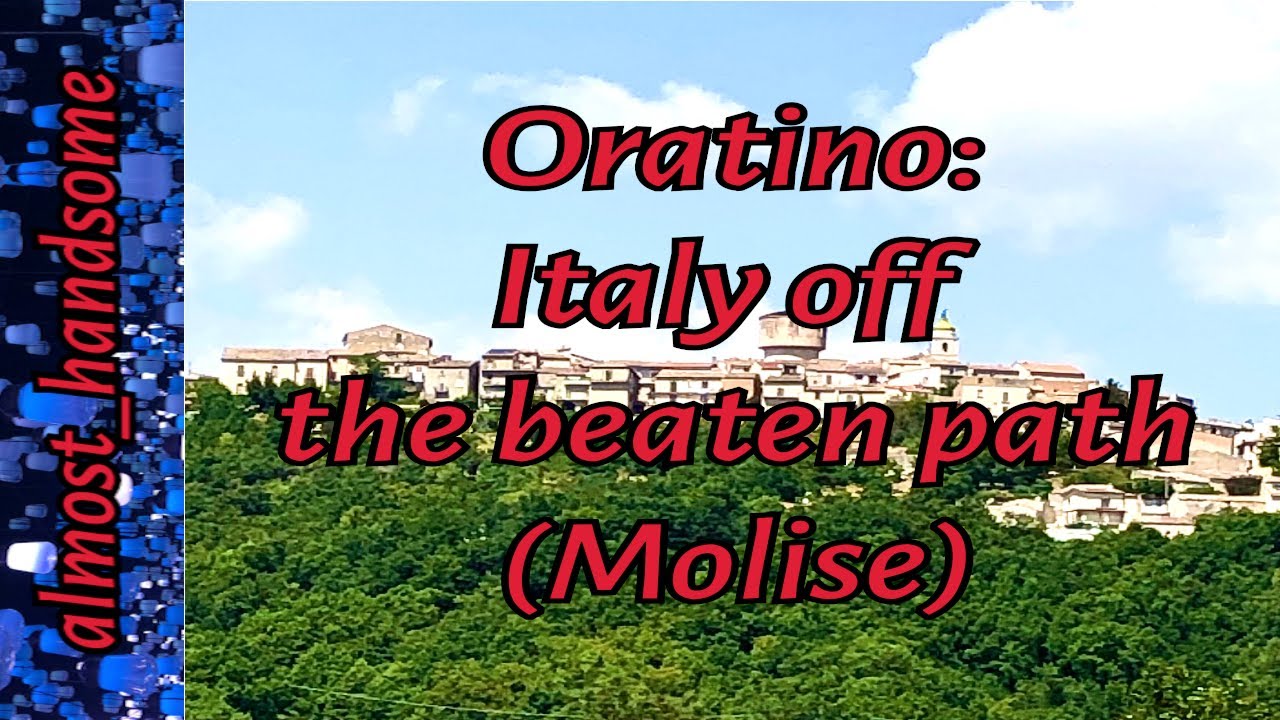
This video was filmed in Oratino a small village (1,700 inhabitants) surrounded by medieval walls perched at the top of an isolated hill with an incredible view around the Appennini mountains and the valleys!
Oratino is listed in the “I borghi più belli d’Italia, the official list of the most beautiful villages of Italy.
Palazzo Giordano
At the entrance of the village, there is the imposing “Palazzo Giordano”. This princely residence with a large square plan was built in the 2nd half of the 15th century. It was originally equipped with four corner towers with battlements and surrounded by a moat. Duke Giuseppe Giordano had them demolished to modernize the palace according to the eighteenth-century taste. In 1805 an earthquake damaged the house: the north-eastern portion was rebuilt from scratch. Above the main entrance there is the family coat of arms. The internal courtyard is surrounded by a portico.
S. Maria Assunta Church
The lovely church of S. Maria Assunta was built between the 13th and 18th centuries. In the vault of the central nave a fresco depicting the Assumption was found and restored, a signed and dated work by the painter Ciriaco Brunetti in 1791. Nearby the church stands the modern water tower built in 1954 that provide running water to the entire village.
The Rocca
The squared Tower -about 12 meters high (39 feet)- is located on a rocky spur near Oratino.
It’s called “La Rocca”, and is what remains of a medieval castle and an adjoining village, which collapsed in the earthquake of 1456.
After a relaxing “passeggiata” around the village I bought from the local grocery store in Piazza Giordano a bottle of “Tintilia” the only original and autochthonous wine of Molise.
Tintilia, comes from the Spanish word “tinto” that means red, and it was a grape widely cultivated till WWII all around the region.
Then locals slowly abandoned the ancient grape for more productive type of vines and the Tintlia almost disappeared.
Now is back, much appreciated by wine connoisseurs: it’s an intense wine, ruby red perfect with local food such us aged cheese, salami, sausages, grilled meat etc..
Don’t forget to buy a bottle once here.
Cin Cin/Cheers/Salute!
Un bacio
Sergio
Music: