
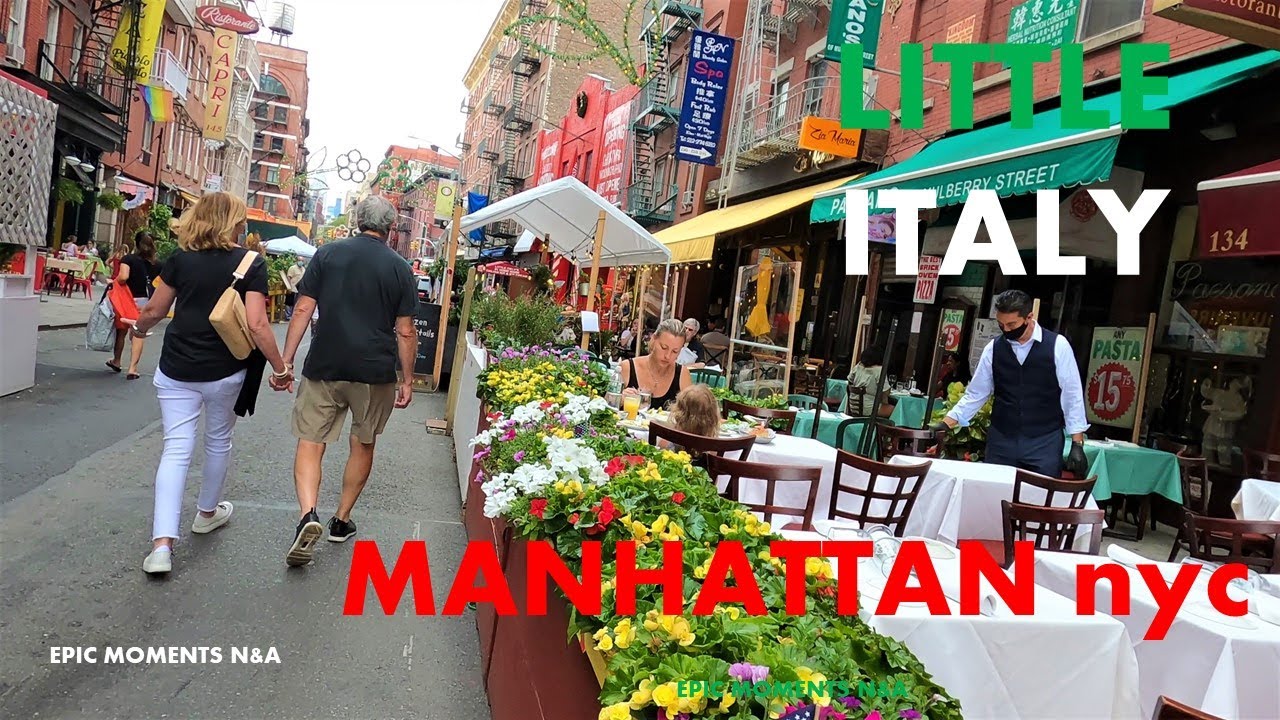
#LittleItaly (Italian: Piccola Italia) is a neighborhood in #LowerManhattan in #NewYorkCity, once known for its large Italian population. It is bounded on the west by #Tribeca and #Soho, on the south by #Chinatown, on the east by the #Bowery and #LowerEastSide, and on the north by #Nolita.
#LittleItaly on #MulberryStreet used to extend as far south as #WorthStreet, as far north as #HoustonStreet, as far west as #LafayetteStreet, and as far east as #Bowery. It is now only three blocks on #MulberryStreet. #LittleItaly originated as #MulberryBend. Jacob Riis described #MulberryBend as “the foul core of New York’s slums.” During this time period “Immigrants of the late 19th century usually settled in ethnic neighborhoods”. Therefore, the “mass immigration from Italy during the 1880s” led to the large settlement of Italian immigrants in #lowerManhattan. The results of such migration had created an “influx of Italian immigrants” which had “led to the commercial gathering of their dwelling and business”.
Bill Tonelli from #NewYork magazine said, “Once, #LittleItaly was like an insular Neapolitan village re-created on these shores, with its own language, customs, and financial and cultural institutions.” Little Italy was not the largest Italian neighborhood in #NewYorkCity, as #EastHarlem (or Italian Harlem) had a larger Italian population. Tonelli said that Little Italy “was perhaps the city’s poorest Italian neighborhood”. In 1910 Little Italy had almost 10,000 Italians; that was the peak of the community’s Italian population. At the turn of the 20th century over 90% of the residents of the Fourteenth Ward were of Italian birth or origins. Tonnelli said that it meant “that residents began moving out to more spacious digs almost as soon as they arrived.” Such a vastly growing community impacted the “U.S. labor movement in the 20th century” by making up much of the labor population in the garment industry”.
After World War II, many residents of the #LowerEastSide began moving to #Brooklyn, #StatenIsland, eastern #LongIsland, and #NewJersey. Chinese immigrants became an increased presence after the U.S. Immigration Act of 1965 removed immigration restrictions, and the #ManhattanChinatown to Little Italy’s south expanded. In 2004, Tonelli said, “You can go back 30 years and find newspaper clips chronicling the expansion of #Chinatown and mourning the loss of #LittleItaly.”
Prior to 2004, several upscale businesses entered the northern portion of the area between #Houston and #KenmareStreet. Tonelli said “Real-estate prices zoomed, making it even tougher for the old-timers—residents and businesspeople alike—to hang on.” After the September 11 attacks in 2001, areas below #HoustonStreet were cut off for the rest of the fall of 2001. The San Gennaro feast, scheduled for September 13, was postponed. Business from the #FinancialDistrict dropped severely, due to the closure of #ParkRow, which connected #Chinatown and the Civic Center; as a result, residents in #LittleItaly and #Chinatown suffered. Tonelli said the post-9/11 events “strangely enough, ended up motivating all these newfangled efforts to save what’s left of the old neighborhood.”
In 2004 Tonelli said “Today, #LittleItaly is a veneer—50 or so restaurants and cafés catering to tourists, covering a dense neighborhood of tenements shared by recent Chinese immigrants, young Americans who can’t afford #Soho, and a few remaining real live Italians.” This sentiment has also been echoed by Italian culture and heritage website ItalianAware. The site has called the dominance of Italians in the area, “relatively short lived.” It attributes this to the quick financial prosperity many Italians achieved, which afforded them the opportunity to leave the cramped neighborhood for areas in Brooklyn and Queens. The site also goes on to state that the area is currently referred to as #LittleItaly more out of nostalgia than as a reflection of a true ethnic population.
In 2010, #LittleItaly and #Chinatown were listed in a single historic district on the National Register of Historic Places. #LittleItaly, by this point, was shrinking rapidly.
They are laborers; toilers in all grades of manual work; they are artisans, they are junkman, and here, too, dwell the rag pickers. … There is a monster colony of Italians who might be termed the commercial or shop keeping community of the Latins. Here are all sorts of stores, pensions, groceries, fruit emporiums, tailors, shoemakers, wine merchants, importers, musical instrument makers. … There are notaries, lawyers, doctors, apothecaries, undertakers. … There are more bankers among the Italians than among any other foreigners except the Germans in the city.
⬇⬇⬇⬇ SOCIAL NETWORKS⬇⬇⬇⬇
twitter: @EpicMoments15