
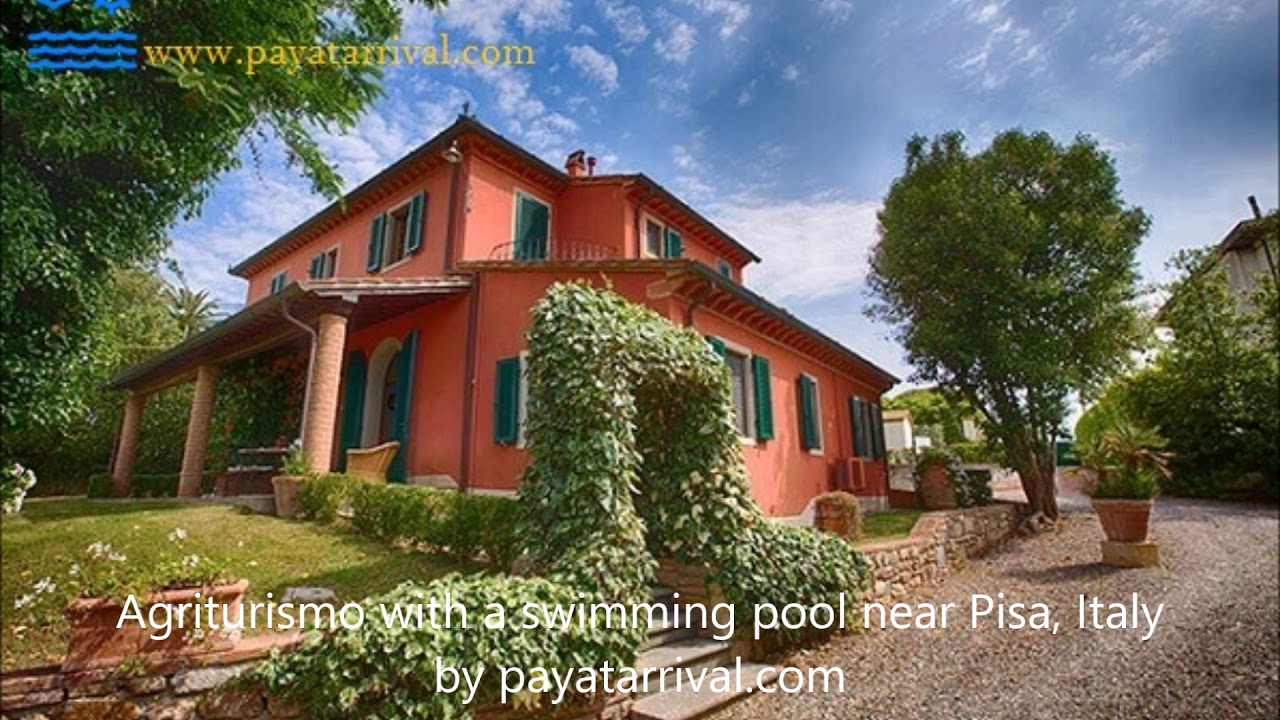
THE HISTORY
This Villa – Farm, already existed at the end of the 1700s and at the beginning of the 1800s as “Casino di Caccia”. The first “cadastral” news of the Villa began in 1858, with the Map of the Leopoldino Land Registry. Between the end of the 1800s and the beginning of the 1900s, the building was modified taking on similar features to the current ones (although the second floor, the balconies and the fish tank, were added between 1920 and 1925; the boundary wall outside in the 40s).
Annexed to the Villa there were also two farms called Sant’Enrico and Sant’Antonio. Many owners have followed one another since the second half of the 1800s. Initially, it was registered as a property of the noble Filicchi, but already in 1873 it was bought by Mr Gustavo Tabet Grazialdo (fu Leone); after only three years, it instead belonged to the ladies Prato Giovanna and Grechi Filomena. In 1899, it was bought by Mr Rignano Guido and in 1903 it was sold to Signora Ester Tedesco (and others); after two years it was again sold and purchased by Signor Torello Luigi; the property remained with this family until 1923, when it was bought by Mrs Anna Fiorini – Ganni (hence the name “Ganni, Villa Anna”).
After eleven years the Villa – farm was sold to Signor Cecchi Oreste di Clemente, until, in 1937, it was bought by Signor Giovacchino Criscuolo, a Genoese, who kept it until 1961; the latter was an accountant for the Achille Lauro Company.
The Criscuolo were five children, three males and two females, of whom three did not marry; for this reason, the Villa, in that period, had been nicknamed by the inhabitants of Fauglia “the Villa of the Scapoli”.
In 1961 the property was bought by Mr Adelchi Regis D’Angin (who gave the villa the name “Artemisia”, in memory of his mother); in 1974 she became the owner of Signora Adele Rossetti, a theatrical artist; these “assets” remained with the Rossetti family until 1993, the year in which it was bought by the Bernardini family, who restored it to the highest standard both internally and externally.
TERRITORY
Fauglia, Casciana Terme, Castellina Marittima, Chianni, Crespina, Lari, Lorenzana, Orciano Pisano and Santa Luce are the municipalities that make up the area of the Pisan Hills. The gentle lines that characterize the hills, the woods of oaks and chestnut trees, the many vineyards scattered almost everywhere contribute to characterize what is one of the most important wine production areas of the province, which can be visited along that part of the “Wine Route of the Pisan Hills “that flows here. Particularly suggestive is the whole landscape in this area of the province of Pisa, characterized by rolling hills, rows of cypress trees, fields planted with wheat that in summer turn golden and in spring are coloured green.
FAUGLIA
Fauglia, surrounded by the greenery and woods of the hilly environment, does not fail to count among its monuments some beautiful villas, such as Villa Gioli (home of the famous painters Macchiaioli) and Villa Trovarsi (once home to Pirandello and Marta Abba).
THE TASTE OF THE TERRITORY
Numerous the food and wine products of the area of the Pisan Hills: olive oil, whose production is present above all in the municipalities of Fauglia and Lari, the pods, produced in large quantities in the month of May and protagonists of many spring festivals in this area. Even more important is the production of fruit, especially the famous Lari cherries. Still, in Lari one of the most characteristic dishes of the Pisan cuisine are the al fiasco beans: the cannellini beans are put to cook with water, very little oil, salt and rosemary inside a flask. Everything is cooked in the ash near the hearth. It is however what the ancient Romans called “the nectar of Bacchus” to be the product par excellence typical of the Pisan hills. The Wine Road that winds its way through the Pisan Hills,