
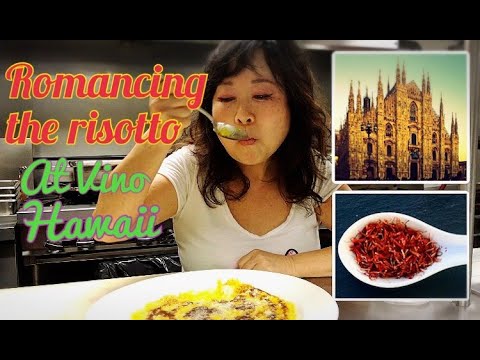
#risotto #risottoallamilanese #cooking
For this episode, I visited Keith Endo in the kitchen of Vino, who shared the charming story of risotto alla Milanese told throughout Italy, that he learned on one of his many culinary trips to the country.
The story of this golden saffron-infused risotto is one of romance and art. The Italians tell the story of a 16th century glassmaker named Valerio, whose daughter was about to marry a young glassmaking apprentice who loved saffron so much that he was nicknamed Zafferano. While working on the windows of the Duomo di Milano, he colored his stained glass yellow with saffron.
On his wedding day on Sept. 8, 1574, Zafferano’s friends surprised him by adding saffron to the rice at his banquet, coloring it a royal gold. Everyone loved the stunt and it became part of Milan’s repertoire and lore.
Accounts of this story vary and its validity is questioned. Italy magazine reported that there was no mention of this dish until the 1800s.
According to the magazine, rice was cooked only in boiling water from the 13th to the 17th centuries. It wasn’t until 1779 that it was recorded that rice was, for the first time, sautèed in butter and wet with broth. Later, a pinch of chopped onion was also added
.
A recipe for riso giallo in padella first appeared in a cookbook in 1809. In this dish, rice is sautéed in butter, beef bone marrow, onion, then moistened with hot broth in which saffron is dissolved. In 1929, Milanese chef Felice Luraschi gave his dish of rice, fat, beef marrow, saffron, nutmeg and stock, flavored at the end with grated cheese a name, risotto alla Milanese giallo.
Today, this dish calls for a watchful eye and constant stirring over approximately 30 minutes to make sure rice does not stick to the bottom of the pan, but not in the way you think. Many people make the mistake of stirring too vigorously, which breaks the rice grains and releases starch, the cause of sticking. This also makes the dish starchy, leaving the diner with a unpleasant sense of fullness.
Endo demonstrated a constant, gentle pushing and folding until the rice center is no longer white, when more vigorous stirring can begin. Broth is added slowly over time, as needed. His recipe follows.
Video by Nadine Kam © 2020. Thanks so much for watching. Please like and subscribe for more cooking adventures and culinary cultural explorarions!
RISOTTO ALLA MILANESE
(Recipe courtesy of chef Keith Endo, Vino)
2 small yellow onions, minced
1 T. garlic, minced
6 cups chicken stock; vegetable stock can also be used
1 T. saffron threads
2 cups Carnaroli arborio rice
1 cup dry white wine
Kosher salt and freshly ground black pepper, to taste
4 T. unsalted butter
1/2 cup Parmigiano-Reggiano cheese, grated
1/8 cup Pecorino-Romano cheese, grated
Sauté onions in a 1/2 T. of neutral cooking oil until translucent. Add garlic. Add rice and slowly push along bottom to sauté, being careful to avoid vigorous stirring to avoid breaking rice. Add wine, salt, pepper and saffron.
Add one cup of stock. Slowly move rice along bottom of pan to prevent from sticking to bottom. The aim is to cook the rice through, until the white center is cooked. Continue to cook and stir rice about 15 minutes, adding more broth as needed.
At this point, the risotto is 3/4 finished. Stir in butter until incorporated. Add more broth as needed. Stir in Parmesan.
Plate by spreading risotto evenly on a plate. Do not mound, to prevent overcooking. Sprinkle Pecorino over top. Endo finishes his risotto with veal jus and tops it with osso bucco in the Milanese tradition.
Music credit: “Renaissance Castle” by Doug Maxwell and Media Right Productions.