
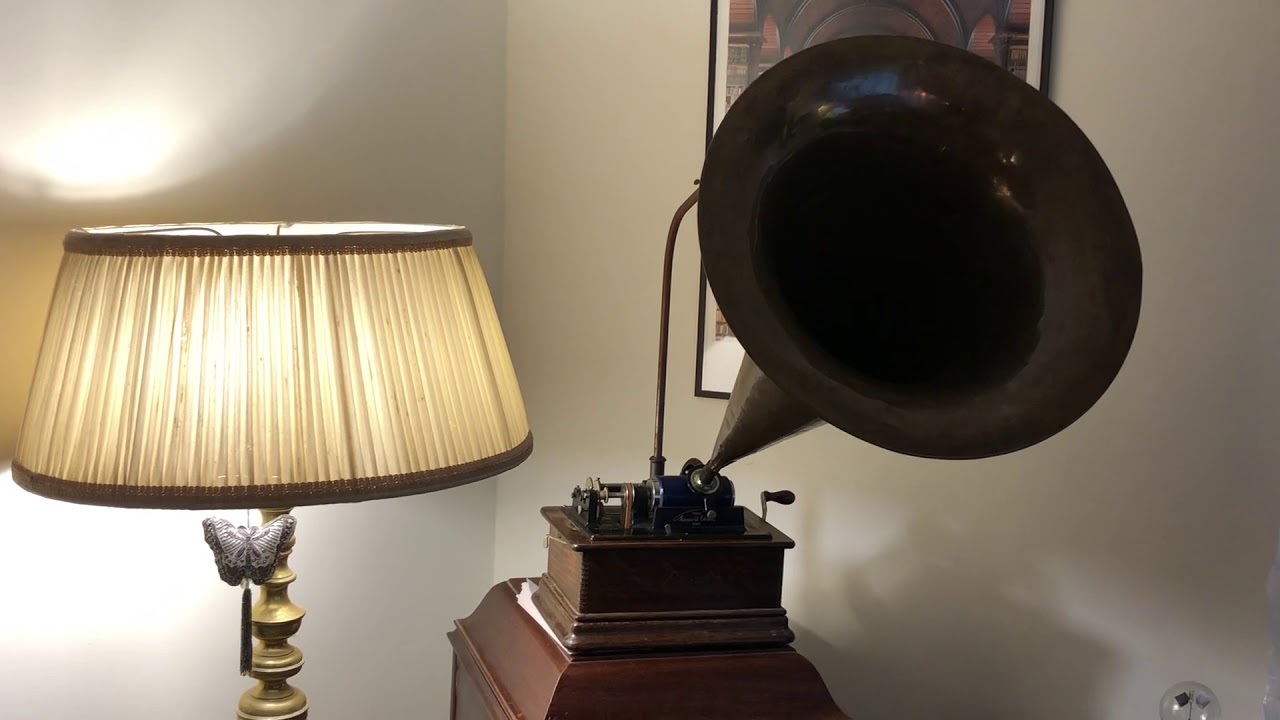
“The Anvil Chorus” from Il Trovatore, Edison Blue Amberol #1989 performed by Edison Light Opera Co., released in 1913. This cylinder is a re-issue of a 4-minute wax Amberol #834 which was released in 1911. It is recognizable to many because, it’s been used on television in commercials, and radio for years.
Il Trovatore (The Troubadour) is a four-act opera based on the successful 1836 play by Antonio García Gutiérrez, titled “El Trovador”. Il Trovatore was first conceived by Verdi in January 1850, when Verdi approached librettist Salvadore Cammarano with his idea for Il Trovatore. Salvadore Cammarano worked on the libretto until his death on July 17th,1852, then Verdi, who had the opera nearly finished, had the libretto completed by Leone Emanuele Bardare, this gave Verdi the opportunity to include some desired revisions. The opera premier took place in Rome, Italy on 19 January 1853. Today, Il Trovatore is performed frequently and is a staple of the standard operatic repertoire. The “Anvil Chorus” performed here, is the English name for the Coro di Zingari (Italian for “Gypsy chorus”), is a chorus from act 2, scene 1 of Il trovatore. It depicts Spanish Gypsies striking their anvils at dawn – hence its English name – and singing the praises of hard work, good wine, and Gypsy women. The piece is also commonly known by its opening words, “Vedi! Le fosche”.
Italian Composer Giuseppe Verdi was born on either October 9th or 10th, 1813 near the village of Busseto, in a province of Parma in Northern Italy, the first child of Carlo Giuseppe Verdi (1785–1867) and Luigia Uttini (1787–1851). Because baptismal register list Verdi as being “born yesterday”, however, since days were often considered to begin at sunset, this could have meant either 9 or 10 October, hence the confusion of birth dates. Verdi’s gift for music was already apparent by 1820–21 when he began his association with the local church, serving in the choir, acting as an altar boy for a while, and taking organ lessons. At age 11, Verdi received schooling in Italian, Latin, the humanities, and rhetoric. By the time he was 12, he began lessons with Ferdinando Provesi, maestro di cappella at San Bartolomeo, director of the municipal music school. Having achieved some fame and prosperity, Verdi began in 1859 to take an active interest in Italian politics, that year Verdi was elected as a member of the new provincial council, and was appointed to head a group of five who would meet with King Vittorio Emanuele II in Turin. They were enthusiastically greeted along the way and in Turin Verdi himself received much of the publicity. In his last years Verdi undertook a number of philanthropic ventures, publishing in 1894 a song for the benefit of earthquake victims in Sicily, and from 1895 onwards planning, building and endowing a rest-home for retired musicians in Milan. In 1900 he was deeply upset at the assassination of King Umberto and sketched a setting of a poem in his memory but was unable to complete it. While staying at the Grand Hotel, Verdi suffered a stroke on 21 January 1901. He gradually grew feeble over the next week, and died on January 27th, 1901 at the age of 87. Verdi was initially buried in a private ceremony at Milan’s Cimitero Monumentale, however, a month later, his body was moved to the crypt of the Casa di Riposo in Milan, Italy.
Librettist & playwrite Salvadore Cammarano was born on March 19th, 1801 in Naples, Italy, his father, Giuseppe, was a painter and set-designer. He died in Naples, Italy on July 17th, 1852
Librettist & poet Leone Emanuele Bardare was born in Naples, Italy in 1820 and died there sometime after 1874.